for institutional deal workflows

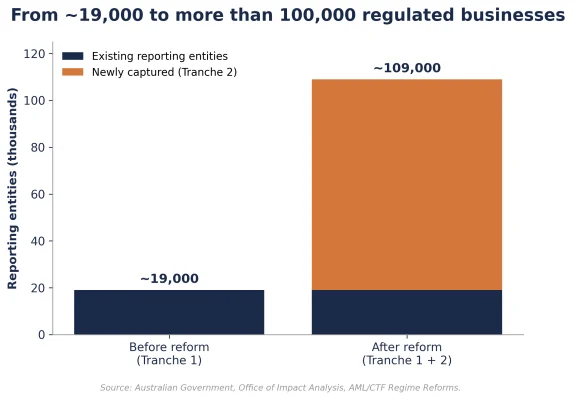
On 1 July 2026, Australia quietly did something it had resisted for two decades. It brought real estate agents, property developers, conveyancers, lawyers and accountants inside the anti-money laundering and counter-terrorism financing (AML/CTF) net. Around 90,000 businesses across these professions now sit under the supervision of AUSTRAC, the financial intelligence regulator, expanding the regime from roughly 19,000 existing reporting entities to more than 100,000 (Australian Government, Office of Impact Analysis, AML/CTF Regime Reforms). Each must verify who their customers are, screen them against sanctions and politically exposed persons lists, keep records for seven years, and report anything suspicious (AUSTRAC, Anti-money laundering and counter terrorism laws cover thousands more businesses, 2026). Australia was the last major developed economy to close this loophole. As of this month, it is closed.
The headlines wrote themselves. New rules to "take billions of dollars of demand out of the housing market" (Yahoo Finance Australia, 30 June 2026). Dirty money finally has nowhere to hide. And for the residential market, there is some logic to this change. But I want to make a narrower and, I think, more useful argument for the people who actually transact in commercial real estate. Having sat on both sides of this, the deal side that welcomes clean, institutional capital and the operational side that has to build the compliance plumbing, my view is that the consensus has the emphasis backwards. This reform will not reprice commercial property in any measurable way. What it will do is quietly reshape who can afford to operate in the industry, and that is the concerning part.
The distinction matters because it changes what you should do about it. If you believe cap rates are about to move, you wait. If you believe the real effect is a slow, structural advantage accruing to scale and compliance infrastructure, you build. This piece is about why the second framing is the right one.
The Market Snapshot: What the Regulators and Industry Are Saying
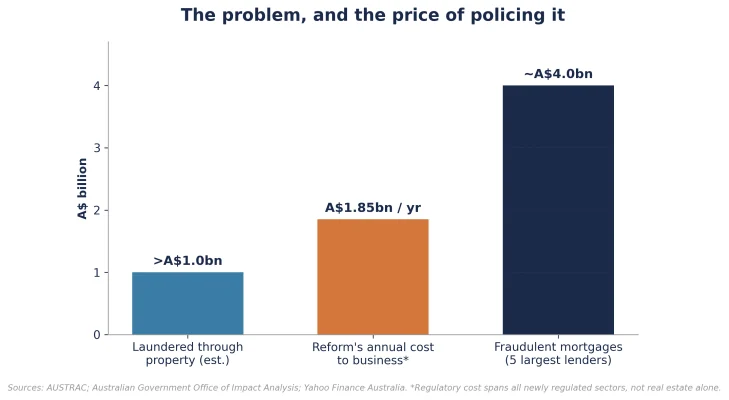
Start with the scale of the problem the reform is trying to solve, because it is smaller and less certain than the rhetoric suggests. AUSTRAC has estimated that more than A$1 billion is laundered through Australian property (AUSTRAC; Yahoo Finance Australia, 30 June 2026). The broader figure most often quoted, that serious and organised crime costs Australia up to A$60.1 billion, comes from the Australian Institute of Criminology, covers the entire economy across 2020 to 2021, and is the upper bound of a range starting at A$24.8 billion (Australian Institute of Criminology, Estimating the costs of serious and organised crime in Australia, 2020–21). Separately, Australia's five largest lenders have estimated there may be around A$4 billion of fraudulent mortgages on their books (Yahoo Finance Australia, 30 June 2026). These are different measures of different things, and the honest summary is that nobody knows the true number laundered specifically through property, which is precisely why the old regime was inadequate.
On the reputational side, the case for reform is harder to argue with. Transparency International places Australia at the bottom of its Opacity in Real Estate Ownership Index, alongside the United States and South Korea, in an assessment of 24 jurisdictions (Transparency International, Opacity in Real Estate Ownership Index, 2025). Criminals linked to China alone laundered more than US$1 billion through Australian real estate in 2015 and 2016 (Transparency International Australia). Queensland, New South Wales and Victoria still do not collect or disclose information on the real individuals who own property (Transparency International Australia). For a country that markets itself to global capital on stability and rule of law, sitting bottom of that table was an embarrassment. The reform fixes the embarrassment.
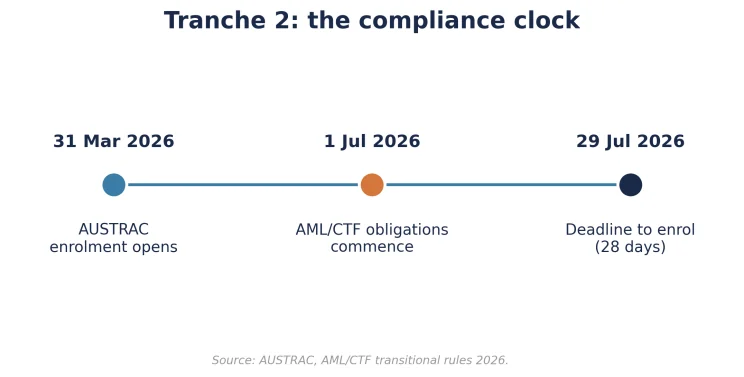
The mechanics are now live. Enrolment with AUSTRAC opened on 31 March 2026, obligations commenced on 1 July, and any business providing a designated service from that date must enrol by 29 July 2026 (AUSTRAC, AML/CTF transitional rules 2026). Reporting entities must maintain a written AML/CTF program, run customer due diligence before providing a designated service, and hold records for seven years. Civil penalties for companies reach up to A$33 million (LegalVision, Does Your Real Estate Business Comply with AML/CTF Laws?, 2026). The industry's response has split along a revealing line. Ray White's Shaun Doyle expects a "modest impact other than scanning some ID and ticking a box" for most transactions, while InfoTrack's Lee Bailie counters that requiring every buyer and seller to prove identity and source of funds "is not a minor administrative change" (Yahoo Finance Australia, 30 June 2026). Both are right, and the gap between them is the interesting concept.
View 1: The Pricing Panic Is Largely Misplaced
Here is the uncomfortable arithmetic for those claiming this reform will move commercial values. The entire estimated pool of money laundered through Australian property is a little over A$1 billion a year (AUSTRAC). The reform that polices it is projected to impose around A$1.85 billion a year in regulatory costs on business, averaged over the next decade (Australian Government, Office of Impact Analysis, AML/CTF Regime Reforms). That figure spans every newly regulated profession, not real estate alone, but the direction of the comparison is the point: the country is set to spend more each year policing the problem than the problem is estimated to be worth. That is a defensible public policy trade, deterrence and reputation are worth more than the headline number, but it tells you immediately that the laundered dollar was never the marginal price-setter in the market.
And where that laundered dollar did operate, it was overwhelmingly residential. Money washed through property tends to buy houses and apartments, assets that are liquid, easy to hold behind a family trust, and simple to exit. It does not typically buy A$200 million office towers or institutional-grade logistics estates. Those deals already pass through banks, law firms and financiers who have run know-your-customer checks for years under the existing regime. The commercial transaction was never the soft target, so removing the soft target does very little to commercial pricing.
This is why I am relaxed about cap rates. The buyers who set prices in institutional CRE, the funds, the offshore pension capital, the listed A-REITs, were already compliant counterparties. Adding a formal AML obligation to the agent in the middle does not change the willingness to pay of a buyer who was already clean. The demand curve for commercial assets barely notices.
View 2: The Real Alpha Is The Newly Formed Compliance Moat
If the pricing story is a distraction, the industry-structure story is not. Compliance is a fixed cost, and fixed costs are regressive. They fall hardest on the smallest operators and barely register for the largest. That single fact is going to reshape who competes in this market over the next five years.
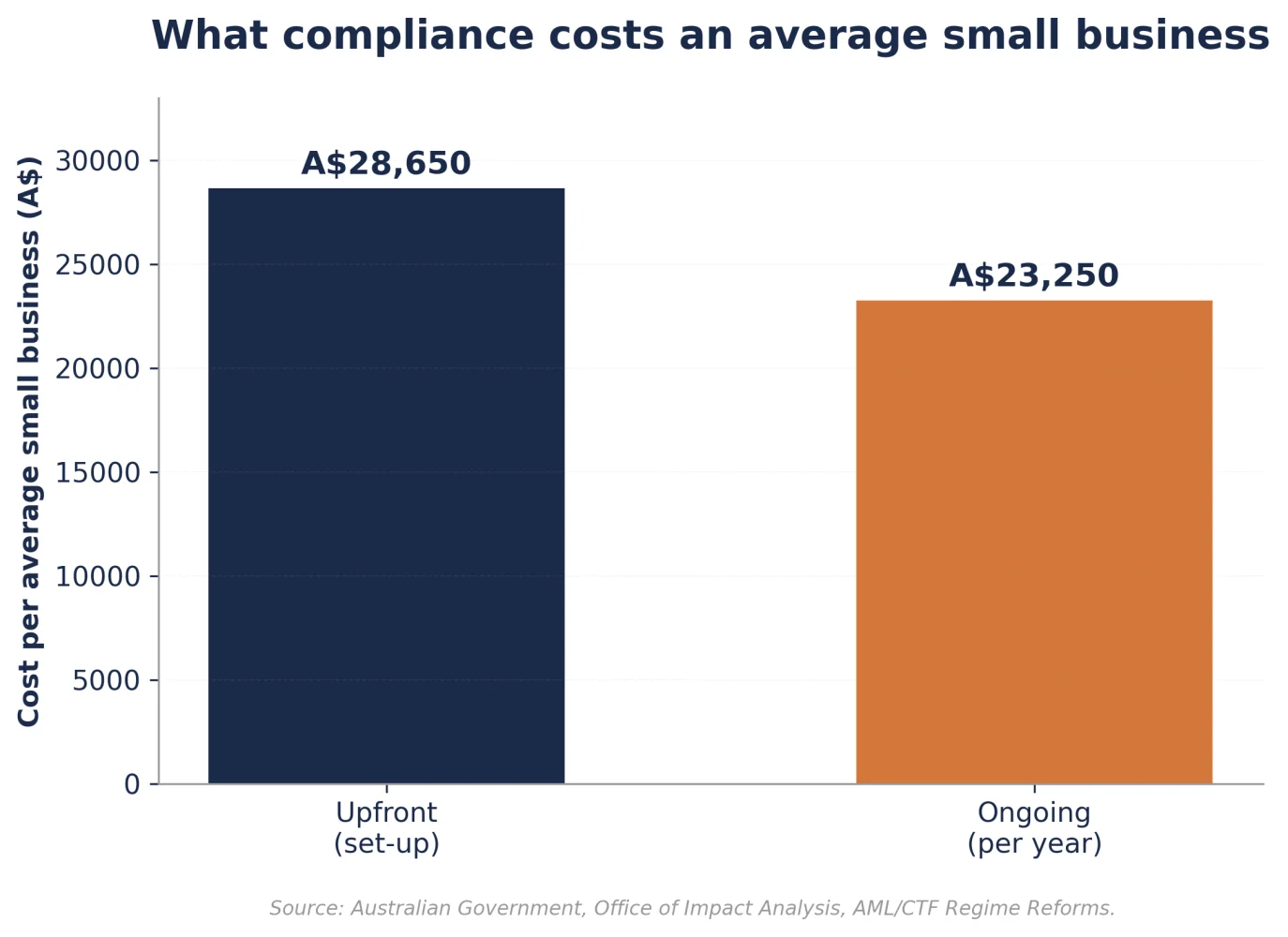
Look at the government's own numbers. The Office of Impact Analysis estimates that an average small business captured by the reform faces up to A$28,650 in upfront compliance costs and around A$23,250 a year to maintain the regime (Australian Government, Office of Impact Analysis, AML/CTF Regime Reforms). For a boutique agency or a one-project developer, that is a real and recurring drag on an already thin margin. For a national platform or an institutional manager, it is a rounding error absorbed by a compliance team that already exists. When a rule is trivial for the big player and material for the small one, it functions as a moat.
The operational burden compounds the financial one. Onboarding friction pulls staff, attention and budget away from the actual business of transacting. A firm with a dedicated compliance function treats this as a workflow. A firm without one treats it as a tax on the principal's time, which is the scarcest resource a small operator has.
I want to be careful not to overstate this as some imminent wipeout of the independent agent. It is not. But the direction of travel is clear, and it favours consolidation, institutional platforms and the compliance technology vendors who will sell the plumbing. This is the genuine second-order effect of the reform, and it is the one almost nobody is writing about because it is less dramatic than "dirty money exits the market." Structural advantages rarely announce themselves. They accrue quietly to whoever can absorb the fixed cost.
View 3: The Global Template Says This Is a Reputational Upgrade
The most counter-intuitive point is the one I hold most firmly. Large-scale institutional capital does not flee regulation. It is drawn to it. A fiduciary deploying a global pension fund's money cares enormously about the compliance risk and reputational exposure of the market it buys into. A jurisdiction known as a laundering honeypot is a liability on an investment committee memo. By closing the loophole, Australia removes a quiet discount it has been carrying for years.
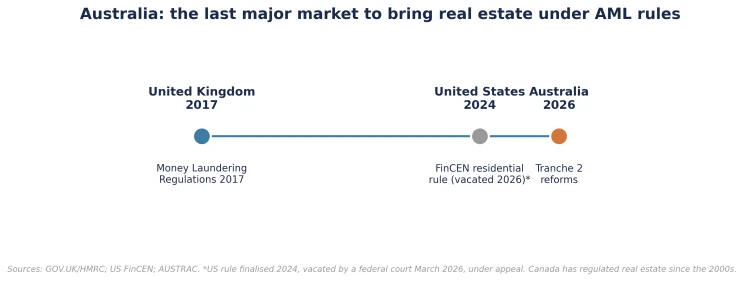
The global precedent supports this. The United Kingdom brought estate agents under formal AML supervision through the Money Laundering Regulations 2017, with HMRC as supervisor, and has since issued penalties to hundreds of agents for breaches (GOV.UK, Understanding risks and taking action for estate agency businesses). Canada has regulated real estate brokers and, later, developers under its Proceeds of Crime (Money Laundering) and Terrorist Financing Act since the 2000s (FINTRAC, Real estate brokers or sales representatives, and real estate developers). The United States finalised a FinCEN rule extending reporting to residential real estate transfers in 2024, though that rule was subsequently delayed and, in March 2026, vacated by a federal court and is now under appeal (US FinCEN, Residential Real Estate Rule, 2024). The lesson across all three is consistent. Property markets kept functioning, values were driven by rates and fundamentals rather than by the compliance regime, and each market emerged with a cleaner reputation. Australia is not running an experiment. It is arriving late to a direction of travel already set elsewhere.
For the commercial market specifically, this is a mild tailwind wearing the costume of a crackdown. The offshore institutional capital that dominates large CRE trades reads a credible AML regime as a de-risking signal, one less reason for an investment committee to discount the jurisdiction. It will not show up as a visible bump in transaction volumes next quarter. It shows up over years, as Australia stops being the developed market with the asterisk next to its name.
Where This Goes From Here
My view is cautiously constructive, and deliberately unglamorous. The 1 July reset will not reprice commercial real estate, the laundered dollar was a residential and reputational problem far more than a commercial-pricing one, and the arithmetic of a A$1.85 billion annual compliance bill against a A$1 billion problem tells you the marginal criminal buyer was never setting cap rates (Office of Impact Analysis; AUSTRAC). Anyone positioning for a repricing is positioning for a move that will not arrive.
What will arrive is slower and more structural. Compliance is a fixed cost, fixed costs favour scale, and over the next several years that pushes the industry toward consolidation, institutional platforms and the vendors who sell the compliance stack. At the same time, a cleaner regime quietly upgrades Australia's standing with exactly the global capital that matters most for commercial assets. The small operator pays the most and benefits the least. The institution pays little and gains a better market to buy into.
So the reform that was sold as a way to take money out of property may end up doing something more interesting. Not draining demand, but changing who gets to supply the service.
Sources
1. Australian Government, Office of Impact Analysis, Anti-Money Laundering and Counter-Terrorism Financing Regime (AML/CTF) Reforms. https://oia.pmc.gov.au/published-impact-analyses-and-reports/anti-money-laundering-and-counter-terrorism-financing-regime
2. AUSTRAC, Anti-money laundering and counter terrorism laws cover thousands more businesses (2026). https://www.austrac.gov.au/news-and-media/news/anti-money-laundering-and-counter-terrorism-laws-cover-thousands-more-businesses
3. AUSTRAC, AML/CTF transitional rules 2026. https://www.austrac.gov.au/about-us/legislation/updates-legislation/amlctf-transitional-rules-2026
4. Yahoo Finance Australia, New rules for real estate sector from tomorrow tipped to take more demand out of housing market (30 June 2026). https://au.finance.yahoo.com/news/new-rules-for-real-estate-sector-from-tomorrow-tipped-to-take-more-demand-out-of-housing-market-220726082.html
5. Australian Institute of Criminology, Estimating the costs of serious and organised crime in Australia, 2020–21 (SR38). https://www.aic.gov.au/publications/sr/sr38
6. Transparency International, Opacity in Real Estate Ownership Index (2025). https://www.transparency.org/en/publications/opacity-in-real-estate-ownership-index-2025
7. Transparency International Australia, Money Laundering. https://transparency.org.au/money-laundering/
8. GOV.UK (HMRC), Understanding risks and taking action for estate agency businesses. https://www.gov.uk/government/publications/money-laundering-understanding-risks-and-taking-action-for-estate-agency-and-letting-agency-businesses/understanding-risks-and-taking-action-for-estate-agency-businesses
9. FINTRAC (Canada), Real estate brokers or sales representatives, and real estate developers. https://fintrac-canafe.canada.ca/re-ed/real-eng
10. US FinCEN, Residential Real Estate Rule (final rule 2024; vacated March 2026, under appeal). https://www.fincen.gov/rre
11. LegalVision, Does Your Real Estate Business Comply with AML/CTF Laws? (2026). https://legalvision.com.au/my-real-estate-business-comply-with-aml-ctf-laws/
12. Gadens, New AML/CTF obligations for real estate businesses from 1 July 2026. https://www.gadens.com/legal-insights/new-aml-ctf-obligations-for-real-estate-businesses-from-1-july-2026-its-time-to-start-getting-ready/