for institutional deal workflows


Introduction
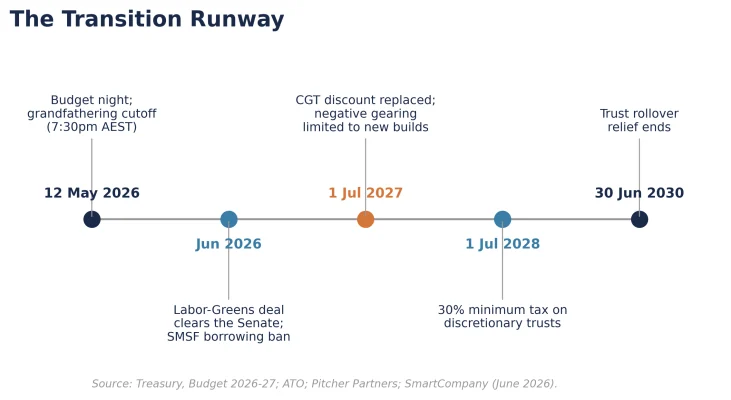
The headline from the 12 May 2026 Federal Budget was the death of the 50% capital gains tax discount, the deduction that has anchored Australian property wealth since 1999. From 1 July 2027, individuals, trusts and partnerships lose the discount and instead pay tax on their real, inflation-adjusted gain, subject to a 30% minimum tax rate (Treasury, Budget 2026-27: Tax reform; ATO, Reforming negative gearing and capital gains tax). Seven weeks on, the conversation has moved past whether it happens. It is no longer a proposal, nor even a deal waiting to clear: on 25 June 2026 the Treasury Laws Amendment (Tax Reform No. 1) Bill 2026 passed both houses of Parliament, the House by 98 votes to 39, and the core CGT and negative gearing changes are now law (SmartCompany, June 2026; The Adviser, June 2026). The price of Greens support in the Senate was a second measure that matters at least as much to property: a ban on self-managed super funds taking on new borrowing to buy residential real estate (The Nightly, June 2026).
Having discussed these changes with investors and brokers across the Australian Property landscape, I read tax reform through one question: not "is the rate higher" but "whose behaviour does this change, and where does the marginal dollar go next." On that test, the 2026 Budget is not primarily a rate story. The loss of the 50% discount grabs the headline, but the real output is behavioural. A 30% floor that overrides your marginal rate, a borrowing ban that removes a leveraged buyer pool, and a transition that quietly rewards patient holders over churners: these reshape who buys Australian property, not just what they net on the way out.
The consensus reaction has split into two camps that are both incomplete. One says investors are finished. The other says nothing changes for serious capital. My view sits between them, and it is directional. This piece works through the mechanics that actually bite, the demand pools the budget removes, and the asset classes the displaced capital is already moving toward. The short version: the floor, not the discount, is the real sting, and the money reroutes rather than retreats.
The Market Snapshot: What the Analysts Are Saying
Start with the mechanics, because most of the commentary has skipped them. From 1 July 2027, the 50% CGT discount is replaced by two things working together. First, cost-base indexation: the purchase price is lifted by CPI for assets held at least twelve months, so only the real gain is taxed and indexation can never create or enlarge a loss (ATO; Pitcher Partners, A fundamental shift in Capital Gains Tax). Second, a 30% minimum tax rate that applies "regardless of the taxpayer's marginal tax rate for the income year," so most investors pay the higher of their marginal rate or 30%, with income-support recipients and pensioners exempt and left on their marginal rate (William Buck, Federal Budget Analysis 2026: Capital Gains Tax).
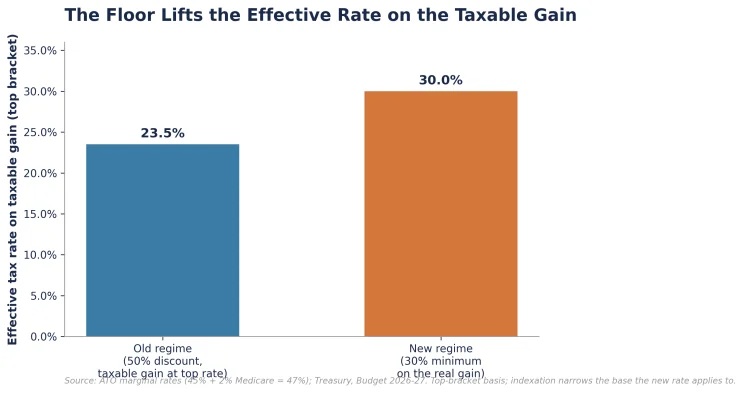
The rate arithmetic bites in two different ways. The real gain is taxed at the higher of your marginal rate or 30% (Pitcher Partners; William Buck). For a top-bracket investor the floor is irrelevant, because their marginal rate already exceeds it: their rate on the taxable gain moves from about 23.5%, being the 47% top marginal rate including the Medicare levy applied to a half-discounted gain, up to their full 47% on the real gain. On a rate basis that is close to a doubling; what softens it is the indexed cost base, which shrinks the gain the rate applies to, so the effective hit on the nominal gain depends on inflation and hold period rather than the headline rate. The 30% floor lands somewhere else entirely: on investors who used to time disposals into low-income years to pay an effective rate well below 30%. For that cohort the floor overrides the marginal rate and the effective rate can roughly double. The floor exists precisely "to deter taxpayers from deferring capital gains to income years in which they are subject to lower marginal tax rates" (Pitcher Partners). That is a behavioural target, not a revenue one.
The fiscal take confirms it. The negative gearing and CGT package is projected to raise just $3.6 billion over five years (Treasury, Budget 2026-27 measures), while Treasury's own regulatory impact analysis puts the extra compliance burden at about $88.4 million per year, a figure professional bodies argue materially understates the true cost (Office of Impact Analysis; CPA Australia). A reform that raises so little relative to its complexity is not chasing dollars. It is chasing behaviour: pushing capital out of established residential and into new supply.
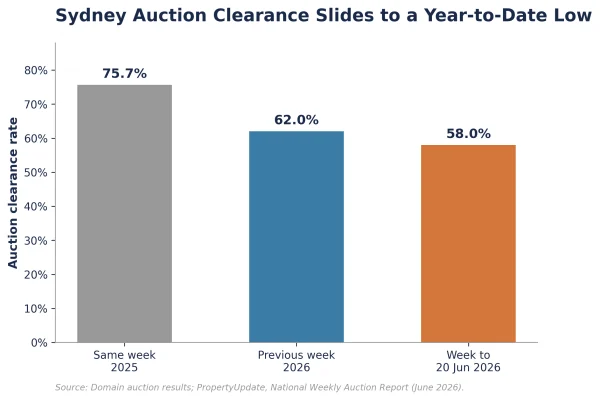
The market has started to price it. Capital-city auction markets have softened into mid-2026, with clearance rates tracking year-to-date lows in most capitals. Sydney cleared just 58.0% in the week to 20 June 2026, down from 62.0% the week before and well below the 75.7% recorded in the same week a year earlier (Domain auction results, June 2026; PropertyUpdate, National Weekly Auction Report). At the same time, the commercial desks are turning constructive. CBRE head of research Pacific Sameer Chopra expects rent growth to be "very, very strong" as supply keeps getting cut by construction costs and tax uncertainty, and Knight Frank chief economist Ben Burston sees the commercial recovery widening through 2026 as office and retail income returns strengthen (Commercial Real Estate, May 2026; Knight Frank Research, Commercial property recovery to strengthen into 2026). The split screen is the story: established residential cooling, commercial warming.
View 1: The 30% Floor, Not the Lost Discount, Is the Real Sting
The discount removal is the part everyone can see. The 30% minimum tax is the part that actually changes decisions.
Under the old regime, the planning game was timing. A high-income professional approaching retirement could hold an investment property, then sell in a year of low taxable income and apply the 50% discount to land an effective CGT rate in the teens. The new floor closes that door. Whatever your circumstances in the year of sale, the real gain is taxed at no less than 30% (William Buck). For the cohort that built its strategy around realising gains in low-income years, the effective rate does not rise by a few points. It can roughly double. That is the behavioural lever, and it is aimed squarely at the most tax-optimised end of private property holding.
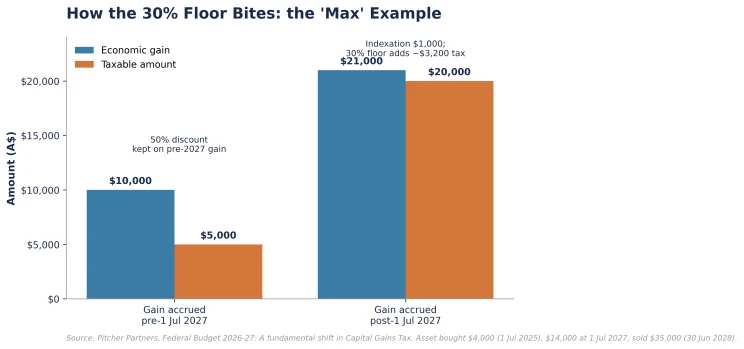
The worked example makes it concrete. Pitcher Partners models an investor, Max, who buys an asset on 1 July 2025 for $4,000. By the transition date of 1 July 2027 it is worth $14,000, and he sells it on 30 June 2028 for $35,000, in a year he also earns $10,000 of interest income. The gain accrued to 1 July 2027 of $10,000 keeps the 50% discount, so $5,000 is taxable at his marginal rate. The post-transition gain of $21,000 is reduced by roughly $1,000 of indexation to $20,000 and taxed under the new rules. The 30% floor adds about $3,200 of tax he would not have paid under the old regime (Pitcher Partners, A fundamental shift in Capital Gains Tax). On a modest gain, that is the floor doing exactly what it was designed to do.
Then there is the sleeper. The price of the Greens' support in the Senate was a ban on self-managed super funds taking on new borrowing to buy residential property, closing the limited-recourse borrowing arrangements (LRBAs) that have let SMSFs gear into residential (SmartCompany, June 2026; The Nightly, June 2026). The ban is prospective and narrow in a way that matters: new residential LRBAs are blocked from 45 days after the legislation receives royal assent, existing loans are grandfathered, refinancing of pre-commencement borrowings is permitted, and business real property acquired through an LRBA is untouched, so SMSFs can still gear into commercial. What disappears is the leveraged SMSF bid for new residential purchases. SMSFs are a serious pool of property demand, and leverage is what makes a fund-sized balance sheet stretch to a whole asset. Remove the borrowing and you remove the leveraged SMSF bid for new purchases. Stacked on top of the 30% floor, the budget does not just tax gains harder. It thins out a class of buyer.
The cumulative point is that this package works on conduct, not just on cash. It penalises deferral, it penalises gearing inside super, and it penalises churn. Investors who read it as a simple rate increase will mis-size the impact in both directions: too mild for the low-income-timing crowd, too severe for the long-term holder.
View 2: The Money Reroutes, and Industrial Wins
Capital does not evaporate when a tax regime tightens. It moves to the path of least resistance. The 2026 Budget has redrawn that path with unusual clarity.
The first redirection is into new builds. The budget keeps negative gearing for newly built dwellings and lets new-build investors choose between the 50% discount and the indexation method when they sell, a carve-out designed to channel capital into supply (Treasury, Budget 2026-27: Tax reform; ATO). For a developer marketing pre-completion stock, the relative tax position of a new apartment versus an established one has just been reset in their favour, and early demand signals back this up: CBRE's residential valuers recorded new-build demand jumping by ten percentage points to 44% of the market after the reforms (Real Estate Business, New-build demand surges following tax reforms, 2026, citing CBRE Residential Valuer Insights Q2 2026).
The second, and larger, redirection is into commercial. Commercial property sits entirely outside the negative gearing changes. Losses remain deductible against any income, and there is no restriction on asset type. Ray White head of research Vanessa Rader frames the pivot directly: commercial "retains full deductibility of losses against other income and offers no restriction on asset type," which makes it increasingly worth examining for investors who used residential as their wealth-building vehicle (Ray White Commercial, Vanessa Rader, 13 May 2026). She is equally clear on the catch: entry costs are higher, financing is more complex, and a vacancy or tenant default hits cash flow harder than an empty rental does. The pivot is real, but it is not frictionless.
Within commercial, the standout is industrial. The sector pairs the tax advantages of commercial with the structural tailwind of constrained supply and resilient occupier demand, which is why post-budget commentary has named industrial as the clearest winner of the investor pivot (Real Estate Business, Budget 2026: the investor pivot has a winner, and it is industrial, May 2026). CBRE's expectation of "very, very strong" rent growth as supply tightens applies with particular force to industrial and logistics, where vacancy is already thin and replacement cost keeps climbing (CBRE, Sameer Chopra, May 2026).
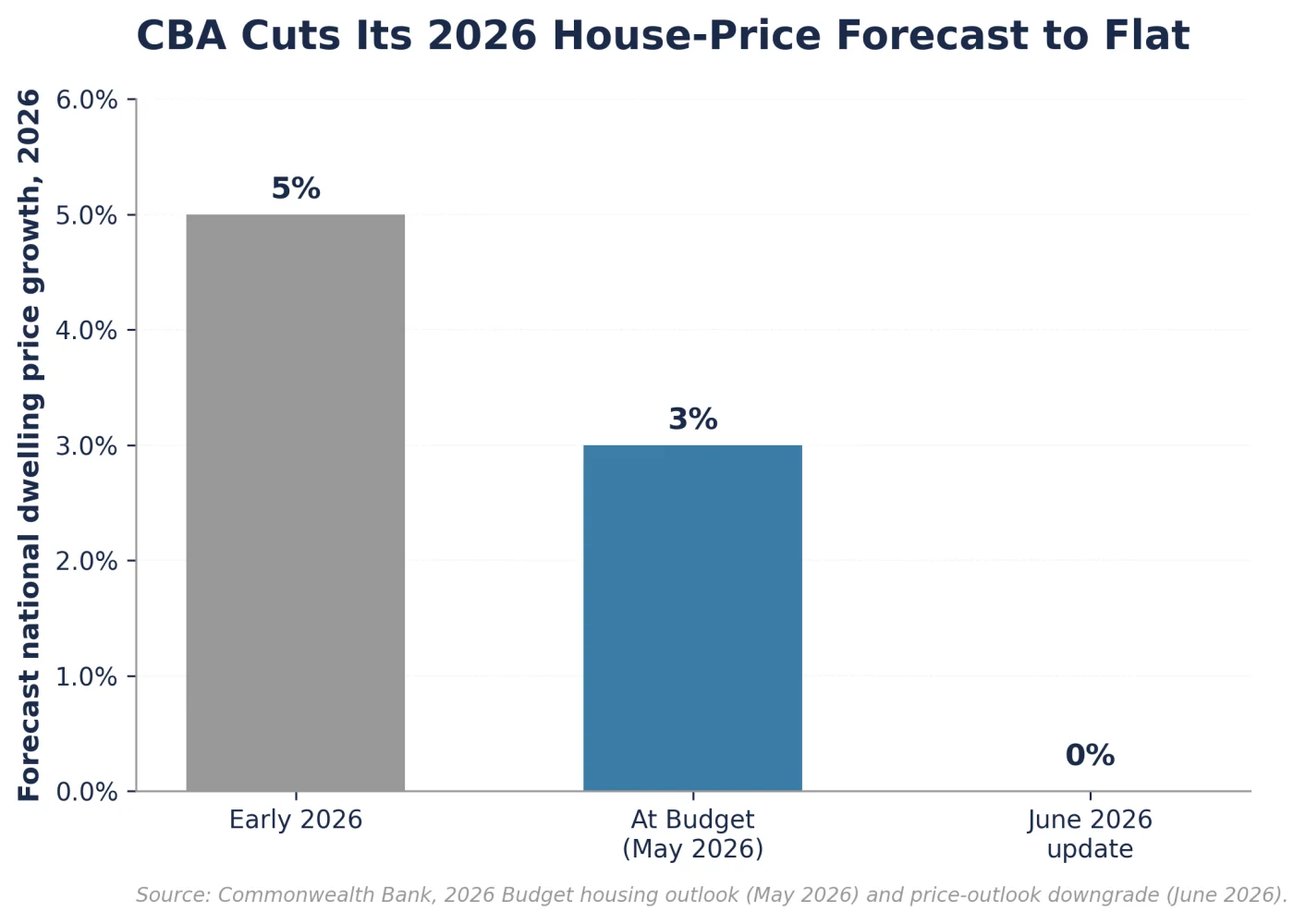
The third redirection is structural rather than sectoral. The reforms widen the gap between leveraged private holders of established residential and institutionally structured capital. Build-to-rent, which Australia has grown to a 51,000-apartment, $40.1 billion pipeline as of early 2026, up from 39,300 apartments and $30.1 billion a year earlier, sits cleanly on the right side of the new settings (BDO Australia, Australian Build to Rent 2026, reported via the Property Council, May 2026). The macro backdrop reinforces the rotation: the Commonwealth Bank, which estimated the package would leave house prices around 3% lower than they otherwise would have been, cut its 2026 national price forecast to flat in June, down from 3% at budget and 5% earlier in the year, citing softer sentiment and weaker investor demand after the negative gearing and CGT changes (Commonwealth Bank, Housing market faces multiple headwinds as price outlook downgraded, June 2026). A softer established-residential market and a tax code that rewards supply, scale and commercial exposure point the marginal dollar in one direction.
View 3: The Transition Is Gentler Than the Panic
The loudest advice circulating since May has been the simplest: sell before 1 July 2027 to beat the change. For many holders, that advice is half wrong, and acting on it blindly will cost money.
The reason is the way the transition is built. The new regime is not retrospective. It uses a valuation-day reset: every asset is effectively marked to its market value at 1 July 2027, the gain accrued up to that date keeps the existing 50% discount, and only the gain accruing afterward falls under indexation and the 30% floor (Pitcher Partners; ATO). A long-term holder therefore banks the historical, discounted gain automatically by holding, and starts a fresh clock on a stepped-up cost base. The choice is not "sell now or lose the discount on everything." It is "sell now, or keep the discount on everything earned to mid-2027 and accept new rules only on future growth."
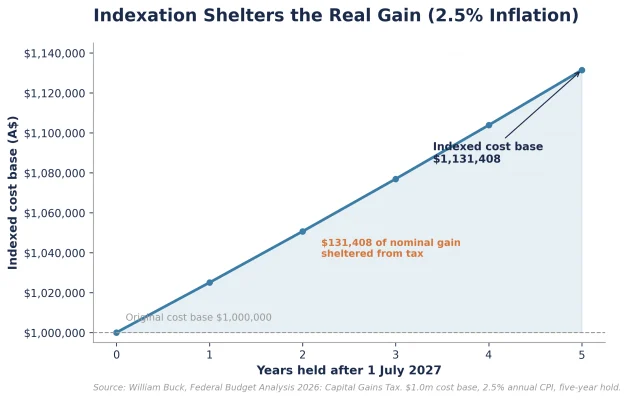
Indexation also does more work than the panic allows. Because the cost base lifts with inflation, only the real gain is taxed. William Buck illustrates the effect: a $1,000,000 cost base growing at 2.5% inflation over five years indexes up to roughly $1,131,408, so the first $131,408 of nominal gain is simply not taxed (William Buck, Federal Budget Analysis 2026: Capital Gains Tax). In a higher-inflation, longer-hold world, indexation can shelter a large slice of the headline gain, partly offsetting the higher rate. The old discount rewarded the size of the nominal gain and, implicitly, churn. Indexation rewards real returns and time in the asset. For genuinely patient capital, that is not obviously a worse deal.
This does not make the change benign. Two real frictions survive. First, gains are still bunched into a single income year without the averaging mechanisms that once existed, which can push an otherwise modest investor into a high marginal bracket for one year (Corrs Chambers Westgarth, CGT and negative gearing amendments, May 2026). Second, the modelling and record-keeping burden is real, which is exactly where the $88.4 million annual compliance estimate comes from (Office of Impact Analysis, 2026). The point is not that the transition is costless. It is that the right move is asset-specific arithmetic, not a blanket dash for the exit. The investor who sells a long-held, low-turnover asset purely to "beat CGT" may forfeit a stepped-up cost base and an indexation shield that would have served them better.
Where This Goes From Here
The honest assessment of the 2026 Budget is that it is the most consequential tax change for Australian real estate since the 50% discount was introduced in 1999, and that its effect is behavioural before it is fiscal. It raises little. It changes a great deal.
Three things I am watching over the next eighteen months.
First, the legislative tail. With the core bill through both houses on 25 June, the "will it pass" question that dominated May and June is settled: the CGT and negative gearing changes are law. What is not yet settled is the detail. The 30% minimum tax on discretionary trust distributions was carved out to a separate, more technical bill still to be introduced later in 2026, and a raft of definitions, including precisely what qualifies as a "new residential dwelling," is left to legislative instrument (Baker McKenzie, July 2026; Corrs Chambers Westgarth, June 2026). Investors can treat the headline regime as fixed and hold a probabilistic view only on the trust and new-build detail, rather than on the package as a whole.
Second, the durability of the commercial pivot. The early signals, stronger new-build enquiry, constructive commercial research, an industrial sector with thin vacancy, all point one way (CBRE; Knight Frank; Real Estate Business, May 2026). The test is whether private capital that has only ever owned residential can actually underwrite commercial risk at scale, or whether Rader's frictions, financing and vacancy, slow the rotation to a trickle.
Third, the transition behaviour. If the "sell before 2027" narrative dominates, expect a wave of established-residential listings into 2026 and 2027 that pressures prices further, on top of the softness already visible in clearance rates (Domain, June 2026). If holders instead do the asset-specific maths and recognise the valuation-day reset, the selling pressure is far gentler than feared. Which of those plays out is, fittingly, a behavioural question.
My view: cautiously constructive on where the capital is going, cautious on where it is leaving. The reroute into new-build, commercial and institutionally structured assets, with industrial at the front, is the durable trade. Leveraged private residential and geared SMSF property are structurally disadvantaged, and the 30% floor plus the borrowing ban will keep that pressure on. The investors who treat this as a behavioural reset, and price the floor, the borrowing ban and the valuation-day reset correctly, will look a lot smarter in 2029 than the ones still arguing about a discount that is already gone.
---
Sources
1. Treasury, Budget 2026-27: Tax reform (and Budget measures), May 2026. https://budget.gov.au/content/04-tax-reform.htm
2. Australian Taxation Office, Tax reform – Boosting home ownership – Reforming negative gearing and capital gains tax, 2026. https://www.ato.gov.au/about-ato/new-legislation/in-detail/individuals/tax-reform-boosting-home-ownership-reforming-negative-gearing-and-capital-gains-tax
3. Pitcher Partners, Federal Budget 2026-27: A fundamental shift in Capital Gains Tax: Pre-CGT assets, indexation and minimum tax, May 2026. https://www.pitcher.com.au/insights/federal-budget-2026-27-a-fundamental-shift-in-capital-gains-tax-pre-cgt-assets-indexation-and-minimum-tax/
4. William Buck Australia, Federal Budget Analysis 2026: Capital Gains Tax, May 2026. https://williambuck.com/tools/federal-budget-2026/capital-gains-tax/
5. Office of Impact Analysis (Treasury), Capital gains tax and negative gearing reform – regulatory impact analysis, 2026. https://oia.pmc.gov.au/
6. CPA Australia, commentary on the compliance cost of the CGT and negative gearing reforms, 2026. https://www.cpaaustralia.com.au/
7. ATO, Tax rates – Australian residents (marginal rates and Medicare levy), 2026. https://www.ato.gov.au/tax-rates-and-codes/tax-rates-australian-residents
8. SmartCompany, CGT, negative gearing reforms to pass after Labor secures Greens support, June 2026. https://www.smartcompany.com.au/federal-budget-2026/cgt-negative-gearing-reforms-pass-labor-secures-greens-support/
9. The Nightly, Labor, Greens strike deal to pass capital gains tax, negative gearing changes after Budget, June 2026. https://thenightly.com.au/politics/labor-greens-strike-deal-to-pass-capital-gains-tax-negative-gearing-changes-after-budget-c-22469944
10. Commercial Real Estate (Domain), Budget tax cuts to push residential investors into commercial market (Sameer Chopra, CBRE), May 2026. https://www.commercialrealestate.com.au/news/2026-federal-budget-commercial-market-residential-investors-1514769/
11. Knight Frank Research, Commercial property recovery to strengthen into 2026 (Ben Burston), May 2026. https://www.knightfrank.com.au/blog/2025/05/27/commercial-property-recovery-to-strengthen-into-2026-according-to-knight-frank-research
12. Ray White Commercial (Vanessa Rader), What does the 2026 Budget negative gearing changes mean for commercial property investors?, 13 May 2026. https://www.commo.com.au/news/2026/05/13/what-does-2026-budget-negative-gearing-changes-mean-commercial-property-investors
13. Real Estate Business, Budget 2026: The investor pivot has a winner, and it's industrial, May 2026. https://www.realestatebusiness.com.au/industry/31807-budget-2026-the-investor-pivot-has-a-winner-and-its-industrial
14. Real Estate Business, New-build demand surges following tax reforms (citing CBRE Residential Valuer Insights Q2 2026), 2026. https://www.realestatebusiness.com.au/industry/32035-new-build-demand-surges-following-tax-reforms
15. Commonwealth Bank of Australia, 2026 Budget: Updated housing outlook, May 2026. https://www.commbank.com.au/articles/newsroom/2026/05/2026-budget-updated-housing-outlook.html
16. Commonwealth Bank of Australia, Housing market faces multiple headwinds as price outlook downgraded, June 2026. https://www.commbank.com.au/articles/newsroom/2026/06/housing-market-faces-multiple-headwinds-as-price-outlook-downgraded.html
17. Domain, Auction Results (week to 20 June 2026), June 2026. https://www.domain.com.au/auction-results/sydney/
18. PropertyUpdate, National Weekly Auction Report, 2026. https://propertyupdate.com.au/this-weekends-auction-results-what-happened-in-sydney-melbourne-brisbane-adelaide-canberra/
19. Corrs Chambers Westgarth, Capital gains tax and negative gearing amendments: key changes and implications, May 2026. https://www.corrs.com.au/insights/capital-gains-tax-and-negative-gearing-amendments-key-changes-and-implications
20. BDO Australia, Australian Build to Rent 2026: A Changing of the Guard (reported via the Property Council), May 2026. https://www.bdo.com.au/en-au/insights/project-and-infrastructure-advisory/2026-build-to-rent-report-a-changing-of-the-guard-in-australia-s-living-sector
21. The Adviser, Negative gearing, CGT reforms pass Parliament, 25 June 2026 (records passage of both houses; House vote 98–39). https://www.theadviser.com.au/growth/48598-negative-gearing-cgt-reforms-pass-senate
22. Baker McKenzie, Australia: Major Changes to CGT and Negative Gearing, July 2026 (as-enacted analysis; confirms the discretionary trust 30% measure was not included in the Act and remains a separate, future bill). https://www.bakermckenzie.com/en/insight/publications/2026/07/australia-major-changes-to-cgt-and-negative-gearing