for institutional deal workflows


Introduction
Are buyers still buying? It is the key question in Australian commercial real estate right now, and the honest answer is more interesting than either the bulls or the bears will tell you. For two years the consensus trade was simple: wait for the Reserve Bank to cut, watch cap rates compress, and ride a recovery that would broaden across every sector. That script has seemingly been torn up. A fresh energy-price shock pushed inflation back up, and the RBA responded with three rate rises in 2026, in February, March and May, taking the cash rate to 4.35% (RBA, Cash Rate Target, June 2026; ANZ, Commercial Property Update, Q2 2026). The cut everyone underwrote never came. The cost of capital went up.
The recovery that built through 2025 has stalled as a result. Transaction volumes cooled in the first quarter of 2026 to A$10.4 billion, down from a stronger fourth quarter, even as the rolling twelve-month figure of A$57.6 billion still reads as the strongest annual result since 2022 (Cushman & Wakefield, Australia Capital Markets Marketbeat, Q1 2026). That gap between a strong trailing number and a softening current one is the whole story. The annual figure is a rear-view mirror. On the windscreen, ANZ now expects slower growth and increased dispersion across markets for the rest of 2026, with Sydney and Melbourne already softening on weaker confidence and reduced borrowing capacity (ANZ, Commercial Property Update, Q2 2026).
So on the data alone, the broad market is going sideways. That is not what I hear on the ground. I speak with developers, operators and investors across Australia most days, and the firms I talk to are still buying. The difference is that vendor price expectations have finally come in materially, the bid-ask spread that froze deals through 2023 and 2024 has closed, and the buyers transacting today are a specific kind: deep-pocketed, mostly unlevered (or not reliant on leverage for returns), and uninterested in waiting for a rate cut they no longer expect. Buying did not stop in 2026. It narrowed. The answer to whether buyers are still buying is yes, but you have to be precise about who, and what.
The Market Snapshot: Strong on Paper, Cooling in the Room
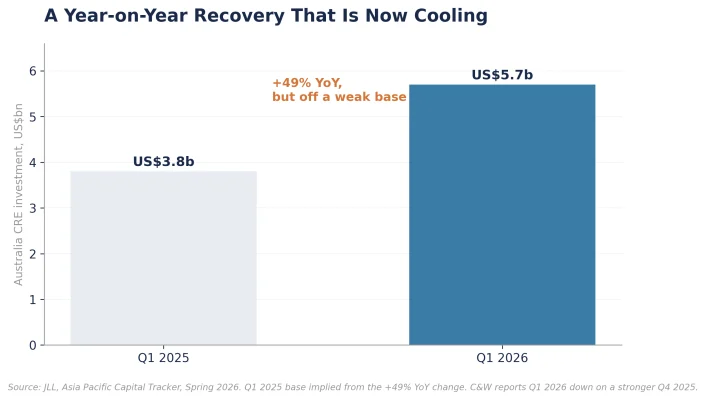
Read only the annual numbers and you would think the recovery is in full swing. Australia recorded US$5.7 billion of investment in the first quarter of 2026, up 49% on the same quarter a year earlier (JLL, Asia Pacific Capital Tracker, Spring 2026), and JLL frames the wider Asia Pacific backdrop as the strongest first quarter on record at US$47.0 billion, up 31% (JLL). But year-on-year growth measured off a weak early-2025 base flatters the picture. Sequentially the market cooled: Cushman & Wakefield's A$10.4 billion first quarter was down on a stronger Q4 2025, and CBRE's forecast of around 5% volume growth for the full year was written before the full force of this year's hikes landed (CBRE, Pacific Real Estate Market Outlook 2026).
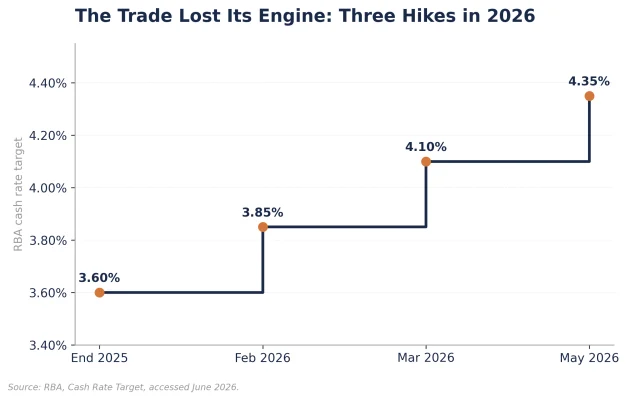
What changed underneath is a clean causal chain. Global energy prices spiked, inflation reaccelerated, and the RBA was forced back into tightening it had hoped to be finished with (ANZ, Commercial Property Update, Q2 2026). That is the engine of the recovery thesis going into reverse. You cannot underwrite cap-rate compression while the central bank is still raising rates.
And yet deals are still being done, because the other half of the equation moved. The repricing has done most of its work. Pricing in the Sydney CBD core office market has moved off the bottom, and CBRE believes prime yields broadly peaked across 2024 and 2025 (CBRE, Australian Cap Rate Outlook). Vendors have accepted where the market actually clears, which is why income-grade stock is still coming to market. In April 2026 Australia Post launched a A$400 million sale-leaseback of seven logistics facilities, one of the largest industrial offerings of the year (Institutional Real Estate Inc., Australia Post Plans A$400m Logistics Portfolio Sale-Leaseback, 2026). The capital chasing that kind of asset never left. It just got more selective, and it is concentrating in three places.
View 1: The Mega-Capital Is Chasing Digital Infrastructure
If you want to see where the largest single cheques in Australian real estate are being written, follow the power. Data centres have become one of the fastest-growing segments of the market, driven by cloud migration, enterprise digitisation and the artificial intelligence build-out (Cushman & Wakefield, Australian Commercial Real Estate Outlook 2026).
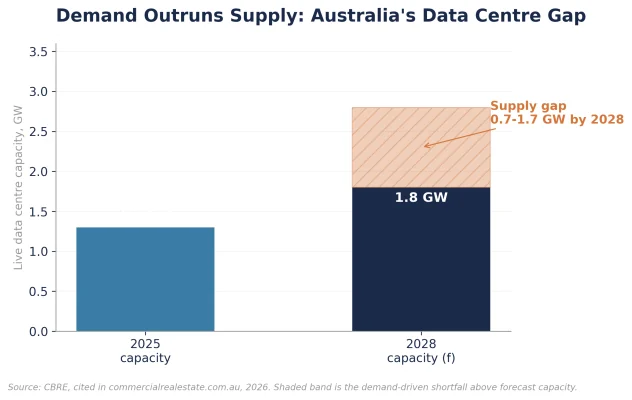
The supply-demand picture is the most lopsided in any property sector. Australia's live data centre capacity sat at roughly 1.3 gigawatts in 2025 and is forecast to reach around 1.8 gigawatts by 2028, still well short of demand and leaving an estimated supply gap of 0.7 to 1.7 gigawatts by 2028 (CBRE, cited in commercialrealestate.com.au, The AI Surge Fuelling Australia's Data Centre Boom, 2026). When supply cannot catch demand, pricing power sits with whoever can deliver megawatts.
The institutional response has been emphatic. Blackstone and Coatue Management led a US$10 billion debt facility for Australian AI data centre developer Firmus Technologies, capital earmarked to fund a national rollout of up to 1.6 gigawatts of infrastructure through 2028 (Mingtiandi, Blackstone Leads $10B in Debt Financing for Australia's Firmus, 2026). That is a single transaction larger than the quarterly volume of most traditional sectors. The point is not that data centres are a clever niche. It is that the biggest pools of global capital have decided digital infrastructure is the asset class with the clearest decade-long demand curve in the country, and they are willing to commit at a scale that dwarfs the rest of the market. This is buying that does not need a rate cut to make sense.
View 2: Living Has Become an Institutional Asset Class
The second place conviction capital is concentrating is beds. For years build-to-rent in Australia was a thesis on a slide deck. In 2026 it became a functioning insto asset class. The sector recorded its first Core and Core-plus style transactions, the clearest signal yet that institutions are treating build-to-rent as stabilised, income-producing residential rather than a development punt (Franklin St, Build to Rent Australia 2026 Report).
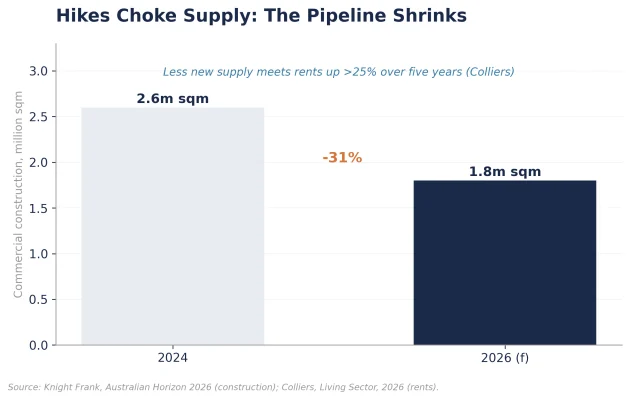
The driver is structural undersupply that rate hikes do nothing to fix, and arguably make worse by choking new development. Australian rents have grown by more than 25% over five years, with the sharpest gaps in the middle ring of major cities and among middle-income households who are priced out of ownership but underserved by existing rental stock (Colliers, Living Sector, 2026). Higher financing costs have pushed construction volumes down: Knight Frank forecasts 1.8 million square metres of commercial construction in 2026, against 2.6 million square metres in 2024, as developers respond to costs and financing constraints (Knight Frank, Australian Horizon 2026). Less new supply tightens the squeeze on the existing stock, which is exactly the dynamic income-focused capital wants underneath a living investment.
Global capital has noticed. Brookfield has publicly identified Australia as a "living" market defined by structural undersupply and long-term demographic tailwinds, the kind of language that precedes platform-scale deployment (EdgeProp, Brookfield Ramps Up Asia Pacific Bets, 2026). When the largest managers describe a sector in demographic rather than cyclical terms, they are signalling a multi-cycle allocation, not a trade. Living is now defensive income with a growth engine bolted on, and it is being underwritten that way, hikes or no hikes.
View 3: Private Credit Is the Crowded Trade, and the Regulator Has Noticed
The third theme is the one I would treat with the most caution, precisely because it is the most crowded. The popular story is that private credit is the clean winner of a constrained-bank world. Higher APRA and Basel III capital requirements have pulled the major banks back from development and transitional lending, and non-bank lenders have stepped into the gap (RBA, Recent Changes in Credit Markets, Bulletin, February 2026). Real estate sits at the centre of it, making up a large share of the Australian private credit market, and the segment has grown fast (Knight Frank, Australian Horizon 2026).
Here is the part that does not make the marketing decks. Private credit is no longer a sleepy beneficiary; it is squarely in the regulator's sights. In March 2026 the Australian Securities and Investments Commission ramped up supervision of the sector, demanding more frequent and detailed data from funds on defaults, redemption requests, liquidity, leverage and the split between retail and wholesale investors (Bloomberg, Australia Ramps Up Private Credit Scrutiny, March 2026). The RBA puts the sector at around A$50 billion of credit outstanding as of December 2025, while flagging notable data gaps in even that estimate (RBA, Recent Changes in Credit Markets, Bulletin, February 2026). It judges systemic risk contained for now, with private credit at less than 2% of total financial system assets, but its central concern is candid: limited visibility over these markets restricts regulators' ability to spot problems before they bite (RBA, Financial Stability Review, March 2026).
The very feature that makes private credit attractive to allocators, lending at equity-like returns with a debt position's protection, depends on disciplined underwriting and honest valuations through a cycle that has just turned harder. With rates higher for longer, some of the development loans written in easier conditions will be tested. The opportunity in credit is real, but the edge now belongs to the lenders with genuine workout capability and conservative marks, not to whoever can raise a fund fastest. The regulator demanding weekly default data is not a vote of confidence. It is a warning that the easy phase of this trade is over.
Where This Goes From Here
Strip away the annual headline and the picture for 2026 is coherent, if less comfortable than the consensus wanted. The recovery was real, and then a fresh inflation shock and three rate hikes stalled it. Broad volumes are cooling, Sydney and Melbourne are softening, and dispersion is widening (ANZ, Commercial Property Update, Q2 2026). The market-wide re-rating that everyone underwrote for 2026 has been postponed, not delivered.
But buying did not stop. It narrowed. The capital still transacting is concentrated and high-conviction: the mega-cheques going into digital infrastructure because it has the clearest demand curve in the country, the institutional money treating living as a multi-cycle allocation because undersupply only deepens with every hike, and the private credit filling the banks' gap, now under a regulator that has stopped watching politely. What these have in common is that none of them needs a rate cut to make sense.
My view: cautiously constructive, but only on the narrow market. I am not betting on the broad recovery resuming until the rate path turns, and after this year, I would not underwrite that before 2027 (maybe pessimistic only time will tell). The opportunity is not to buy the market. It is to buy what deep, patient capital is buying, from vendors who have finally accepted real pricing, in sectors that compound regardless of the cycle. So are buyers still buying? Yes. Just not the buyers, and not the assets, we had in mind. The recovery did not broaden. It got pickier. In a higher-for-longer world, that is exactly what you would expect, and exactly where the edge is.
---
Sources
1. JLL, Asia Pacific Capital Tracker, Spring 2026. https://www.jll.com/en-au/insights/asia-pacific-capital-tracker
2. Cushman & Wakefield, Australia Capital Markets Marketbeat Report, Q1 2026. https://www.cushmanwakefield.com/en/australia/insights/australia-capital-markets-marketbeat-report
3. ANZ, Commercial Property Update, Q2 2026. https://www.anz.com.au/business/business-hub/resources/industry-insights/commercial-property-update-q2-2026/
4. CBRE, Pacific Real Estate Market Outlook 2026 (April 2026 edition). https://www.cbre.com.au/insights/reports/pacific-real-estate-market-outlook-2026
5. CBRE, Australian Cap Rate Outlook. https://www.cbre.com.au/insights/reports/australian-cap-rate-outlook
6. Institutional Real Estate Inc., Australia Post Plans A$400m Logistics Portfolio Sale-Leaseback, 2026. https://irei.com/news/australia-post-plans-a400m-logistics-portfolio-sale-and-leaseback/
7. Knight Frank, Australian Horizon 2026: 7 Top Predictions for the Commercial Property Market. https://www.knightfrank.com.au/blog/2025/11/30/7-top-predictions-for-the-commercial-property-market-in-2026-knight-frank
8. Knight Frank, Australia's Private Credit Market Set for Sustained Growth as Traditional Lending Tightens. https://apac.knightfrank.com/horizon/content/australias-private-credit-market-set-for-sustained-growth-as-traditional-lending-tightens
9. RBA, Cash Rate Target, accessed June 2026. https://www.rba.gov.au/statistics/cash-rate/
10. RBA, Recent Changes in Credit Markets and Their Implications for Monetary Policy, Bulletin, February 2026. https://www.rba.gov.au/publications/bulletin/2026/feb/recent-changes-in-credit-markets-and-their-implications-for-monetary-policy.html
11. RBA, Financial Stability Review, March 2026. https://www.rba.gov.au/publications/fsr/2026/mar/resilience-of-the-australian-financial-system.html
12. Bloomberg, Australia Ramps Up Private Credit Scrutiny, Seeks More Data, March 2026. https://www.bloomberg.com/news/articles/2026-03-27/australia-ramps-up-private-credit-scrutiny-with-more-data-demand
13. Mingtiandi, Blackstone Leads $10B in Debt Financing for Australia's Firmus, 2026. https://www.mingtiandi.com/real-estate/data-centres/blackstone-leads-10b-in-debt-financing-for-australias-firmus/
14. commercialrealestate.com.au, How the AI Surge Is Fuelling Australia's Data Centre Investment Boom, 2026 (CBRE data). https://www.commercialrealestate.com.au/news/the-ai-surge-fuelling-australias-data-centre-investment-boom-1424227/
15. Franklin St, Build to Rent Australia 2026 Report. https://www.franklinst.com.au/news/build-to-rent-australia-2026-report/
16. Colliers, Australia's Living Sector Converging as Capital Targets Long-Term Renters, 2026. https://www.theaseandeveloper.com/news/2026/02/13/australia%E2%80%99s-living-sector-converging-capital-targets-long-term-renters-colliers
17. EdgeProp, Brookfield Ramps Up Asia Pacific Bets Across Logistics, Living and Hospitality, 2026. https://www.edgeprop.sg/property-news/brookfield-ramps-up-asia-pacific-bets-across-logistics-living-and-hospitality
18. RBA / market commentary on cash rate path and forecasts: Aussie, What Experts Predict for the RBA's June 2026 Interest Rate Decision, June 2026. https://www.aussie.com.au/insights/news/expert-predictions-rba-rates/