for institutional deal workflows


Every few years a corner of Australian real estate gets reclassified from "niche" to "institutional." Childcare did it. Healthcare and life sciences did it. Purpose-built student accommodation did it. Specialist Disability Accommodation, the purpose-built housing funded under the National Disability Insurance Scheme, is now having that moment. The pitch is seductive: government-backed income, double-digit yields, and a structural undersupply measured in the tens of thousands of dwellings.
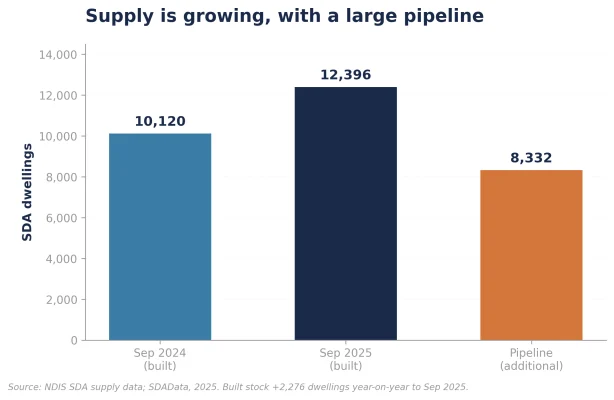
The headline numbers do most of the selling. As of 30 September 2025 there were 12,396 SDA dwellings nationally, up 2,276 on a year earlier, with a further 8,332 in the development pipeline (NDIS SDA supply data; SDAData, Australian SDA Market Overview 2025). Some 25,502 NDIS participants held SDA funding at December 2025, growing at roughly 4% a year (NDIS, SDA Data, December 2025). Funds targeting the sector advertise returns broadly in the 10% to 14% range, with Australian Unity's fund targeting a 10% p.a. internal rate of return (Australian Unity, SDA Fund Information Memorandum, April 2025). Macquarie's Enliven platform has assembled 727 dwellings and just closed a A$480m syndicated social loan led by ANZ (ANZ, bluenotes, April 2026).
Having assessed social-infrastructure and government-revenue real estate across childcare, healthcare and student housing, I have learned to read these stories carefully. The income is real and it is genuinely defensive. But "government-backed" and "guaranteed" are not the same word, and the gap between the gross opportunity and the realised cash flow is where most of the risk lives. My view is selectively bullish: the institutional platforms will do well, and most of the retail SDA sold on a 10% headline yield is mispriced. Here is why.
The Market Snapshot: What the Brokers Are Saying
SDA is the capital side of the NDIS housing equation. It funds the bricks and mortar; a separate support stream funds the people. Every dwelling must be certified by an accredited assessor into one of four design categories, Improved Liveability, Fully Accessible, Robust, or High Physical Support, and pricing scales sharply with the category and build type (NDIS, SDA Pricing and Payments). High Physical Support new-build dwellings in metropolitan areas now attract annual SDA funding above A$117,000 per place, which is what underwrites the double-digit gross yields (NDIS, SDA Pricing Arrangements 2025-26; Paramount Homes, SDA Price Guide 2026).
The advisory community has moved from curiosity to coverage. Knight Frank has brokered fully leased SDA portfolios across Queensland and Victoria, signalling that secondary-market liquidity is starting to form (Knight Frank, via Property Markets News, 2024). JLL now provides SDA valuation as part of its residential offering, a quiet but important marker; an asset class is not institutional until the major valuers will put their name to it (JLL, Residential Property Services). Corrs Chambers Westgarth and PwC have both published frameworks describing SDA as an emerging asset class on a path to maturity (Corrs Chambers Westgarth, SDA: an emerging asset class for investors; PwC Australia, NDIS Specialist Disability Accommodation: pathway to a mature market).
The capital is following. Beyond Enliven, CBA coordinated an A$840m facility for APM-linked SDA activity, and a Lighthouse-managed disability accommodation trust is backed by the Victorian Funds Management Corporation (Macquarie Group, How institutional investment is reshaping SDA, 2025; VFMC). When a sovereign wealth-style manager, two of the big four banks, and a state funds manager are all underwriting the same thesis, the asset class has cleared its first credibility hurdle. The harder questions come next.
View 1: The Real Bottleneck Is Matching, Not Building
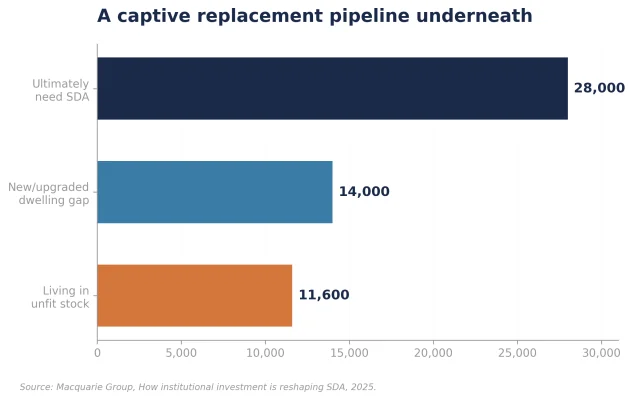
The undersupply narrative is the load-bearing wall of every SDA pitch, and it is only half true. Yes, Macquarie estimates roughly 28,000 Australians will ultimately need SDA against a built stock that still leaves a gap of around 14,000 new or upgraded dwellings (Macquarie Group, 2025). But supply and demand in SDA are not fungible. The national utilisation rate sits at roughly 42%, meaning well under half of the eligible, funded demand is actually housed in matched stock (SDAData, SDA Housing Supply and Demand).
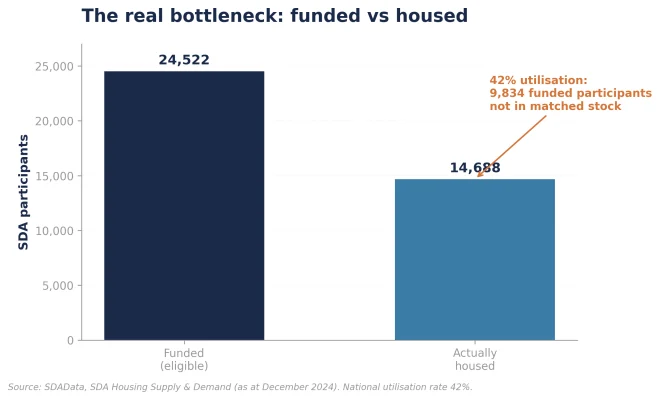
That gap between "funded" and "housed" is the whole ballgame. A High Physical Support dwelling built in an outer-suburban growth corridor does nothing for a Fully Accessible participant who needs to stay near family and clinicians in an inner ring. SDA demand is hyper-local and category-specific in a way that a spreadsheet of national shortfall numbers completely obscures. The childcare sector learned this lesson the hard way a decade ago: national undersupply coexisted with pockets of ruinous oversupply, and the operators who built to a demand map rather than a national average were the ones who survived.
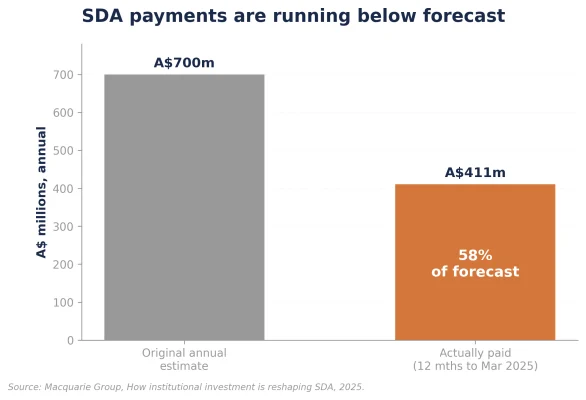
The corroborating evidence is in the cash. In the 12 months to March 2025, A$411m in SDA payments was made, only around 58% of the original A$700m annual estimate (Macquarie Group, 2025). Bulls read that shortfall as runway. I read it as friction: assessment backlogs, vacancy in mismatched stock, and the simple reality that funded demand converts to occupied tenancies slowly and unevenly. The opportunity is real, but it rewards precision, not volume.
View 2: One Payer, Mid-Reform
Strip away the real estate language and SDA is a credit instrument with a single counterparty: the Commonwealth. The 10%-plus yield is not a property yield in any conventional sense; it is a sovereign-revenue yield wearing a residential wrapper. That is a feature when you want income that is uncorrelated to the office cycle or retail spending. It is a profound concentration risk when the payer is actively trying to slow its own spending.
The NDIS is mid-reform, and the direction of travel is cost restraint. The scheme has a legislated growth target well below its recent trajectory, and the 2025-26 and 2026 reform packages have already restructured pricing across adjacent supports, including tiered Supported Independent Living rates and tightened registration and compliance requirements (VisiCase, NDIS Reforms 2026; NDIS, Pricing Updates). SDA price limits themselves rose 3.95% for 2025-26, indexed broadly to the Disability Support Pension (NDIS, SDA Pricing Arrangements 2025-26). Indexation is comforting until you remember that the same machinery that grants a 3.95% uplift can grant zero, or redesign the category pricing entirely, with a single policy decision.
This is the discipline that government-revenue real estate demands. Childcare investors live and die by the Child Care Subsidy; healthcare landlords are exposed to Medicare and state health budgets; student accommodation depends on visa settings. None of these are uninvestable, but the experienced capital prices the policy risk explicitly rather than pretending the income is risk-free. The SDA product currently being marketed to retail investors at a flat 10% headline, with no haircut for single-payer concentration or reform risk, is not pricing that risk at all. The institutions, tellingly, are funding through social loans and diversified platforms, structures built to absorb a policy shock that a single geared house cannot.
View 3: The Edge Has Moved to the Platform
If the risks above sound like a bear case, they are not. They are the case for why this becomes an institutional asset class rather than a cottage industry, and why the returns accrue to operators with scale. The edge in SDA has already shifted from building a compliant dwelling, which any competent developer can now do, to running occupancy, tenant onboarding, support-provider relationships and compliance across a portfolio. That is a platform capability, not a construction skill.
Two structural features make the platform model defensive. First, there is a captive replacement market underneath the growth story. Around 11,600 SDA participants currently live in dwellings considered no longer fit for purpose, stock that must be replaced or modernised as design standards tighten (Macquarie Group, 2025). That creates a renewal pipeline that exists regardless of net market growth, a floor under demand for operators positioned to deliver compliant new product.
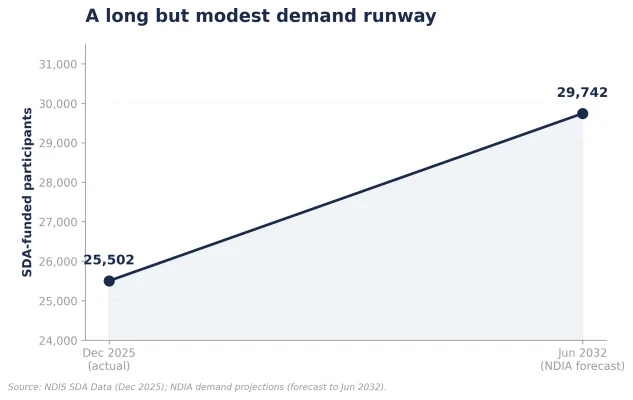
Second, the NDIA's own forecasts point to 29,742 SDA-funded participants by June 2032, a long demand runway for platforms that can match supply to need rather than simply add dwellings (NDIA forecast, cited in SDA Data, 2025).
This is where the mum-and-dad investor and the institution part ways. The individual investor, sold a single high-yield house, is the one carrying undiversified vacancy and policy risk. The platform, managing hundreds of dwellings across categories and states with sector-leading occupancy, is the one converting the messy reality of SDA demand into the smooth, defensive income the asset class promises (Macquarie Group, 2025). In the maturing market, the retail buyer increasingly looks like the exit liquidity, not the long-term winner.
Where This Goes From Here
SDA is a genuine asset class, and the institutional money arriving is not wrong. But the consensus framing, "government-backed 10% yield in a chronically undersupplied market," compresses three very different risk profiles into one number and sells them at the same price.
My view is cautiously bullish, with the emphasis on cautious. The replacement demand is real and defensive. The platform operators, with diversified portfolios, social-loan funding and genuine occupancy expertise, are building something durable, and I would back the Enlivens of this market over the medium term. What I would not do is buy the single-payer, single-asset version of this trade at a yield that prices in none of the concentration or reform risk. The 42% utilisation rate and the 58% spend-to-forecast ratio are not footnotes; they are the market telling you that the gap between a funded participant and a paying tenancy is wider than the brochure admits.
Sovereign yield is still yield. Just price it like sovereign credit, not like a sure thing.
---
Sources
1. NDIS, Specialist Disability Accommodation (SDA) Data, December 2025 quarter. https://dataresearch.ndis.gov.au/reports-and-analyses/specialist-disability-accommodation-sda-data
2. SDAData, Australian SDA Market Overview: State-by-State Breakdown 2025. https://sdadata.com.au/australian-sda-market-overview-state-by-state-breakdown-2025/
3. SDAData, SDA Housing Supply and Demand Data. https://sdadata.com.au/sda-ndis-supply-demand-data/
4. Macquarie Group, How institutional investment is reshaping specialist disability accommodation in Australia, 2025. https://www.macquarie.com/au/en/insights/how-institutional-investment-is-reshaping-specialist-disability-accommodation-in-australia.html
5. ANZ, From emerging to established: how Specialist Disability Accommodation has come of age, bluenotes, April 2026. https://www.anz.com.au/bluenotes/2026/april/enliven-housing-social-loan/
6. Australian Unity, Specialist Disability Accommodation Fund Information Memorandum, 2 April 2025. https://www.australianunity.com.au/
7. NDIS, Specialist Disability Accommodation Pricing Arrangements 2025-26. https://ndis.gov.au/providers/housing-and-living-supports-and-services/specialist-disability-accommodation/sda-pricing-and-payments
8. Paramount Homes, SDA Price Guide 2026: Understanding Payment Rates. https://www.paramounthomes.com.au/news/sda-price-guide-2026-understanding-payment-rates
9. Corrs Chambers Westgarth, Specialist disability accommodation: an emerging asset class for investors. https://www.corrs.com.au/insights/specialist-disability-accommodation-an-emerging-asset-class-for-investors
10. PwC Australia, NDIS Specialist Disability Accommodation: pathway to a mature market. https://www.pwc.com.au/insights/ndis-specialist.html
11. Knight Frank, Fully leased SDA portfolio across Queensland and Victoria, via Property Markets News, 2024. https://propertymarkets.news/fully-leased-specialist-disability-accommodation-portfolio-across-queensland-and-victoria-up-for-sale/
12. VisiCase, NDIS Reforms 2026: What Every Provider Must Know. https://visicase.com/ndis-reforms-2026-how-the-latest-changes-impact-your-organisation-and-what-you-must-do-now-2/
13. NDIS, Pricing Updates. https://www.ndis.gov.au/providers/pricing-and-payments/pricing/pricing-updates
14. JLL, Australia's premier residential property partner. https://www.jll.com/en-au/insights/australias-premier-residential-property-partner