for institutional deal workflows


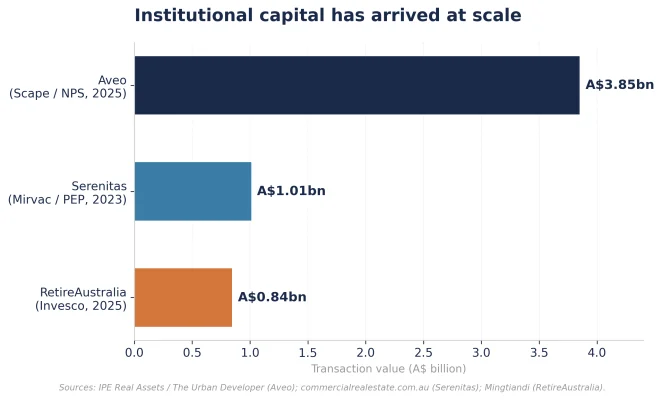
In June 2025, Scape and Korea's National Pension Service paid A$3.85 billion for Aveo, a portfolio of 65 retirement villages, in the largest direct real estate transaction in Australian history (IPE Real Assets; The Urban Developer, 2025). It edged out Blackstone's A$3.8 billion Milestone logistics sale from 2021. That single cheque, written by the third-largest pension fund on earth, is the clearest signal yet that Australian retirement living has crossed from a fragmented, owner-operator cottage industry into an institutional asset class.
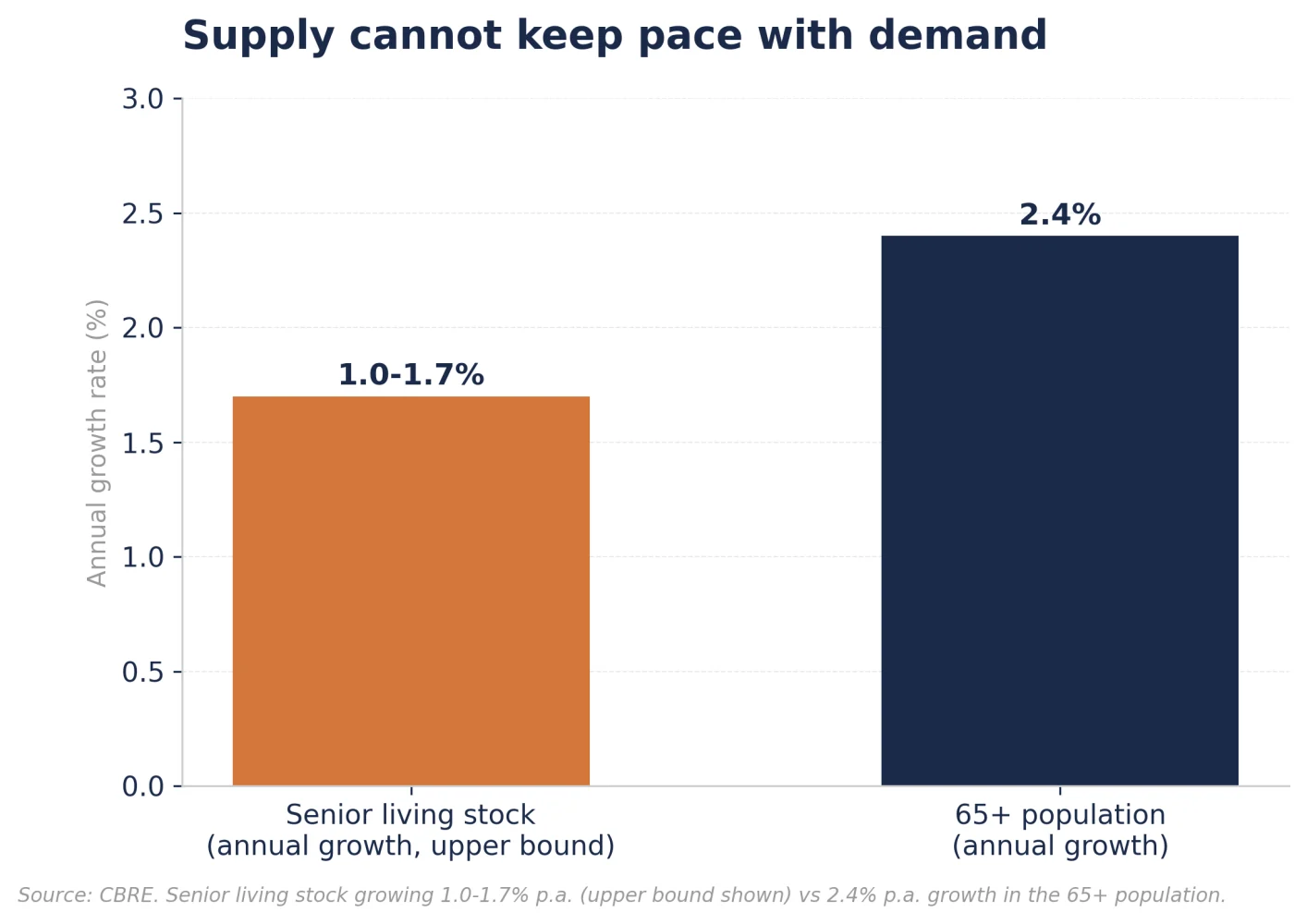
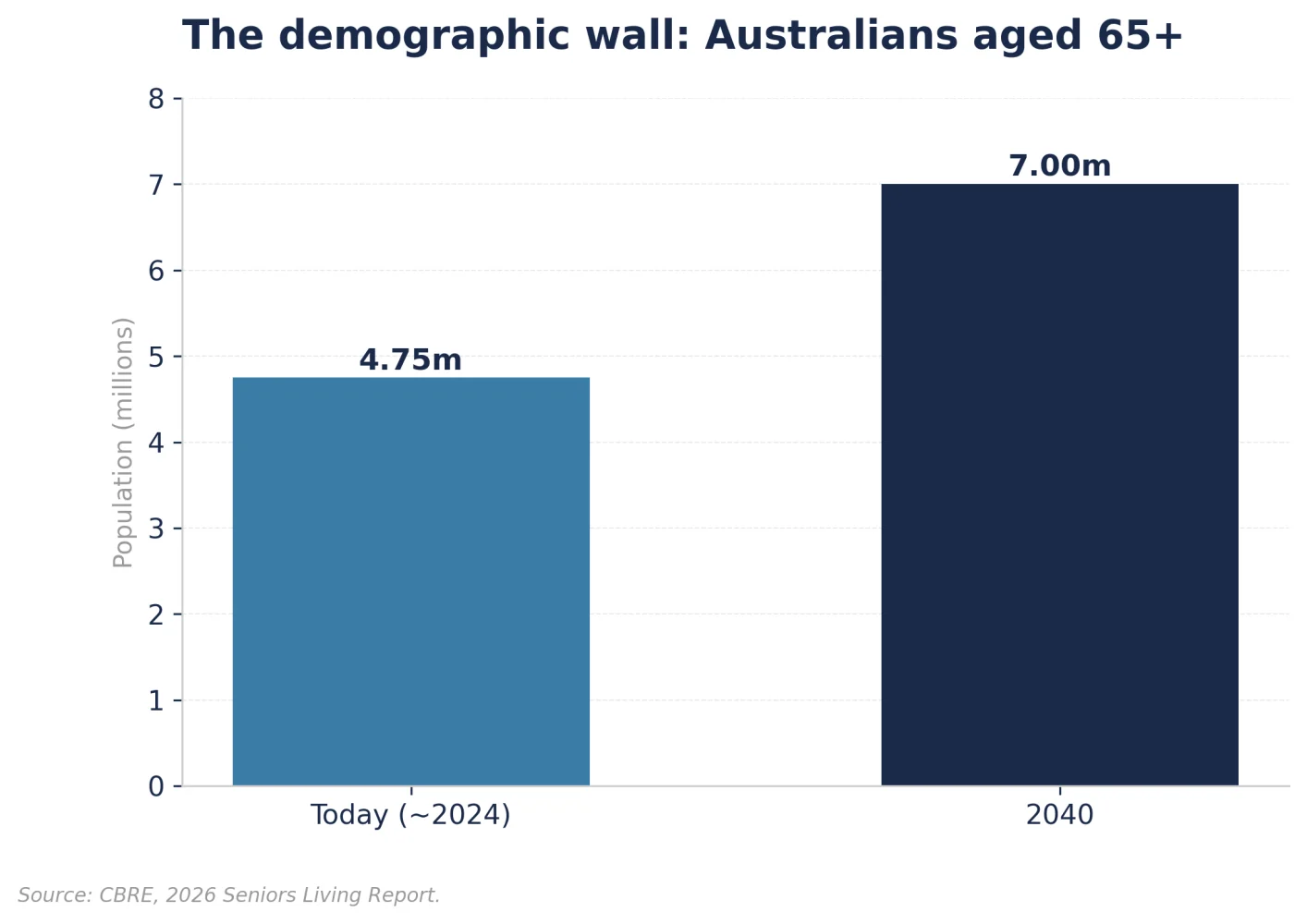
Having assessed seniors living and land lease platforms in both an investment and advisory capacity, I think the demand story is among the most bankable in Australian real estate. The 65-plus population grows from roughly 4.75 million today to 7.0 million by 2040 (CBRE, 2026 Seniors Living Report). That curve is already locked in by people alive today. It does not depend on migration settings, the rate cycle, or consumer confidence. CBRE forecasts a shortfall of more than 40,000 seniors living units by 2030 (CBRE, 2026 Seniors Living Report, January 2026). On the demand side, this is about as close to a sure thing as the sector offers.
However, at the Property Stack we do try to provide balance in our views. The easy version, acquiring a legacy deferred-management-fee village book at a tight yield and clipping the coupon, is precisely the part of the model that state regulators are now dismantling. The real edge is narrower and more specific. It sits in the land lease community structure, and in operator quality, not in passive ownership of the old village contract. The demand is right. For a lot of the capital flooding in, the model is wrong.
The Market Snapshot: What the Brokers Are Saying
The brokers are, for once, close to unanimous on direction, if not on price.
CBRE frames the sector around scarcity. Its 2026 Seniors Living Report forecasts an undersupply of more than 40,000 units by 2030, with only about 11% of Australians over 65 living in retirement villages or residential aged care (CBRE, 2026 Seniors Living Report). It notes that planning approvals for retirement villages run anywhere from 365 days to more than 730 days in extreme cases (CBRE, 2026 Seniors Living Report), a supply-side handbrake that demand alone cannot release.
JLL quantifies the capital appetite, and the cleanest read sits in the deeper US market, where seniors housing transaction volume reached a decade high of roughly US$24 billion in the year to end-2025 (JLL, 2026 US Seniors Housing and Care Investor Survey). In the same US survey, 86% of participants said they planned to expand their seniors housing portfolios in 2026, and 85% expected cap rates to compress further over the next 12 months, up sharply from 57% a year earlier (JLL, 2026 US Seniors Housing and Care Investor Survey). That is the mood of the global capital now circling Australia: sentiment has turned decisively risk-on.
Colliers owns the land lease community (LLC) data. It sizes the LLC sector at roughly A$12 billion and puts the average development cost at about A$127,000 per site in 2025, drawn from feasibility studies and completed projects across some 3,500 sites in Queensland, New South Wales and Victoria (Colliers, Land Lease Community Market Overview). Colliers reports current LLC yields ranging between 4.5% and 7%, with assets expected to appreciate 4% to 6% a year (Colliers, Land Lease Community Market Overview).
Knight Frank supplies the demographic backbone, noting that over the next 20 years the over-65 cohort is expected to grow at roughly three times the pace of the national average, and flagging land lease as the subsector where US and UK precedent points to the most runway in Australia (Knight Frank, Horizon Report 2025).
The throughline is consistent: enormous, predictable demand; chronic undersupply; and a wall of capital trying to get in. The disagreement, and the opportunity, is in which vehicle actually captures it.
View 1: Demand Was Never the Question. Absorption Is.
The seductive part of this sector is also its trap. Everyone can see the demographic wall, which means the demand half of the thesis is fully priced. The question that actually determines returns is whether that demand can be absorbed into deliverable, sellable product. On the evidence of the last decade, it mostly has not been.
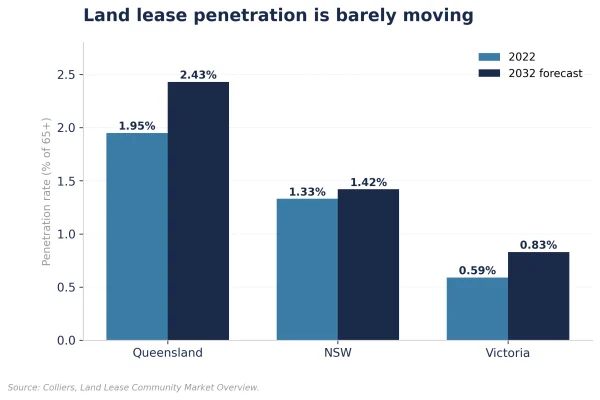
Penetration rates tell the story. In land lease, Queensland leads at 1.95% in 2022, forecast to reach just 2.43% by 2032. New South Wales sits at 1.33%, crawling to a forecast 1.42%, and Victoria moves from 0.59% to 0.83% over the same period (Colliers, Land Lease Community Market Overview). These are not the trajectories of a market clearing its backlog. They are the trajectories of a market that cannot build fast enough, held back by 365-to-730-day approval timelines and rising construction costs (CBRE, 2026 Seniors Living Report).
This matters because a shortfall is only an investment opportunity if you can monetise it. A 40,000-unit gap that takes two years per project to approve is not a tailwind you clip passively; it is an operating challenge you have to solve. The capital that wins here is the capital that controls land, planning capability and a construction pipeline, not the capital that simply buys stabilised income and waits for the demographics to do the work. Demand is the easy part. Deliverability is the trade.
View 2: The Capital Has Arrived, But How Full the Price Is The Question
The institutionalisation of the sector is real and it has happened fast. Beyond the A$3.85 billion Aveo deal, Mirvac, Pacific Equity Partners and Tasman Capital acquired land lease operator Serenitas for A$1.01 billion in 2023, a portfolio of 27 communities and more than 6,200 sites (Mirvac; commercialrealestate.com.au, 2023). Invesco Real Estate agreed to buy RetireAustralia, a portfolio of 28 villages, for A$845 million in 2025 (Mingtiandi; Institutional Real Estate Inc, 2025). Stockland's Halcyon platform now spans around 5,000 homeowners across 24 land lease communities (The Weekly Source, 2025), and Macquarie Asset Management is deploying capital into the space through its A$2.9 billion real estate partners fund (Colliers).
This is validation, and it should not be dismissed. When the world's third-largest pension fund and a roster of blue-chip managers all underwrite the same thesis, the institutional-grade question is effectively answered. The asset class is legitimate.
But validation and value are not always the same thing. Stabilised LLC yields now sit in the 5.0% to 5.75% range nationally (CBRE, 2026 Seniors Living Report), and in the US, where the survey data is deepest, 85% of seniors housing investors expect cap rates to compress further, up from 57% a year earlier (JLL, 2026 US Seniors Housing and Care Investor Survey). Buying a defensive, operationally intensive asset at a sub-6% yield, after a buying wave, into a market where the prevailing investor mood still expects yields to keep falling, is a momentum trade rather than a structural one.
It is worth remembering that Blackstone's record Australian deal in 2021, the one Aveo just surpassed, landed in logistics right before logistics yields decompressed. Record prints are as often cycle markers as they are conviction signals. The capital is right about the sector. It is just paying a price that leaves less room for error than prior cycles.
View 3: The Real Edge Is Land Lease, Because Regulation Is Repricing the Old Model
I believe this part the consensus is being underweighted. The traditional retirement village runs on a deferred management fee: residents pay a reduced entry price, then surrender a slice of their unit's value, often 20% to 35%, when they leave. That mechanism is the engine of village economics, and it is now squarely in the regulators' sights.
Victoria's Retirement Villages Amendment Act 2025 received Royal Assent on 3 June 2025 and takes effect on 1 May 2026, the most significant overhaul of village legislation in decades (Russell Kennedy; Saward Dawson, 2025). It tightens how and when deferred fees can be charged. Separately, VCAT has found that the Residential Tenancies Act prevents a land lease operator from charging deferred management fees at all (Housing for the Aged Action Group, 2025). State by state, the contractual machinery that underwrites legacy village returns is being narrowed, and the reform risk is fragmented and hard to price.
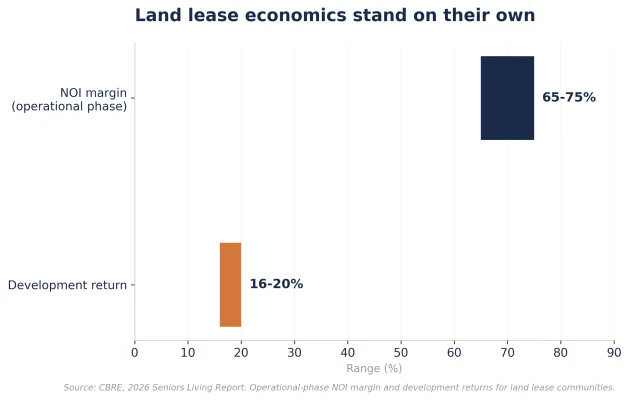
This is exactly why the land lease community model is structurally advantaged, and why it deserves to be the centre of the thesis rather than a footnote. In an LLC, the resident owns the home and leases the land, paying a weekly site fee that is partially offset by Commonwealth Age Pension rent assistance. The income is an annuity, not a deferred lump sum hostage to a resident's exit and a tribunal's interpretation of fee fairness. The economics stand on their own: NOI margins of 65% to 75% in the operational phase and development returns of 16% to 20% (CBRE, 2026 Seniors Living Report). The LLC is not just a different product; it is a more durable contract in a tightening regulatory environment.
The implication for capital is direct. Underwriting that leans on legacy DMF assumptions is exposed to a reform cycle it cannot control. Underwriting built on transparent, recurring site fees is not. The alpha is not in the sector versus the rest of real estate. It is in the model versus the model.
Where This Goes From Here
The demographic wall guarantees the demand. It does not guarantee anybody's returns. Those will be decided by two things the brochures tend to skip: whether you can actually deliver product through a 365-to-730-day planning gauntlet, and whether your income model survives the regulators rather than depending on the version they are dismantling.
My view: cautiously bullish over the medium term, but selectively so. I would back land lease communities with strong development pipelines and disciplined operators well ahead of stabilised legacy village books bought at sub-6% yields on the assumption that cap rates keep falling. The first is a structural position aligned with where regulation, affordability and resident preference are all heading. The second is a momentum trade riding a demographic wave that may have already been priced in.
---
Sources
1. CBRE, 2026 Seniors Living Report, 12 January 2026. https://www.cbre.com.au/insights/reports/australian-seniors-housing ; coverage: https://www.theweeklysource.com.au/cbre-2026-seniors-living-undersupply-to-leave-retirees-with-nowhere-to-live/
2. CBRE Australia, Ageing populations and retiree wealth drive senior living demand. https://www.cbre.com.au/insights/articles/ageing-populations-and-retiree-wealth-drive-senior-living-demand
3. JLL, 2026 US Seniors Housing and Care Investor Survey and Trends Outlook / Seniors housing investment reaches decade high of US$24 billion, March 2026 (figures are United States market data). https://www.jll.com/en-us/newsroom/seniors-housing-investment-reaches-decade-high-of-24-billion
4. Colliers, Land Lease Community Market Overview. https://www.theweeklysource.com.au/colliers-land-lease-community-market-overview-significant-growth-fundamentals/ ; development cost: https://www.theweeklysource.com.au/colliers-whats-the-average-cost-of-a-land-lease-community-development-in-2025/
5. Knight Frank, Horizon Report 2025. https://australianhorizon.knightfrank.com.au/
6. IPE Real Assets, Scape Australia buys Aveo retirement living portfolio for A$3.8bn, 2025. https://realassets.ipe.com/news/scape-australia-buys-aveo-retirement-living-portfolio-for-a38bn/10131301.article
7. The Urban Developer, Scape Scoops Up Aveo in $3.85bn Deal, 2025. https://www.theurbandeveloper.com/articles/scape-aveo-acquisition-deal-retirement
8. commercialrealestate.com.au, Pacific Equity Partners, Mirvac sign $1 billion Serenitas acquisition, 2023. https://www.commercialrealestate.com.au/news/pacific-equity-partners-mirvac-sign-1-billion-serenitas-acquisition-2-1242471/ ; Mirvac release: https://www.mirvac.com/about/news-and-media/serenitas-acquisition
9. Mingtiandi, Invesco Buying Australia Retirement Village Group for $551M, 2025. https://www.mingtiandi.com/real-estate/finance/invesco-buying-australia-retirement-village-group-from-new-zealanders-for-551m/ ; portfolio detail: https://irei.com/news/invesco-real-estate-announces-acquisition-of-retireaustralia-with-a-portfolio-of-29-retirement-villages/
10. The Weekly Source, Stockland Halcyon notches up 24 land lease communities, 2025. https://www.theweeklysource.com.au/development/stockland-halcyon-notches-up-24-land-lease-communities-unveils-its-latest-212-home-llc-on-the-sunshine-coast
11. Russell Kennedy, Victorian Retirement Villages Reforms, 2025. https://www.russellkennedy.com.au/insights-events/insights/victorian-retirement-villages-reforms ; Saward Dawson: https://sawarddawson.com.au/victorian-retirement-villages-act-reform-2025-key-insights/
12. Housing for the Aged Action Group, Not just unfair, unlawful: VCAT rules against village charging Deferred Management Fees, 2025. https://www.oldertenants.org.au/publications/not-just-unfair-unlawful-vcat-rules-against-village-charging-deferred-management-fees
13. Colliers, Land Lease Communities. https://www.colliers.com.au/en-au/services/healthcare-and-retirement-living/land-lease-communities