for institutional deal workflows


Introduction
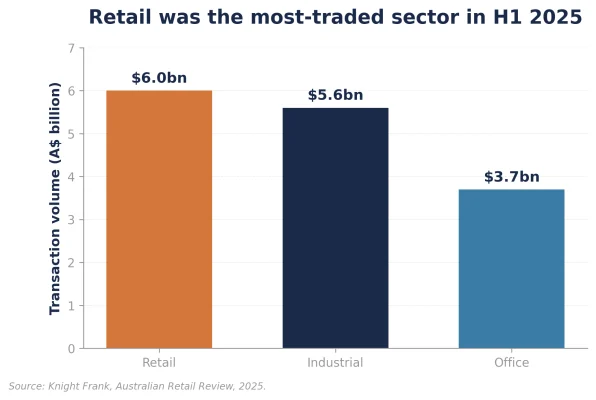
For most of the past decade, large format retail was the asset class institutional Australia preferred to own quietly rather than talk about. Bulky goods, homemaker centres, the big sheds on the edge of town anchored by a hardware giant or a furniture chain: useful for income, rarely the headline. That has changed. In the first half of 2025, retail was the most-traded commercial property sector in the country, with $6 billion transacted, ahead of industrial at $5.6 billion and office at $3.7 billion (Knight Frank, Australian Retail Review, 2025). Within that, large format retail has been the standout, with 2025 transaction volumes already exceeding the combined totals of 2023 and 2024 (Colliers, Australian Retail Snapshot Q3 2025).
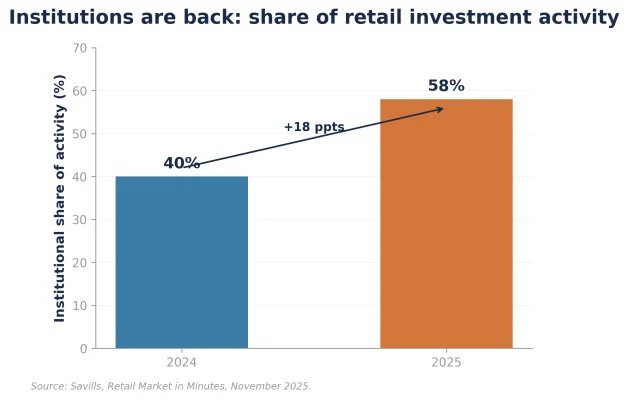
The narrative wrote itself through 2025: a defensive, inflation-linked, e-commerce-resistant income stream being repriced as the market bet that rates had peaked and capital flooded back. Institutional investors drove 58% of retail investment activity in 2025, up from 40% the year prior (Savills, Retail Market in Minutes, November 2025), and the brokers were close to unanimous that 2026 would be a record year.
Two developments in 2026 complicate that story. First, rates did not peak. The Reserve Bank lifted the cash rate to 4.35% in May 2026, its third increase of the year, after headline inflation reaccelerated to 4.6% and a Middle East fuel shock fed through to prices (RBA, Monetary Policy Decision, May 2026). The cost-of-capital tailwind the recovery leaned on has become a headwind. Second, the 2026-27 Federal Budget redrew the tax map for property, in ways that cut for commercial and against offshore capital.
The picture, in other words, is more nuanced than the 2025 consensus. The defensive-income story is real, but the demand side leans heavily on the housing cycle. The scarcity bid is real, but with rates rising again, the easy yield compression is likely behind us. And the most durable source of value may not be the rent at all, but the land underneath the box and what it could one day become. This piece works through three lenses against that changed backdrop: large format as a bond proxy, the scarcity and consolidation trade, and the quiet convergence of big-box retail with last-mile logistics.
The Market Snapshot: What the Brokers Are Saying
Lets start with the capital flows, because they frame everything else...
Knight Frank put H1 2025 retail turnover at $6 billion, up 17% on the $5.1 billion traded in H1 2024, and the most of any commercial sector (Knight Frank, Australian Retail Review, 2025). New South Wales led with $3 billion, ahead of Queensland at $1 billion and Victoria at $0.9 billion. Crucially, capital values for retail grew 1.6% over the year to Q2 2025, the first annual growth since Q1 2023, supported by real household disposable income rising 4.2% to Q2 2025 and nominal retail sales up 5.1% over the year to July (Knight Frank, Australian Retail Review, 2025).
JLL, using a different sample, recorded $5.5 billion of retail sales nationwide in H1 2025 and noted that large format rents grew 4.8% in 2024, the strongest of any retail subtype (JLL, Retail 2025). Victoria alone saw a record $1.67 billion of retail transactions in the first half (JLL, 2025).
Colliers is the most direct on large format specifically: 2025 volume had already passed the combined 2023 and 2024 totals, reaching roughly $1.97 billion, with household spending on furnishings and equipment up 3.7% year-on-year underpinning tenant performance (Colliers, Australian Retail Snapshot Q3 2025). Colliers also flags Queensland as the national leader, with more than $457 million of large format assets trading across 20 transactions in 2025, up 330% year-on-year.
Savills frames the recovery through the housing lens, noting that bulky goods demand tracks the residential market recovery as households furnish and renovate. It also captures the capital shift most directly: institutional investors drove 58% of retail investment activity in 2025, up from 40% in 2024 (Savills, Retail Market in Minutes, November 2025).
CBRE supplies the supply-side argument. Large format retail and neighbourhood centres make up around 75% of the limited new retail supply expected over the next three years, almost all of it in population growth corridors (CBRE, Pacific Real Estate Market Outlook 2026). Large format yields compressed modestly through 2025, and CBRE expects total returns of around 9% per annum for nearly half of prime retail assets, driven by income (CBRE, Pacific Real Estate Market Outlook 2026).
Cushman & Wakefield captures the mood: institutional capital, both domestic and offshore, is "firmly back in acquisition mode," and with low future supply supporting rental growth, the firm sees 2026 as potentially a record year for retail (Cushman & Wakefield, 2025 EOY Market Commentary and 2026 Forecast).
The signal is consistent across all six houses: volumes up, capital returning, supply constrained, yields tightening. One caveat frames everything that follows. Most of this data was compiled while the market still expected rate cuts. The RBA's 2026 hikes, to 4.35% in May (RBA, Monetary Policy Decision, May 2026), have lifted the discount rate against which all of it should be read, and that changes how much room is left.
View 1: The Bond Proxy That Still Has a Cyclical Heartbeat
The institutional case for large format starts with the income. Compared with an enclosed shopping centre, a big-box asset is cheap to run: tenants typically take long leases on net or semi-net terms, fit out their own space, and stay put. The result is long weighted average lease expiries and low capital expenditure leakage, the combination institutional buyers prize most.
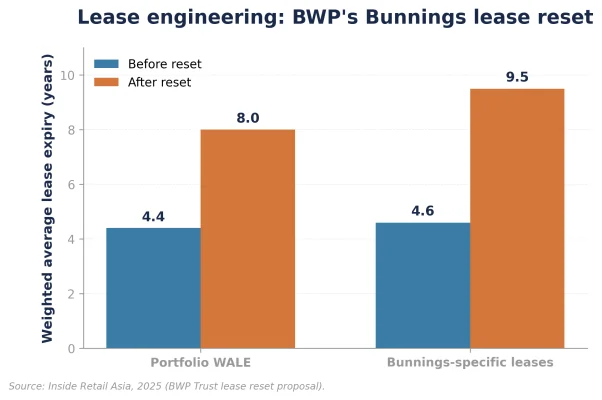
The covenants help. The anchor tenants are names like Bunnings, JB Hi-Fi, Officeworks and Harvey Norman, several of them ASX-listed with national balance sheets behind the lease. The market is pricing that quality accordingly. A regional South Australian Bunnings traded at a 5.00% yield for $27.98 million in 2025, a sharp number for a single-tenant asset outside a capital city (JLL, 2025). The lease-engineering opportunity is real too: BWP Trust's plan to reset 62 Bunnings leases would extend the portfolio's average lease length from roughly 4.4 years to 8 years, and Bunnings-specific leases from 4.6 to 9.5 years, with an estimated value uplift near $50 million (Inside Retail Asia, 2025).
Charter Hall Retail REIT has built a strategy around exactly this income quality, lifting its convenience net-lease portfolio to 39% of total value at 30 June 2025, up from 28% a year earlier (Charter Hall, Retail REIT FY2025 Results). It has since deepened that platform with four standalone Bunnings outlets for $151 million (IBTimes, 2025). The REIT reported record specialty leasing spreads of 5.5%, with new leases up 7.6% and renewals up 4.9% (Charter Hall, FY2025), evidence that the income is not just stable but growing.
I will caveat the nuance here. The same data that makes large format look defensive also reveals its cyclicality. Savills is explicit that the sales recovery is tracking the housing market, and Colliers ties tenant performance to a 3.7% lift in spending on furnishings and household equipment (Savills; Colliers, 2025). When you buy a homemaker centre, you are buying a claim on Australians furnishing and renovating homes, an activity tightly bound to housing turnover, interest rates and consumer confidence. The income is high quality, but it is not acyclical. Calling large format a pure bond proxy overstates the case; it is better understood as quality income with a cyclical heartbeat.
View 2: Scarcity and Consolidation Are Repricing the Sector Now
The more compelling near-term argument is structural scarcity meeting consolidating ownership.
On supply, the pipeline is thin and getting thinner. With large format and neighbourhood centres comprising about 75% of limited new supply over the next three years, and that supply concentrated in growth corridors, the existing stock of well-located metropolitan assets is effectively a closed set (CBRE, Pacific Real Estate Market Outlook 2026). New large format development competes for the same urban-fringe land that industrial and last-mile logistics developers want, and industrial usually wins the bid, choking off new retail supply before it starts (Corrs Chambers Westgarth, The Future of Last-Mile Infrastructure).
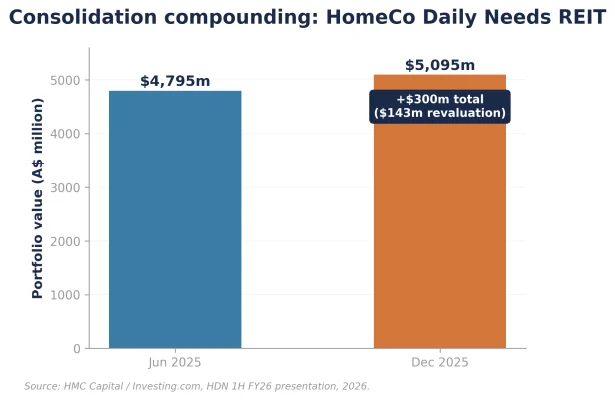
On the demand side, institutional capital is consolidating the sector at scale. The defining transaction was HMC Capital's $2.2 billion merger of HomeCo Daily Needs REIT with Aventus, completed in early 2022, which created a 51-property, $4.1 billion portfolio concentrated in metropolitan growth corridors (The Urban Developer, 2022). That platform has kept compounding: HomeCo Daily Needs REIT's portfolio rose from $4,795 million in June 2025 to $5,095 million in December 2025, including $143 million of valuation uplift, and it carries a development pipeline exceeding $650 million (HMC Capital, HDN 1H FY26 Results). Recent additions include a six-property retail portfolio for $222 million and Armstrong Creek Shopping Centre for $55.6 million (HMC Capital, 2025).
When a small number of well-capitalised REITs are accumulating a non-replenishing asset base, prices move. Large format yields compressed through 2025, and Colliers expected further compression into early 2026 as opportunities became scarce (Colliers, Australian Retail Snapshot Q3 2025).
The caution is sharper than it was six months ago. If scarcity and consolidation were repricing the sector, the cheap window is closing, and the rate reversal may have shut it. CBRE's longer-range view already had cap rates broadly flat across 2026 to 2028 (CBRE, Australian Cap Rate Outlook, December 2025); with the RBA hiking again to 4.35% (RBA, May 2026), the risk to that view skews to mild expansion, not further compression. The implication is unambiguous: buyers entering now must underwrite income and rental growth, not another leg of multiple expansion. The scarcity trade rewarded those who moved in 2025; latecomers are paying for a thesis the market has already largely absorbed, into a less friendly rate environment.
View 3: When the Big Box Becomes the Last Mile
The most interesting argument is the one the consensus has not fully priced: that a large format asset is increasingly two things at once, a retail income stream and a parcel of strategically located, low-coverage urban land.
HMC Capital does not describe its daily needs portfolio as shops. It describes it as "a highly strategic $4.1 billion portfolio of last-mile logistics infrastructure" in Australia's leading metropolitan growth corridors (The Urban Developer, 2022). That language is deliberate. The Aventus-legacy estate sits on around 2.5 million square metres of land at roughly 38% site coverage (The Urban Developer, 2022), meaning the majority of the land is car park and yard, not building. Low site coverage on well-located, well-connected land is the definition of embedded optionality
The convergence runs both ways. Industrial land near urban hubs is increasingly scarce, much of it lost to residential rezoning, which has inflated values and intensified competition for last-mile sites (Corrs Chambers Westgarth, The Future of Last-Mile Infrastructure). At the same time, the physical attributes that make a big-box retail site work, large floor plates, multiple ingress and egress points, existing dock doors, high clearances and abundant parking, are precisely what a last-mile fulfilment operator needs. Underperforming retail boxes are being eyed as conversion candidates for exactly this reason (Corrs Chambers Westgarth, 2025).
This reframes the underwriting. If you buy a metropolitan large format centre at a retail yield, you are arguably buying the land at a discount to its highest-and-best use, with the existing retail income paying you to wait while you hold optionality over last-mile logistics, residential or mixed-use intensification. That optionality is the part of the thesis the headline yield does not capture.
The discipline required here is to treat optionality as upside, not base case. Rezoning in Australia is slow, planning-risk-heavy and capital-intensive, and not every site converts. A buyer who pays a full price today on the assumption of a future rezoning that may take a decade is underwriting hope. The right approach is to buy assets where the in-place income and covenant stand on their own, and where the land optionality is a free, or close to free, option on top. Bought that way, large format is one of the few sectors offering defensive income and a genuine development call in the same asset.
Where This Goes From Here
The evidence points one way, with one large qualification. Australian large format retail is being structurally repriced by a real combination of constrained supply, returning institutional capital and consolidating ownership, and the income quality that makes it attractive is durable. The brokers are right that the fundamentals have turned.
The qualification is the macro. Most of the obvious money already has a name on it: the institutional share of retail activity jumped from 40% to 58% in a single year (Savills, 2025), and the RBA's move to 4.35% in May 2026 (RBA, May 2026) means the cost-of-capital tailwind has reversed into a headwind. Buyers chasing the sector now for another round of capital growth are likely to be disappointed, and the demand side still leans on a housing recovery that higher rates may stall.
Policy adds a two-sided twist that an offshore allocator in particular should weigh. The 2026-27 Federal Budget restricted negative gearing, but only for residential property; commercial assets, large format included, are explicitly unaffected (Aussie, Federal Budget 2026), which at the margin nudges domestic private capital toward commercial. Pulling the other way, the Government's draft foreign-resident CGT changes would broaden the definition of taxable Australian real property, replace the point-in-time principal asset test with a 365-day test, and tighten purchaser withholding (Clayton Utz, Australian Budget 2026-27, 2026; Corrs Chambers Westgarth, 2026). For the offshore institutional capital the brokers say is returning, that is real friction, and it belongs in the after-tax return, not in the footnotes.
On balance, the case is constructive but disciplined. The durable edge is not the cap rate; it is the combination of a strong covenant, growing net-lease income and a low-coverage land parcel with last-mile and intensification optionality. Underwritten that way, with the land treated as a free option rather than a paid-for assumption, large format remains one of the more compelling risk-adjusted entries in Australian real estate, even with rates rising. Underwritten as a momentum trade on further compression, it is late, and the RBA has just made it later. The smart bid is not buying retail. It is buying land at a retail yield, and getting paid to hold it.
---
Sai Naicker is the Founder and CEO of CrossCourtAI. He has assessed institutional real estate opportunities in both an investment and advisory capacity at Cerberus Capital, J.P. Morgan and Barrenjoey. He speaks with developers, operators, and investors across Australia daily.
---
Sources
1. Knight Frank, Australian Retail Review and "Retail one of the hottest commercial property sectors," 2025. https://www.commo.com.au/news/2025/10/01/retail-one-hottest-commercial-property-sectors-knight-frank/1759273343
2. Knight Frank, Australian Retail Review April 2025. https://www.knightfrank.com/research/report-library/australian-retail-review-april-2025-12096.aspx
3. JLL, Retail 2025 and Victoria retail investment release, 2025. https://www.jll.com/en-au/insights/victorias-retail-investment-market-rebounds-with-record-dollar167-billion-in-transactions-for-first-half-of-2025
4. Colliers, Australian Retail Snapshot Q3 2025. https://www.colliers.com.au/-/media/files/anz/australia/research/2025/quarterly-snapshots/q3/q3_2025_colliers_research_retail_snapshot.ashx
5. Colliers, Retail Investment Review and Outlook 2026. https://www.colliers.com.au/en-au/research/australian-investment-review-2026-retail
6. Savills, Retail Market in Minutes Report November 2025. https://www.savills.com.au/research_articles/167771/225211-0/retail-market-in-minutes-report-november-2025
7. CBRE, Pacific Real Estate Market Outlook 2026. https://www.cbre.com.au/insights/reports/pacific-real-estate-market-outlook-2026
8. CBRE, Australian Cap Rate Outlook December 2025. https://www.cbre.com.au/insights/reports/australian-cap-rate-outlook-december-2025
9. Cushman & Wakefield, 2025 EOY Market Commentary and 2026 Forecast. https://www.cushmanwakefield.com/en/australia/news/2025/12/2025-eoy-market-commentary-and-2026-forecast
10. The Urban Developer, "HomeCo Merges with Aventus in $2.2bn Deal," 2022. https://www.theurbandeveloper.com/articles/homeco-merges-with-aventus-in-22bn-deal
11. HMC Capital / Investing.com, HomeCo Daily Needs REIT 1H FY26 Presentation, 2026. https://www.investing.com/news/company-news/homeco-daily-needs-reit-1h-fy26-presentation-ffo-growth-of-25-outperforming-peers-93CH-4498483
12. Charter Hall, Charter Hall Retail REIT 2025 Full Year Results, 2025. https://propertymarkets.news/charter-hall-retail-reit-2025-full-year-results/
13. Inside Retail Asia, "What BWP's plan for Bunnings sites says about Australia's retail property market," 2025. https://insideretail.asia/2025/07/10/what-bwps-plan-for-bunnings-sites-says-about-australias-retail-property-market/
14. Corrs Chambers Westgarth, The Future of Last-Mile Infrastructure. https://www.corrs.com.au/insights/the-future-of-last-mile-infrastructure
15. IBTimes, "Charter Hall Retail REIT Snaps Up Four Bunnings Stores for A$151m to Bolster Net-lease Portfolio," 2025. https://www.ibtimes.com/charter-hall-retail-reit-snaps-four-bunnings-stores-151-m-bolster-net-lease-portfolio-3788999
16. JLL, "Regional South Australian Bunnings Warehouse sold to Private Investor," 2025. https://www.commo.com.au/properties/2025/07/08/regional-south-australian-bunnings-warehouse-sold-private-investor-jll
17. Colliers, "Queensland leads large format retail as demand outpaces supply" (retailbiz coverage), 2025. https://www.retailbiz.com.au/latest-news/queensland-leads-large-format-retail-as-demand-outpaces-supply/
18. Reserve Bank of Australia, Statement by the Monetary Policy Board: Monetary Policy Decision, May 2026. https://www.rba.gov.au/media-releases/2026/mr-26-12.html
19. Clayton Utz, "Australian Budget 2026-27: sweeping tax changes to bring foreseeable (and unintended) consequences for investors," May 2026. https://www.claytonutz.com/insights/2026/may/australian-budget-2026-27-sweeping-tax-changes-to-bring-foreseeable-and-unintended-consequences-for-investors
20. Corrs Chambers Westgarth, "Significant and retrospective changes to Australia's taxable Australian property laws: draft legislation released," 2026. https://www.corrs.com.au/insights/significant-and-retrospective-changes-to-australias-taxable-australian-property-laws-draft-legislation-released
21. Aussie, "Federal Budget 2026: What the tax changes mean for property investors," 2026. https://www.aussie.com.au/insights/articles/federal-budget-2026-property-tax-changes/