for institutional deal workflows


Introduction
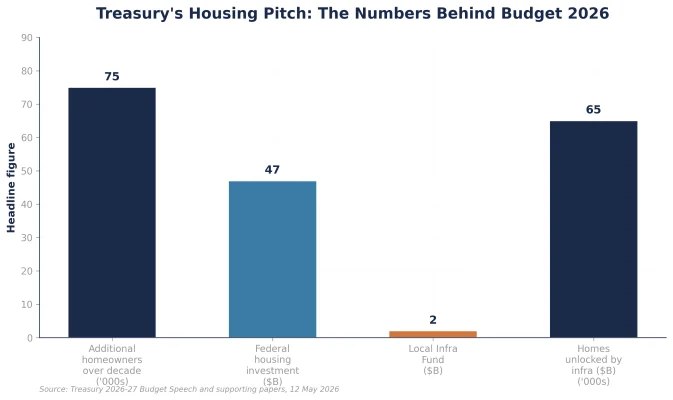
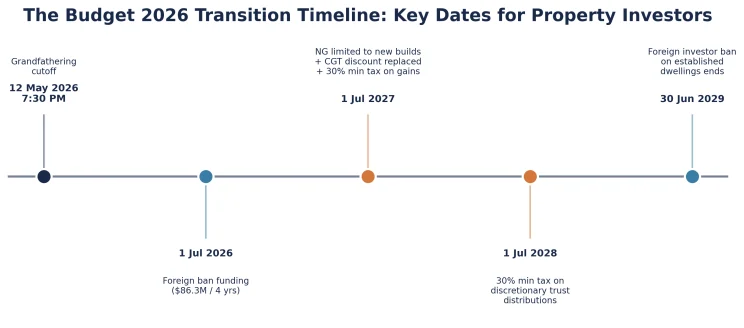
At 7:30 PM AEST on 12 May 2026, Treasurer Jim Chalmers drew a line through Australian property investing. From that exact minute, every residential investment purchase belongs to a different tax regime. The 50% capital gains tax discount that has anchored Australian wealth-building since 1999 will be gone by 1 July 2027, replaced by inflation indexation and a 30% minimum tax on real gains. Negative gearing, the country's most politically protected deduction, will be limited to new builds. Distributions from discretionary trusts, a common holding vehicle for private commercial property, face their own 30% minimum tax from 1 July 2028 (Pitcher Partners, Federal Budget 2026-27: A fundamental shift in Capital Gains Tax). The Treasurer's modelling projects 75,000 additional homeowners over the next decade and lifts federal housing investment to $47 billion, including a $2 billion Local Infrastructure Fund aimed at unlocking 65,000 additional homes (Treasury, 2026-27 Budget Speech).
Having assessed Australian real estate opportunities in both an investment and advisory capacity, including time at Cerberus working on one of the country's largest LLC platforms, I have watched capital re-price around tax regimes before. The 1999 Ralph Review reforms created the negative-gearing-plus-CGT-discount playbook that a generation of Australian investors built portfolios on. The 12 May 2026 package rewrote it. What gets missed in the headline reaction, which has alternated between "investors are dead" and "this changes nothing for institutional capital," is that the budget is neither uniformly bearish nor a free pass. It rewards certain asset types, certain holding vehicles, and certain timing windows, and it penalises others.
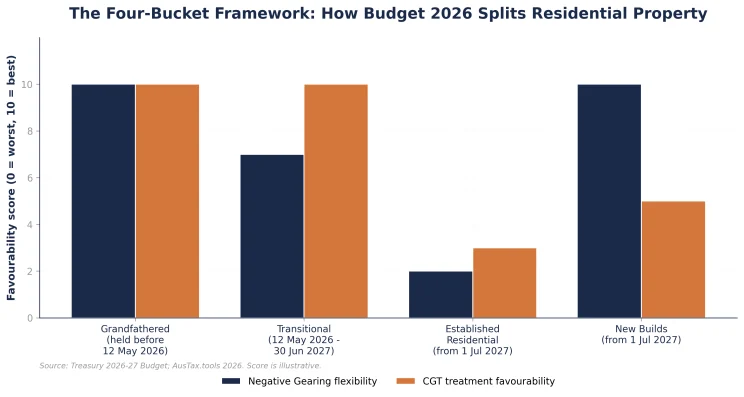
The accurate frame is not winners versus losers in aggregate. It is a four-bucket reallocation: grandfathered holdings, the 12 May 2026 to 30 June 2027 transitional window, post-1 July 2027 established residential, and new builds (AusTax.tools, Federal Budget 2026 Summary). Map your portfolio to the right bucket and the answer to "is this bullish or bearish" becomes obvious. Get the structure wrong and you are paying more tax than you need to for the next decade.
The Market Snapshot: What the Analysts Are Saying
The 12 May package is the most significant overhaul of Australian property tax since the 50% CGT discount was introduced in 1999 (Baker McKenzie, Budget Bites: CGT Discount and Negative Gearing, May 2026). The core measures land in five places.
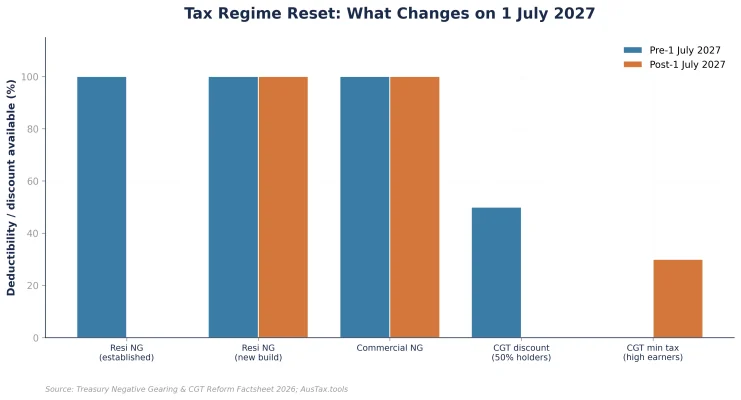
First, the 50% CGT discount is being replaced from 1 July 2027 with cost base indexation linked to CPI, plus a 30% minimum tax rate on real capital gains for assets held 12 months or longer. The change applies to all CGT assets held by individuals, trusts and partnerships, including commercial property, with no new-build carve-out for non-residential assets (William Buck, Federal Budget Analysis 2026: Capital Gains Tax). Main residence and small business CGT concessions are untouched. The 60% discount for qualifying affordable housing is preserved. Superannuation funds keep their one-third discount on 12-month-plus holdings (AusTax.tools, Federal Budget 2026 Summary).
Second, negative gearing will be restricted to new builds from 1 July 2027. Rental losses on established residential properties purchased after 7:30 PM on 12 May 2026 will be quarantined, meaning they can only offset other residential rental income or future capital gains, not wages or business income (Treasury, Negative Gearing and Capital Gains Tax Reform Factsheet). Crucially, commercial property, shares and other asset classes retain full deductibility against any income.
Third, discretionary trust distributions will face a 30% minimum tax rate from 1 July 2028, designed to curb income splitting through low-income beneficiaries. Treasury costings forecast this measure will raise $4.47 billion in 2029-30 alone, as cited in Ray White Commercial's post-budget analysis (Ray White Commercial, What does the 2026 Budget negative gearing changes mean for commercial property investors?, 13 May 2026).
Fourth, the foreign investor ban on established residential dwellings, originally legislated for two years from 1 April 2025, has been extended by a further two years and three months to 30 June 2029, funded by $86.3 million over four years (ATO, Foreign investment: extending the ban on foreign purchases of established dwellings).
Fifth, build-to-rent (BTR), widely held trusts, super funds and SMSFs are explicitly exempted from the negative gearing changes, alongside private investors backing government affordable housing programs (Johnson Winter Slattery, Revised build-to-rent tax concessions).
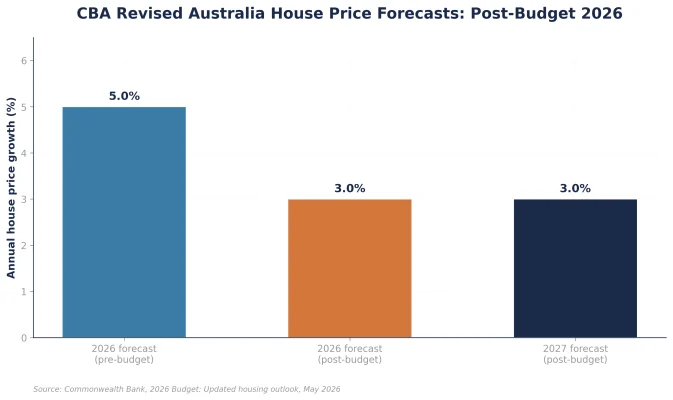
CBA's revised housing outlook quantifies the price impact. The bank now forecasts 3% national price growth for calendar 2026, revised down from 5%, and 3% for 2027. The reforms themselves are projected to leave house prices "just under 3% lower than they otherwise would have been," with the negative gearing and CGT changes specifically subtracting around 0.6 percentage points from 2026 growth and just under 1 percentage point from 2027 (Commonwealth Bank, 2026 Budget: Updated housing outlook). Median rents are projected to rise by approximately $2 per week, a number the Treasury and CBA both describe as "very small and gradual" (Treasury; CBA).
The market reaction has been bifurcated. Residential portfolios with established stock face a clear de-rating. Institutional capital, BTR developers, and commercial owners with the right holding structure are arguably advantaged. The detail is in the structure.
View 1: Capital Will Reroute, Not Retreat
The lazy reading of Budget 2026 is that investors lose. The accurate reading is that capital gets reallocated.
The four-bucket framework determines the direction. Pre-12 May holdings are grandfathered, fully exempt from the negative gearing changes for as long as they are held. The transitional period from 12 May 2026 to 30 June 2027 still allows losses against any income until 30 June 2027, after which the residential-only quarantine kicks in (AusTax.tools, Federal Budget 2026 Summary). Established residential bought from 1 July 2027 onwards is the worst-treated bucket. New builds remain fully geared, indefinitely.
This is a deliberate steering mechanism. The Treasurer's modelling shows the package shifting roughly 75,000 properties from investors to first-home buyers over a decade while simultaneously preserving the negative gearing incentive for anyone willing to add new stock to the market (Treasury, 2026-27 Budget Speech). For institutional capital that already operates at scale in new development, this should be a positioning advantage.
The build-to-rent pipeline is the clearest beneficiary. Australia's BTR pipeline reached 51,000 apartments worth $40.1 billion across operating, under-construction and planning stages as of early 2026, up from 39,300 apartments and $30.1 billion a year earlier, a 30% lift in twelve months (Property Council of Australia industry data, reported in Australian build to rent surges past $40 billion valuation, May 2026). Industry-side projections, including BDO's, suggest the asset class could reach 350,000 apartments over the next decade if institutional capital continues to compound at current rates (BDO, Build to Rent 2026 outlook commentary).
The exemptions stack in BTR's favour. Widely held trusts and superannuation funds are excluded from the new gearing rules. BTR developments are explicitly carved out. Eligible BTR projects already received a 15% managed investment trust withholding rate (reduced from 30%) and a 4% capital works deduction under legislation passed in December 2024, subject to qualifying conditions including 50 or more dwellings, a 15-year minimum hold and a 10% affordable housing allocation (Johnson Winter Slattery, Revised build-to-rent tax concessions). Layer the new federal grandfathering and exemption framework on top, and the relative tax position of institutional BTR versus a leveraged private investor in established residential stock widens materially.
Commercial property occupies a similar zone. Negative gearing changes do not apply to commercial assets at all. Losses remain deductible against any income. That said, the 30% CGT minimum tax does apply, with no new-build carve-out for commercial. Ray White's Vanessa Rader put it directly: "The pivot is not straightforward. Commercial property carries a meaningfully different risk profile" requiring deeper due diligence than residential (Ray White Commercial, 13 May 2026). The point stands, though: a private investor used to running a leveraged residential portfolio is now structurally pushed toward either new builds, BTR-adjacent vehicles, or commercial assets.
View 2: The Structure Tax Hits Hardest
The single most overlooked measure in the budget is the discretionary trust minimum tax. From 1 July 2028, distributions from discretionary trusts will face a 30% minimum rate (AusTax.tools, Federal Budget 2026 Summary). Discretionary trusts are one of the most common holding structures for private commercial property in Australia, alongside unit trusts and corporate vehicles (Ray White Commercial, 13 May 2026). That a residential issue and a CRE issue.
Stack the changes. The 50% CGT discount disappears for trusts on 1 July 2027. The minimum 30% tax on capital gains applies to trusts. Then a year later, the minimum 30% on distributions arrives. For a high-income family running a portfolio of mid-market commercial assets through a discretionary structure, the after-tax IRR compression is real and cumulative.
The mirror image of the structure tax is the structural advantage handed to widely held vehicles. Listed property trusts, REITs, super funds, SMSFs and widely held managed investment trusts are explicitly excluded from negative gearing changes (Treasury, Negative Gearing and Capital Gains Tax Reform Factsheet). Super funds retain their one-third CGT discount on 12-month-plus holdings (AusTax.tools, Federal Budget 2026 Summary).
The practical consequence: capital that is currently in private discretionary trusts faces a strong incentive to migrate toward institutional vehicles, BTR structures, or super-based holdings ahead of the 1 July 2027 and 1 July 2028 effective dates. This is not theoretical. The William Buck note observed that the 50% CGT discount was originally introduced in 1999 "to encourage investment, reduce complexity in the tax system and make Australia more internationally competitive" (William Buck, Federal Budget Analysis 2026: Capital Gains Tax). Stripping it back, layered onto the trust changes, materially changes how Australian private wealth is structured.
From an institutional perspective this is the most interesting line in the budget. The relative cost of capital for institutional and widely held vehicles versus private discretionary trusts has just shifted, in a way that the consensus residential-focused commentary has largely missed. The widely held vehicles that international capital already uses to access Australian property, particularly qualifying MITs, are now also the most tax-efficient option for domestic capital choosing between structures. That convergence is bullish for institutional fundraising and for any platform that can credibly aggregate domestic capital at scale.
View 3: The 18-Month Window Is Where the Real Decisions Get Made
The most actionable item in Budget 2026 is not the policy itself. It is the transition window.
Between now and 30 June 2027, three things are simultaneously true. First, the 50% CGT discount still applies to disposals (Pitcher Partners, Federal Budget 2026-27: Tax reform key dates). Second, established residential properties purchased before 7:30 PM on 12 May 2026 are grandfathered on negative gearing for the life of the holding (Treasury, Negative Gearing and Capital Gains Tax Reform Factsheet). Third, transitional purchases between 12 May 2026 and 30 June 2027 retain full negative gearing flexibility until 30 June 2027 before the quarantine kicks in (AusTax.tools, Federal Budget 2026 Summary).
Three different decisions follow from this.
Holders of established residential who were planning to sell in the next two to three years now face a clear arithmetic: dispose before 1 July 2027 to lock in the 50% discount, or hold and pay 30% minimum on real gains after that date. For long-dated holds the indexation method may actually be more favourable, depending on inflation outcomes. For shorter holds with significant nominal gains, sell. The 12 to 18 month window is the planning horizon (Ray White Commercial, 13 May 2026).
Holders of significant assets in discretionary trusts face a longer planning window, but a more complex one. The trust distribution changes do not arrive until 1 July 2028, but the CGT changes inside the trust apply from 1 July 2027. Restructuring into widely held vehicles, family investment companies, or super structures takes time, particularly where stamp duty and CGT events on transfer need to be modelled.
Developers and BTR platforms are operating in the most favourable window. New builds retain full negative gearing indefinitely and the 50% CGT discount is retained as an option for buyers of newly built residential (Treasury, Negative Gearing and Capital Gains Tax Reform Factsheet). For a developer marketing pre-completion product, the relative attractiveness of new-build stock versus established stock has just been reset in their favour. Capital that was sitting on the sidelines waiting for clarity on CGT and negative gearing now has clarity, and it points toward new construction. CBA's modelling captures this in net terms: the policy combination is projected to leave house prices around 3% lower over time, but that aggregate masks the relative outperformance new builds should see versus established stock (Commonwealth Bank, 2026 Budget: Updated housing outlook).
The window is short. It closes in 13 months for the CGT discount, in 25 months for the trust changes. The cost of inaction is real. The cost of moving early is generally a transaction cost. Most institutional players are already running the numbers.
Where This Goes From Here
The honest answer on Budget 2026 is that it is the most consequential tax change for Australian real estate in 27 years, and the response cannot be uniformly bullish or bearish. It depends entirely on where each asset sits in the four-bucket framework.
Three things I will be watching over the next 18 months.
First, the size of the institutional BTR pipeline beyond the current $40.1 billion. If BTR exemptions are the carrot to redirect private residential capital into institutional rental supply, the test is whether platforms can absorb that capital at scale. A pipeline that doubles from here, toward BDO's 350,000-apartment ten-year projection, would validate the policy design. A pipeline that stalls would suggest the exemptions were necessary but not sufficient.
Second, the legislative passage of the package. The changes need to clear Parliament, and any tax reform package of this scale carries non-trivial implementation risk between announcement and enactment. The 1999 Ralph Review reforms passed in a more bipartisan environment. The current package will be contested in the Senate, and the final shape of grandfathering and exemption rules can shift in committee. Investors making decisions today need a probabilistic view, not a deterministic one.
Third, the secondary effect on commercial values. Commercial property is the underappreciated beneficiary on the negative gearing side and the underappreciated victim on the trust side. The net effect for a typical private CRE investor depends on the holding structure, the loan-to-value ratio, and the expected hold period. For institutional commercial capital, the directional effect is positive. For high-income private investors operating through discretionary trusts, the directional effect is negative. The gap between these two cohorts is widening.
My view: structurally constructive on institutional CRE and BTR, structurally cautious on private leveraged residential. The 12 May package looks bearish on the surface but is in fact a tailwind for institutional capital, build-to-rent platforms, new-build developers and any investor willing to restructure ahead of 1 July 2027. The losers are clearly defined: high-income individuals running leveraged portfolios of established residential through discretionary trusts. The winners are equally clearly defined: widely held vehicles, BTR, new builds, and institutionally-structured commercial.
The investors who read the four-bucket framework correctly and act inside the transitional window will look very smart in 2029. The ones still hoping the changes get rolled back may not.
---
Sai Naicker is the Founder and CEO of CrossCourtAI and a former Australia-based investor at Cerberus Capital and Investment Banker at J.P. Morgan/Barrenjoey. The Property Stack is a weekly newsletter on Real Estate, AI and Alpha.
Sources
1. Treasury, 2026-27 Budget Speech, Parliament House Canberra, 12 May 2026. https://ministers.treasury.gov.au/ministers/jim-chalmers-2022/speeches/2026-27-budget-speech-parliament-house-canberra
2. Treasury, Negative Gearing and Capital Gains Tax Reform Factsheet, May 2026. https://budget.gov.au/content/factsheets/download/tax-explainers-negative-gearing-capital-gains-tax.pdf
3. AusTax.tools, Federal Budget 2026 Summary: Every Tax Measure Announced (2026-27 FY), May 2026. https://austax.tools/tax-insights/federal-budget-2026-summary/
4. William Buck Australia, Federal Budget Analysis 2026: Capital Gains Tax, May 2026. https://williambuck.com/tools/federal-budget-2026/capital-gains-tax/
5. Pitcher Partners, Federal Budget 2026-27: A fundamental shift in Capital Gains Tax: Pre-CGT assets, indexation and minimum tax, May 2026. https://www.pitcher.com.au/insights/federal-budget-2026-27-a-fundamental-shift-in-capital-gains-tax-pre-cgt-assets-indexation-and-minimum-tax/
6. Pitcher Partners, Federal Budget 2026-27: Tax reform key dates, May 2026. https://www.pitcher.com.au/insights/federal-budget-2026-27-tax-reform-key-dates/
7. Baker McKenzie, Australia: Budget Bites: CGT Discount and Negative Gearing, May 2026. https://www.bakermckenzie.com/en/insight/publications/2026/05/australia-budget-bites-cgt-discount-and-negative-gearing
8. Commonwealth Bank of Australia, 2026 Budget: Updated housing outlook, May 2026. https://www.commbank.com.au/articles/newsroom/2026/05/2026-budget-updated-housing-outlook.html
9. Ray White Commercial (Vanessa Rader), What does the 2026 Budget negative gearing changes mean for commercial property investors?, 13 May 2026. https://www.commo.com.au/news/2026/05/13/what-does-2026-budget-negative-gearing-changes-mean-commercial-property-investors
10. Johnson Winter Slattery, Revised build-to-rent tax concessions lay foundations to encourage housing investment. https://jws.com.au/what-we-think/revised-build-to-rent-tax-concessions-lay-foundations-to-encourage-housing-investment/
11. Australian Taxation Office, Foreign investment: extending the ban on foreign purchases of established dwellings. https://www.ato.gov.au/about-ato/new-legislation/in-detail/international/banning-foreign-purchases-of-established-dwellings
12. Perpetual, 2026 Federal Budget: the housing tax shake-up, May 2026. https://www.perpetual.com.au/insights/federal-budget-2026/
13. Property Council of Australia / industry data, Australian build to rent surges past $40 billion valuation, May 2026. https://www.canberratimes.com.au/story/9241508/australian-build-to-rent-surges-past-40-billion-valuation/
14. BDO Australia, Build to Rent 2026 Outlook.