for institutional deal workflows


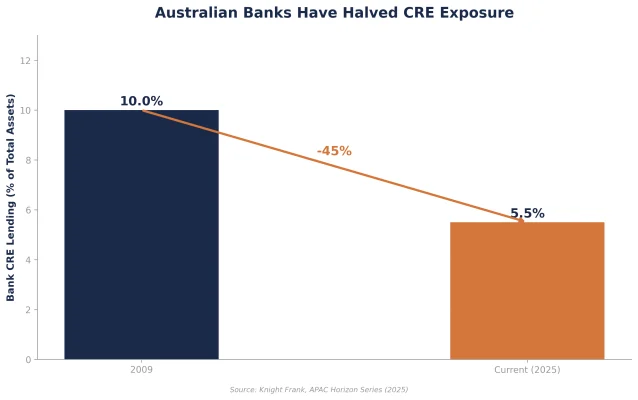
Something fundamental has shifted in how Australian commercial real estate gets funded. Over the past decade, the country's major banks have steadily withdrawn from construction and development lending, cutting their CRE exposure from 10% to 5.5% of total assets (Knight Frank, APAC Horizon Series, 2025). The gap they left behind, now estimated at A$50 billion in private credit outstanding (RBA, Bulletin, February 2026), is being filled by a rapidly growing universe of non-bank lenders. CBRE projects that figure will reach A$90 billion by 2029 (CBRE, Private Credit in Australian Real Estate, 2025).
Having assessed these opportunities in both an investment and advisory capacity, including structuring credit positions across large-scale development portfolios at a global alternative asset manager, the structural case for private credit in Australian CRE is as clear as I have seen it. But the picture is more complex than the headline growth numbers suggest. With ASIC flagging serious governance concerns, construction insolvencies at record highs, and over 100 managers competing for deal flow, the gap between disciplined lenders and reckless capital has never been wider.
This article examines what the brokers are reporting, where the genuine structural tailwinds lie, and where the risks are building beneath the surface.
The Market Snapshot: What the Brokers Are Saying
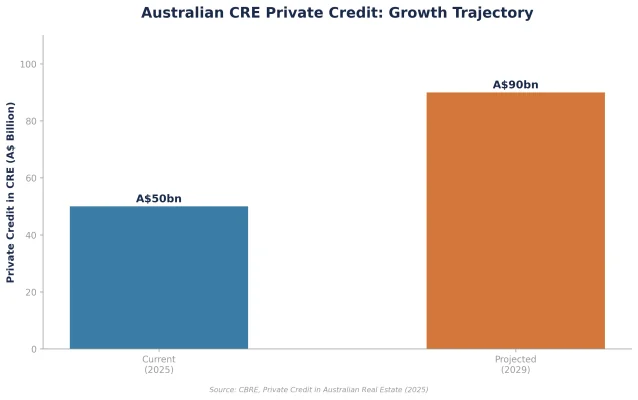
The consensus among major brokers is clear: private credit in Australian CRE is in a structural growth phase, not a cyclical blip.
CBRE estimates that private credit currently funds approximately A$50 billion in Australian real estate (CBRE, Private Credit in Australian Real Estate, 2025). The firm projects this will grow to A$90 billion by 2029, driven primarily by residential development lending. Private credit already provides funding for over a quarter of all residential construction in Australia (CBRE, Private Credit in Australian Real Estate, 2025). Notably, the Top 10 private credit providers currently hold an 85% market share, suggesting the market remains concentrated despite over 100 active managers (CBRE, Private Credit in Australian Real Estate, 2025; Broadridge, 2025).
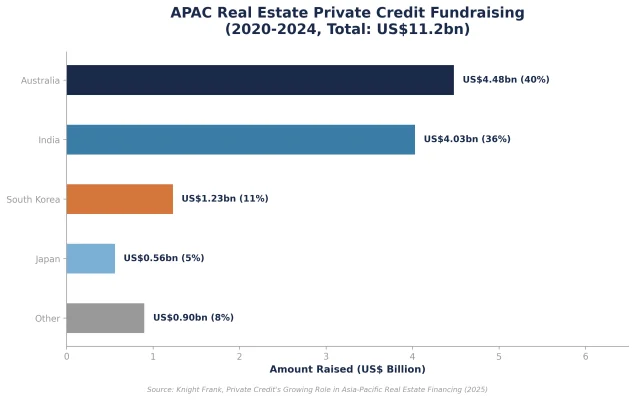
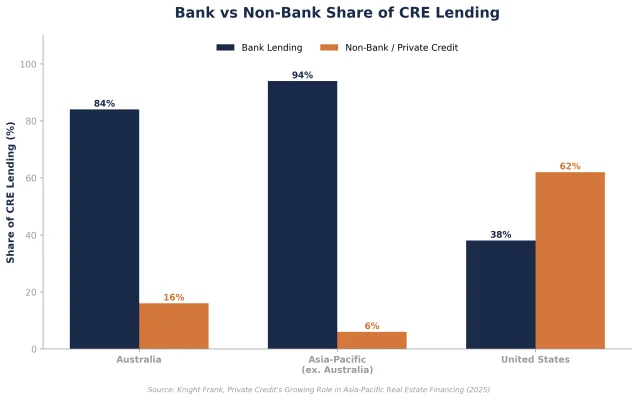
Knight Frank reports that Australia captured 40% of the US$11.2 billion in APAC real estate private credit raised between 2020 and 2024, making it the dominant market in the region (Knight Frank, Private Credit's Growing Role in Asia-Pacific Real Estate Financing, 2025). Private credit now accounts for approximately 16% of total CRE lending in Australia, with major bank share dropping from 87% to 75% (Knight Frank, APAC Horizon Series, 2025). The firm projects a total growth opportunity of US$90 to US$110 billion across Australia, Hong Kong SAR, India, and South Korea over the next three years, with Australia representing nearly 50% of that expansion (Knight Frank, APAC Horizon Series, 2025). Credit funds generally target returns of 3-6.5% above the RBA cash rate, translating to net returns of 9-12% (Knight Frank, APAC Horizon Series, 2025).
Alvarez & Marsal sizes Australia's total private debt market at A$224 billion in assets under management, a 9% year-on-year increase, comprising A$132 billion in corporate lending and A$92 billion in CRE lending (Alvarez & Marsal, Australian Private Debt Market Review 2025). CRE private lending now accounts for approximately 18% of the domestic CRE lending market (Alvarez & Marsal, Australian Private Debt Market Review 2025).
The Reserve Bank of Australia takes a more conservative view, estimating private credit at approximately A$50 billion in credit outstanding as of December 2025, while acknowledging significant data gaps (RBA, Bulletin, February 2026). The central bank characterises private credit growth as reflecting both cyclical and structural factors, suggesting the trend is likely to persist.
What is notable across all these reports is the consistency of the underlying narrative: banks are pulling back structurally, not temporarily. The combination of Basel III capital requirements, APRA's tightening stance, and the new debt-to-income cap introduced in February 2026 (APRA, 2026) means traditional lenders are unlikely to reverse course. The question is no longer whether private credit will fill the gap, but how large that gap will ultimately become.
View 1: Private Credit Is the New Bank for Australian Development
The most significant structural shift in Australian CRE finance over the past decade is not a change in interest rates or cap rates. It is the permanent withdrawal of major banks from construction and development lending.
Since 2009, banks have halved their CRE exposure from 10% to 5.5% of total assets (Knight Frank, APAC Horizon Series, 2025). This is not a cyclical adjustment. It reflects a deliberate strategic pivot driven by regulatory capital requirements that make construction lending prohibitively expensive for bank balance sheets. APRA's risk-weight frameworks, combined with Basel III liquidity requirements, have made every dollar of construction lending significantly more capital-intensive than a standard residential mortgage or corporate facility.
The result is a permanent funding vacuum. The scale of this under-penetration is striking. In Australia, private credit accounts for less than 20% of CRE lending. In the United States, non-bank lenders now account for 62% of all CRE funding, with banks providing just 38% (Knight Frank, Private Credit's Growing Role in Asia-Pacific Real Estate Financing, 2025). Across Asia-Pacific more broadly, 94% of lending still flows through banks, a stark contrast to the US model (Knight Frank, Private Credit's Growing Role in Asia-Pacific Real Estate Financing, 2025).
This convergence thesis is not about Australia becoming the US overnight. It is about recognising that the structural conditions, bank retreat from construction, regulatory pressure, and growing institutional appetite for yield, are directionally identical. Australia's private credit market is where the US market was 15 years ago, and the trajectory from here is upward.
For borrowers, particularly mid-market developers who have historically relied on relationship banking, the shift is already being felt. Non-bank lenders now fund over a quarter of all residential construction nationally (CBRE, Private Credit in Australian Real Estate, 2025). For disciplined lenders, this means a deep, recurring pipeline of transactions in a market where banks have structurally reduced competition.
View 2: Australia's Construction Insolvency Crisis Is Private Credit's Greatest Filter
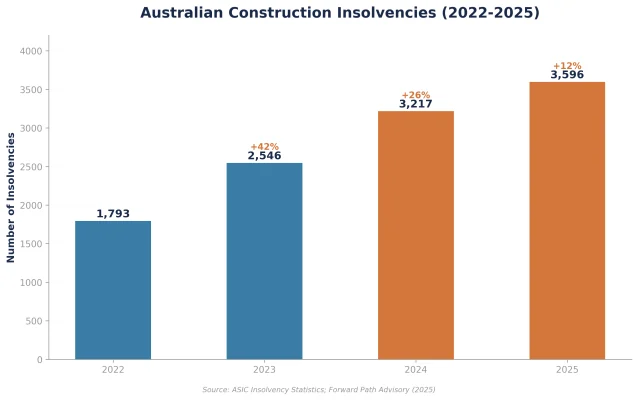
At first glance, this looks like a terrible backdrop for lending into the sector. But for disciplined private credit operators, the construction insolvency wave has actually strengthened the market in three important ways.
First, it has eliminated undercapitalised developers. The builders who failed, largely exposed to fixed-price contracts during a period of extreme cost volatility, were precisely the counterparties that sophisticated lenders had already avoided. The surviving developer base is, on balance, better capitalised, more experienced, and more realistic about project economics.
Second, it has increased pricing power for lenders. With fewer developers capable of securing and delivering projects, and banks continuing to retreat, the supply of quality borrowers has tightened relative to demand. Credit funds targeting 3-6.5% above the RBA cash rate are not extracting supernormal returns; they are being fairly compensated for real risk in a market with limited competition (Knight Frank, APAC Horizon Series, 2025).
Third, it has forced regulatory attention that benefits the entire ecosystem. ASIC's REP 814 report, released in September 2025, flagged concerns about valuation practices, conflicts of interest, and portfolio transparency among private credit managers (ASIC, REP 814: Private Credit in Australia, September 2025). The regulator noted that real estate-focused funds constitute approximately 50% of the private credit market, including the riskier end of construction and development finance (ASIC, REP 814, 2025). While some view ASIC's scrutiny as a headwind, the professionalisation it demands, independent valuations, transparent fee structures, arm's-length dealings, will ultimately separate institutional-grade lenders from the rest.
The construction insolvency crisis is not a reason to avoid private credit. It is the catalyst that is cleaning up both the borrower base and the lender base simultaneously.
View 3: The Housing Undersupply Makes CRE Private Credit a Policy Imperative
Australia's National Housing Accord set an ambitious target of 1.2 million new homes by June 2029. The National Housing Supply and Affordability Council now forecasts that only 938,000 will be delivered, a shortfall of 262,000 dwellings (NHSAC, State of the Housing System Report, 2025). Over the first 15 months of the Accord period, 81,000 fewer homes were constructed than the target pace required (NHSAC, State of the Housing System Report, 2025).
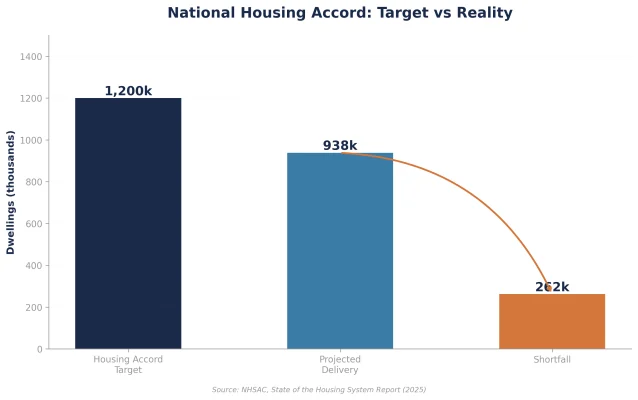
No state or territory is on track to meet its targets. The gap between political ambition and construction reality is widening, not narrowing.
This creates a straightforward policy imperative: if Australia needs to build significantly more housing, and the banks are not going to fund the construction, then private credit is not merely an "alternative" funding source. It is an essential component of national housing delivery.
The mathematics are simple. With CBRE estimating that private credit already funds over a quarter of all residential construction (CBRE, Private Credit in Australian Real Estate, 2025), any meaningful acceleration of the housing pipeline requires a corresponding expansion of non-bank lending capacity. Tightening regulation in a way that constrains private credit flows to development would directly undermine the housing targets that both federal and state governments have committed to.
This does not mean private credit should operate without oversight. ASIC's concerns about valuation practices and transparency are legitimate and necessary. But the regulatory framework needs to distinguish between protecting retail investors from opaque fund structures and constraining the flow of institutional capital into development lending. The two objectives require different instruments.
For private credit managers with institutional governance, independent valuations, and genuine development lending expertise, the policy environment is supportive. The government needs their capital to flow. The question is whether the regulatory framework can mature fast enough to match the market's growth.
Where This Goes From Here
The structural case for private credit in Australian CRE is compelling. Bank withdrawal is permanent. The housing pipeline is vast and underfunded. Australia remains dramatically under-penetrated relative to the US market. And for disciplined lenders with genuine underwriting capability, the risk-adjusted returns remain attractive.
But "cautiously bullish" is my view not "all in." Three risks warrant close attention.
First, the AUM-to-deployment gap. Alvarez & Marsal sizes the market at A$224 billion in AUM (Alvarez & Marsal, Australian Private Debt Market Review 2025), while the RBA estimates just A$50 billion in credit outstanding (RBA, Bulletin, February 2026). That divergence demands scrutiny. Dry powder sitting in funds earning management fees is not the same as capital deployed in quality transactions.
Second, the retail distribution question. ASIC's findings in REP 814 about opaque valuations, self-dealing, and inconsistent investor treatment relate disproportionately to retail-facing funds (ASIC, REP 814, September 2025). The institutionalisation of the market is a positive trend; the democratisation of it, without adequate transparency, is not.
Third, concentration risk. With over 100 managers but the Top 10 holding 85% market share (CBRE, Private Credit in Australian Real Estate, 2025), the tail of smaller operators is long and fragmented.
My view: cautiously bullish over the medium term. The A$50 billion-to-A$90 billion trajectory is data-backed, and for lenders with institutional-grade governance, deep development expertise, and rigorous independent valuations, this is one of the most attractive credit markets in Asia-Pacific. But this is a market that rewards discipline, not enthusiasm. The margin of safety comes from underwriting quality, not from the tailwind alone.
---
Sai Naicker is an investor and advisor in Australian CRE and proptech, with a background in institutional credit and alternative asset management. He writes The Property Stack, a newsletter covering real estate, AI, and alpha.
---
Sources
1. CBRE, Private Credit in Australian Real Estate (2025) - https://www.cbre.com.au/insights/reports/private-credit-in-australian-real-estate
2. Knight Frank, Private Credit's Growing Role in Asia-Pacific Real Estate Financing, APAC Horizon Series (2025) - https://apac.knightfrank.com/horizon/content/private-credits-growing-role-in-asia-pacific-real-estate-financing
3. Knight Frank, Australia's Private Credit Market Set for Sustained Growth as Traditional Lending Tightens (2025) - https://apac.knightfrank.com/horizon/content/australias-private-credit-market-set-for-sustained-growth-as-traditional-lending-tightens
4. Alvarez & Marsal, Australian Private Debt Market Review 2025 - https://www.alvarezandmarsal.com/thought-leadership/australian-private-debt-market-review-2025
5. Reserve Bank of Australia, Recent Changes in Credit Markets and Their Implications for Monetary Policy, Bulletin (February 2026) - https://www.rba.gov.au/publications/bulletin/2026/feb/recent-changes-in-credit-markets-and-their-implications-for-monetary-policy.html
6. ASIC, REP 814: Private Credit in Australia (September 2025) - https://www.asic.gov.au/regulatory-resources/find-a-document/reports/rep-814-private-credit-in-australia/
7. ASIC Insolvency Statistics - https://www.asic.gov.au/about-asic/corporate-publications/statistics/insolvency-statistics/
8. Forward Path Advisory, Building Company Insolvencies in Australia: May 2023 to May 2025 (2025) - https://www.forwardpathadvisory.com.au/2025/05/30/building-company-insolvencies-in-australia-may-2023-to-may-2025/
9. National Housing Supply and Affordability Council, State of the Housing System Report (2025) - https://nhsac.gov.au/news/release-state-housing-system-report-2025
10. Broadridge, Australia's Booming Private Credit Market: Growth, Challenges, and the Future (2025) - https://www.broadridge.com/article/asset-management/australias-booming-private-credit-market-growth-challenges-and-the-future
11. APRA, Debt-to-Income Lending Limits (February 2026) - https://www.apra.gov.au/news-and-publications/apra-to-limit-high-debt-to-income-home-loans-to-constrain-riskier-lending