for institutional deal workflows

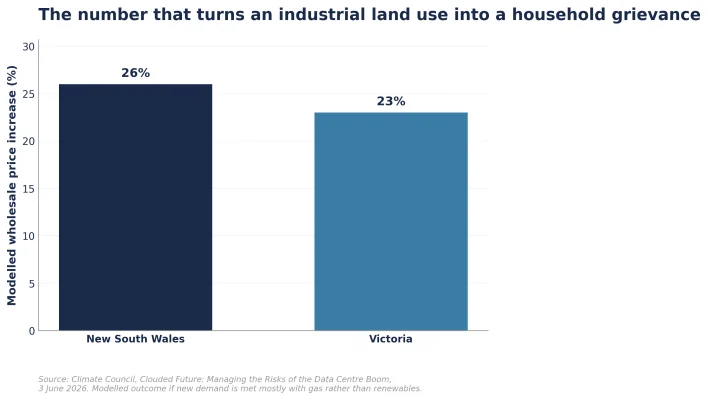
On 3 June 2026, the Climate Council published modelling with a single number in the headline. If new data centre demand in New South Wales and Victoria is met mostly with gas rather than renewables, wholesale electricity prices could rise 26% in NSW and 23% in Victoria by 2035 (Climate Council, Clouded Future: Managing the Risks of the Data Centre Boom, 3 June 2026).
Whether that figure survives scrutiny matters less in my opinion. What matters to anyone holding data centre exposure is that the number now exists, it is attributed to a credible body, and it connects a class of industrial asset to a household power bill. That connection is the key risk. It has been made, it will be repeated through a NSW parliamentary inquiry reporting in September and a Senate inquiry running alongside it, and it will be made in front of every council and consent authority assessing a data centre development application for the next five years.
Almost every data centre model I see stress-tests grid capacity, connection timing and power cost. Very few stress-test the political durability of the approval. Power availability is a capital problem, and capital problems get solved. Public tolerance is not a capital problem, and when it binds, it binds absolutely.
The Market Snapshot: What the Brokers Are Saying
The sector's own data has quietly become the case against it, which is an unusual position for a growth asset class.
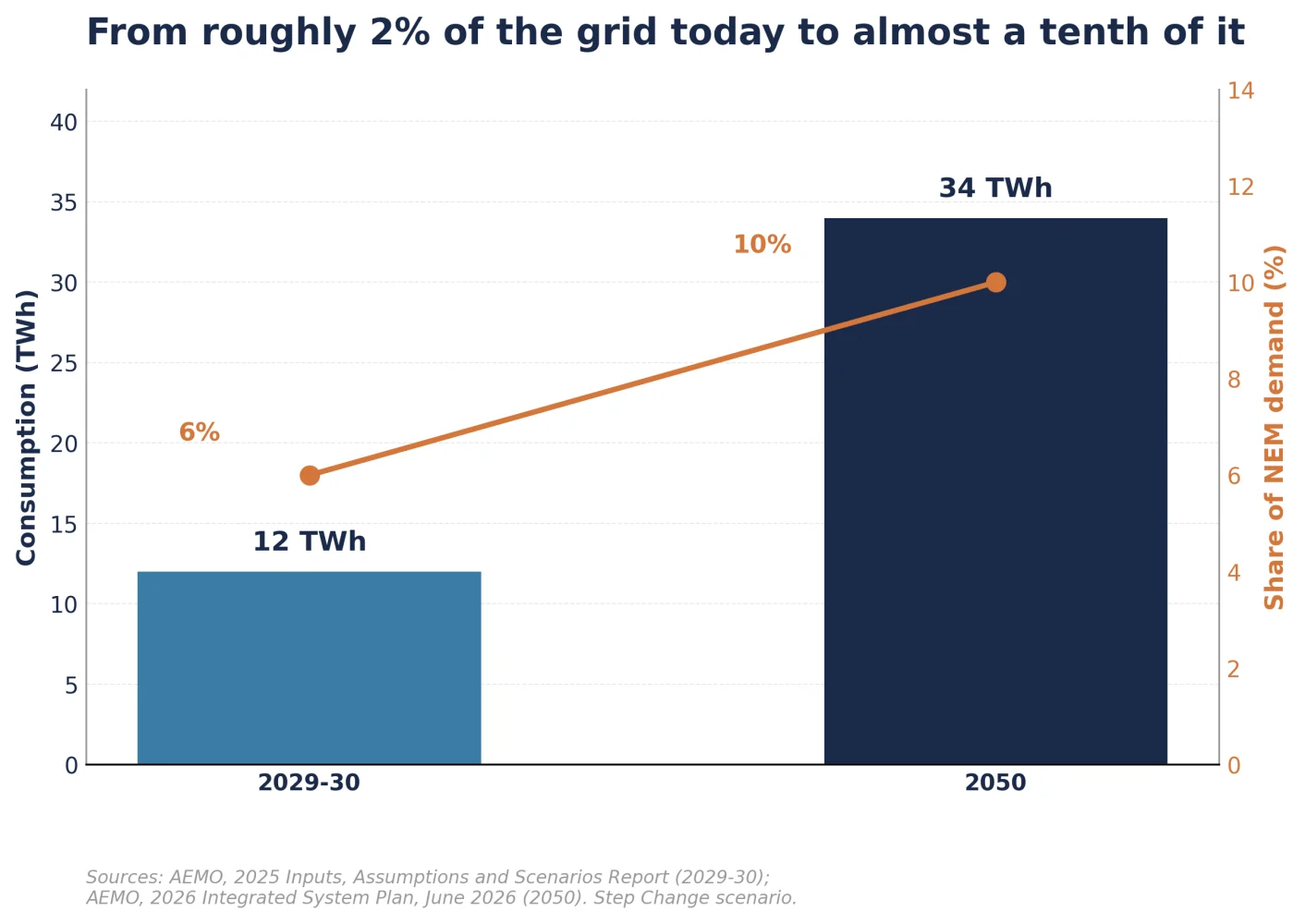
AEMO now treats data centres as a system-planning input rather than a demand footnote. Its 2026 Integrated System Plan, released in June 2026, identifies data centres as one of the defining drivers behind a near doubling of electricity consumption across the National Electricity Market over the next 25 years. Data centres account for around 2% of grid-supplied consumption today. Under the Step Change scenario they grow at an average of 25% year on year to reach around 12 TWh by 2029-30, equivalent to 6% of the NEM's grid-supplied electricity (AEMO, 2025 Inputs, Assumptions and Scenarios Report), and around 34 TWh by 2050, or almost 10% of total underlying demand (AEMO, 2026 Integrated System Plan, June 2026).
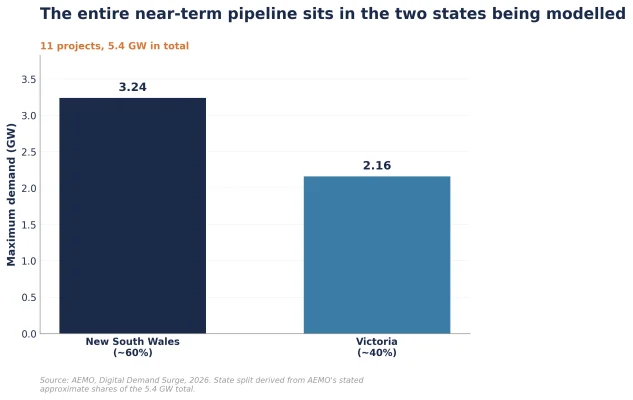
The near-term pipeline is concentrated in exactly the two states the price modelling covers. At the end of the March 2026 quarter, 11 large-scale projects of more than 5 MW each, representing 5.4 GW of maximum demand, were progressing through the transmission connection process, with around 60% of that capacity in New South Wales and 40% in Victoria (AEMO, Digital Demand Surge, 2026).
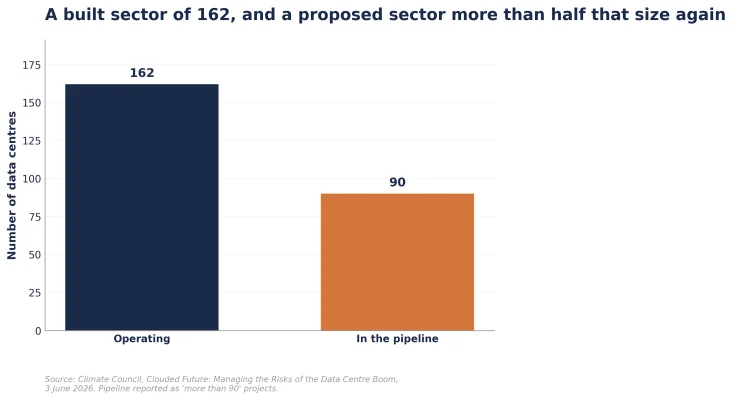
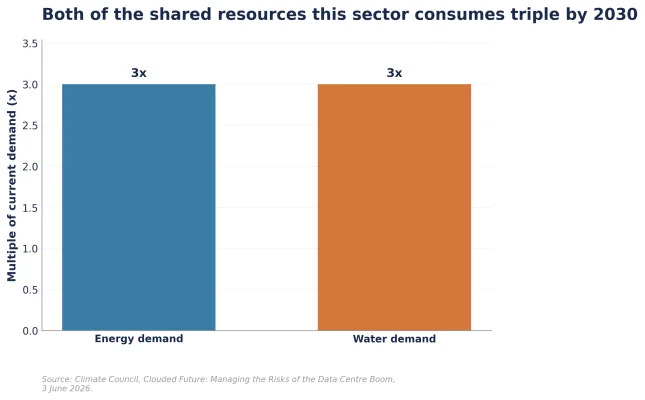
The Climate Council puts the installed base at 162 data centres operating nationally with more than 90 projects in the pipeline, and notes that data centre electricity demand grew 18% in NSW and nearly doubled in Victoria over the twelve months to mid-2026. Its modelling also finds national grid emissions would run roughly 14% higher in 2035 than under a renewables-led path, and that water demand for cooling is projected to triple by 2030, with single-site connection requests received for up to 40 million litres a day (Climate Council, 3 June 2026).
CBRE continues to report a supply shortfall of roughly 0.7 to 1.7 GW by 2028 against demand of 2.5 to 3.5 GW, with national vacancy at 12% (CBRE, via W.Media, 2026). Knight Frank still ranks Australia second globally for data centre investment (Knight Frank, Global Data Centres Report, 2025).
View 1: Social Licence Binds Before Power Does
There is a reason the 40 million litres a day figure appears in the Climate Council's release and not in any broker report. It is not a market statistic. It is a campaign statistic, and it is devastatingly effective at a council meeting.
This is the asymmetry the sector has not priced. A grid constraint is negotiated with AEMO, a network service provider and a generator, over a defined process, by people who are paid to reach a commercial outcome. A social licence constraint is negotiated with everybody, over an undefined period, by people who are not obliged to reach any outcome at all. The first is a schedule risk. The second is a binary one.
The 26% is the number that makes the second kind of risk operative, because it converts an industrial land use into a line on a household bill.
The direction of travel in policy confirms which one governments now consider live. The federal expectations framework released in March 2026 addresses placement, energy and water. The Prime Minister's 15 July commitment requires large-scale facilities to pay full grid connection costs with no pass-through to households or other businesses, and to reduce consumption when the system is under strain (PV Tech, 15 July 2026). On 29 July, energy ministers agreed to mandate that data centres offset their demand through additional renewable generation, with all jurisdictions signing except Queensland and the Northern Territory (SBS News, 29 July 2026). Every one of those measures is a response to the same political problem: the perception that this sector consumes shared infrastructure and exports the cost.
New South Wales has published its own five principles for the sector, and the sustainability elements read as a list of what communities have already objected to: avoiding sensitive areas near schools and residential zones, discouraging diesel generators on air quality grounds, and promoting recycled water infrastructure to reduce pressure on drinking water supplies (Johnson Winter Slattery, 2026). Those are not energy policies. They are amenity policies, which means they are planning policies, which means they attach to consent.
If you are underwriting a site today, the question is not whether power arrives. It is whether the community between your site and the substation has a reason to object, and whether your proponent has given them one.
View 2: The Cost Allocation Question Is Already Answered
"Who pays for the grid" is being treated as an open policy debate. It is not. It has been answered, in the same direction, at both federal and state level, and the answer is that the proponent pays.
The federal position requires full grid connection costs to be borne by the facility with no pass-through (PV Tech, 15 July 2026). The second of New South Wales' five principles is that developers fund all infrastructure upgrades, with cost recovery from data centre proponents rather than retail consumers (Johnson Winter Slattery, 2026). Add the 29 July additionality obligation on top and the position is consistent: new load funds the network and generation it requires.
For a real estate investor, that resolves into three specific line items that most Australian data centre feasibilities I have seen still treat as either shared or contingent.
The first is network augmentation capex, borne in full rather than socialised across the network tariff base. The second is new generation, whether financed directly or contracted through a long-dated PPA, which is a balance sheet commitment with a duration that may exceed the tenant's lease. The third is the least discussed and, I would argue, the most consequential.
A demand response obligation, the requirement to curtail consumption when the grid is under strain, is an operational constraint on the facility. Follow it through the capital stack. An operational constraint on the facility affects the service level the operator can offer. The service level is the substance of the colocation agreement or lease. The lease is the income stream. The income stream is what the valuation capitalises and what the debt covenants are sized against. A rule written as an energy market measure ends up, four steps later, sitting inside the lease covenant.
That chain is the single most important thing for a real estate audience to understand about this policy cycle, and it is not being drawn in research I have read.
View 3: Approval Duration Is Where Social Licence Gets Priced
If social licence is difficult to model, its consequence is not. It shows up as time, and time is the input every institutional investor already knows how to price. The comparison is stark. State Significant Development assessments in New South Wales currently take close to two years. Victoria assessed and approved NEXTDC's Port Melbourne development in 75 days (Johnson Winter Slattery, 2026).
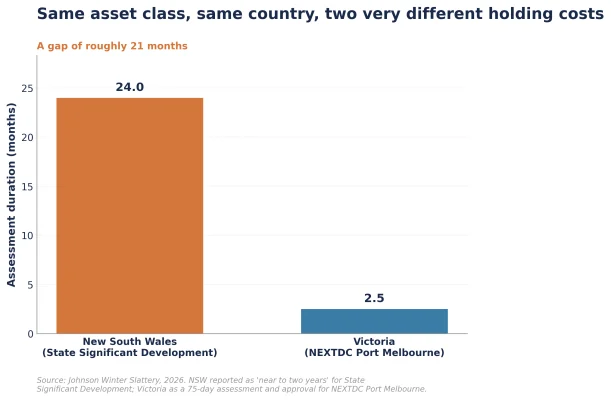
Twenty-one months of additional holding cost, on a site of the scale these projects require, is not a procedural inconvenience. It is a material difference in land value between two states, and it explains the Melbourne shift more completely than land price or power availability alone.
New South Wales knows this, which is why the Investment Delivery Authority exists. On 27 March 2026 the state endorsed 15 data centre projects worth A$51.9 billion for expedited assessment, and set aside a further A$40.7 billion of proposals as premature or overly speculative (NSW Government, 27 March 2026; Johnson Winter Slattery, 2026). That is a fast lane and a filter operating together, and the filter is the more interesting half. Roughly 44% of the value presented to the state's own priority process did not pass it.
The political salience scales with the capital. Data centre investment in New South Wales has grown 65% a year on average over the past three years, reaching A$2.6 billion in 2024-25, and now represents 12% of all non-residential building development in the state (Johnson Winter Slattery, 2026). A sector at 12% of non-residential development is no longer a niche that can be approved quietly. It is a visible land use with a constituency, and visible land uses with constituencies get inquiries.
Where This Goes From Here
There is a date to underwrite to, and it is 30 September 2026.
The New South Wales Legislative Council's Public Accountability and Works Committee is required to report on its data centre inquiry by then. Submissions closed on 27 March 2026 and hearings ran in May. Its terms of reference span planning frameworks, electricity demand and grid impact, emissions targets, water usage and community impact (Johnson Winter Slattery, 2026; Clayton Utz, 2026). It is the first inquiry of its kind in Australia, in the state holding around 60% of the national transmission connection queue (AEMO, Digital Demand Surge, 2026), and its recommendations are widely expected to inform the Commonwealth and the other states. A Senate inquiry into AI and data centres is running in parallel (Clayton Utz, May 2026).
That report will not change electricity physics. It will change the conditions attached to consent, and conditions attached to consent are what determine whether an announced project becomes a built one.
My view: cautiously bullish on the assets, considerably more cautious on the pipeline. The operating stock is scarce, pre-committed and difficult to replicate, and everything in this article makes replication harder, which is good for whoever already owns capacity. What I would not do is capitalise announced pipeline at anything resembling the value of operating capacity. The gap between the two is now a political variable, and political variables do not compress on a schedule.
The sector spent the last three years competing for power. It is about to spend the next three competing for permission, and permission has no queue position, no connection agreement and no price you can hedge.
Every data centre model in the country has a line for the cost of electricity. Almost none has a line for the cost of being politically unpopular.
--
--
Sources
1. Climate Council, "Clouded Future: Managing the Risks of the Data Centre Boom," 3 June 2026. https://www.climatecouncil.org.au/resources/clouded-future-managing-the-risks-of-the-data-centre/
2. Climate Council, "Data centre boom risks 26% jump in power prices and more pollution," 3 June 2026. https://www.climatecouncil.org.au/resources/data-centre-boom-risks-26-jump-in-power-prices-more-pollution/
3. AEMO, "2026 Integrated System Plan," June 2026. https://www.aemo.com.au/energy-systems/major-publications/integrated-system-plan-isp/2026-integrated-system-plan-isp
4. AEMO, "Digital demand surge: Preparing Australia's power systems for the rise of data centres," 2026. https://www.aemo.com.au/newsroom/news-updates/digital-demand-surge
5. W.Media, "AEMO: Data centres could account for almost 10% of NEM electricity demand by 2050," 2026. https://w.media/aemo-data-centres-could-account-for-almost-10-of-nem-electricity-demand-by-2050/
6. CBRE, "Australia among world's leading data centre hubs," via W.Media, 2026. https://w.media/australia-among-worlds-leading-data-centre-hubs-cbre/
7. PV Tech, "Australia to legally require large data centres to become net-generators of renewable energy," 15 July 2026. https://www.pv-tech.org/australia-to-legally-require-large-data-centres-to-become-net-generators-of-renewable-energy/
8. SBS News, "The new plan to prevent data centres from driving power prices up," 29 July 2026. https://www.sbs.com.au/news/article/new-plan-prevent-data-centres-driving-power-prices-up/j0li5asyx
9. Johnson Winter Slattery, "Data centre development focus: 'dirt to tokens', planning approval speed and maintaining social licence," 2026. https://jws.com.au/what-we-think/data-centre-development-focus-dirt-to-tokens-planning-approval-speed-and-maintaining-social-licence/
10. Clayton Utz, "Data centre of attention: unpacking NSW's data centre inquiry's possible moves," April 2026. https://www.claytonutz.com/insights/2026/april/data-centre-of-attention-unpacking-nsws-data-centre-inquirys-possible-moves
11. Clayton Utz, "Watts on the line? Unpacking the Senate's data centre and AI inquiry," May 2026. https://www.claytonutz.com/insights/2026/may/watts-on-the-line-unpacking-the-senates-data-centre-and-ai-inquiry
12. NSW Government, "NSW Government backs data centre investment, sets course for sustainable development," 27 March 2026. https://www.nsw.gov.au/ministerial-releases/data-centre-investment-sustainable-development
13. W.Media, "NSW moves 15 data centres worth AUD 51.9bn into IDA pipeline," 2026. https://w.media/nsw-moves-15-data-centres-worth-aud-51-9bn-into-ida-pipeline/
14. CBRE, "Global Data Center Trends 2026," CBRE Research, 2026. https://www.cbre.com/insights/reports/global-data-center-trends-2026
15. Knight Frank, "Global Data Centres Report 2025," via W.Media, 2025. https://w.media/knight-frank-report-identifies-australia-as-second-only-to-the-usa-as-data-centre-investment-destination/
16. Australian Government, Minister for Industry and Innovation, "An Australian approach to AI: Expectations for data centres that deliver for Australians," March 2026. https://www.minister.industry.gov.au/ministers/timayres/media-releases/australian-approach-ai-expectations-data-centres-deliver-australians
17. AEMC, "AEMC proposes new grid standards for data centre connections," March 2026. https://www.aemc.gov.au/news-centre/media-releases/aemc-proposes-new-grid-standards-data-centre-connections
18. AEMO, "2025 Inputs, Assumptions and Scenarios Report," 2025. https://www.aemo.com.au/energy-systems/major-publications/integrated-system-plan-isp/2026-integrated-system-plan-isp