for institutional deal workflows

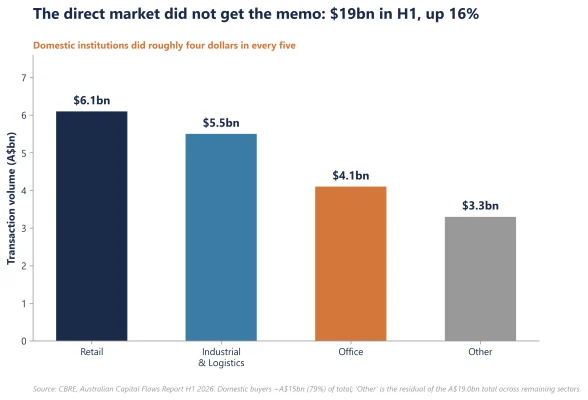
Australia is currently running two markets for the same buildings, and they disagree about the price. In the direct market, transaction volumes rose 16% to A$19.0 billion in the first half of 2026, with domestic institutions doing roughly 80% of activity (CBRE, Australian Capital Flows Report H1 2026). In the listed market, the S&P/ASX 200 A-REIT index has fallen 9.7% over the past 12 months (Market Index, Aug 2026), leaving several of the country's largest landlords trading at discounts to net tangible assets that range from par to more than 35%.
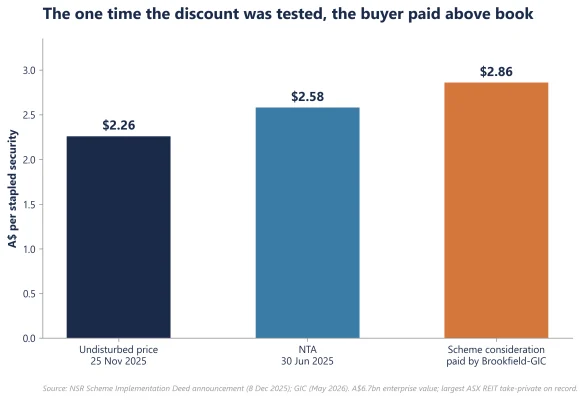
The consensus explanation is fair: the screen is right, the valuers are behind, and direct book values are due a markdown. Having discussions with fund managers on both the public and private side, I think the evidence now actually points the other way. The one time the discount was properly tested at scale, the private market paid above book.
That test was National Storage REIT. Before the bid, the securities traded at $2.26, roughly 12% below the June 2025 NTA of $2.58. Brookfield and GIC paid $2.86, a 10.9% premium to that NTA and a 26.5% premium to the undisturbed price, in a scheme valuing the business at A$6.7 billion of enterprise value, the largest take-private of an ASX-listed REIT on record (NSR Scheme Implementation Deed, Dec 2025; GIC, May 2026). The listed market said the assets were overvalued. The buyers who could see the assets paid a premium to book. That gap, between the price of the wrapper and the price of the bricks, is what this edition is about.
The Market Snapshot: What Results Season Just Told Us
The August 2026 results season gave the clearest read yet on the dislocation, because operationally the sector is fine.
Dexus delivered FY26 AFFO of 45.0 cents per security with office occupancy of 95.7%, well above the market, and NTA of $8.92, up 1% (Dexus, 2026 Annual Results, Aug 2026). The securities closed at $5.78 on 27 August (stockanalysis.com), roughly 35% below NTA.
Mirvac lifted operating profit 7% to $508 million, reported NTA of $2.33 with headline gearing down to 24.1%, noted that NTA has returned to growth, and launched a $200 million buy-back (Mirvac, FY26 Full-Year Result, Aug 2026). The securities closed at $1.82 on 27 August (stockanalysis.com), about 22% below that NTA.
Stockland beat guidance with FFO of $892 million, up 10.4%, NTA of $4.39, up 4%, and gearing cut to 22.7%; the market rewarded the development-led result, with the securities surging 14% on results day (Capital Brief, 19 Aug 2026), and at the 27 August close of $4.42 they sit right at NTA (Stockland, FY26 Results; stockanalysis.com). GPT grew half-year FFO 5% to $338.8 million at 97.6% portfolio occupancy, with NTA of $5.61 at June 2026 (GPT, 2026 Interim Result, 17 Aug 2026); at the 27 August close of $4.65 the securities sit roughly 17% below it (stockanalysis.com).
Down the market-cap curve the discounts widen. Dexus Industria closed 27 August at $2.37, roughly 31% below its $3.42 NTA (stockanalysis.com; Investing.com, Aug 2026). Dexus Convenience Retail closed at $2.75, around 29% below its $3.86 NTA, and responded by doubling its buy-back to 5% of securities on issue (stockanalysis.com; Investing.com, Aug 2026). Meanwhile the NTAs themselves are rising, not falling: Charter Hall Retail's NTA jumped 8.4% and Dexus Convenience Retail's rose 6% over FY26 (Investing.com, Aug 2026).
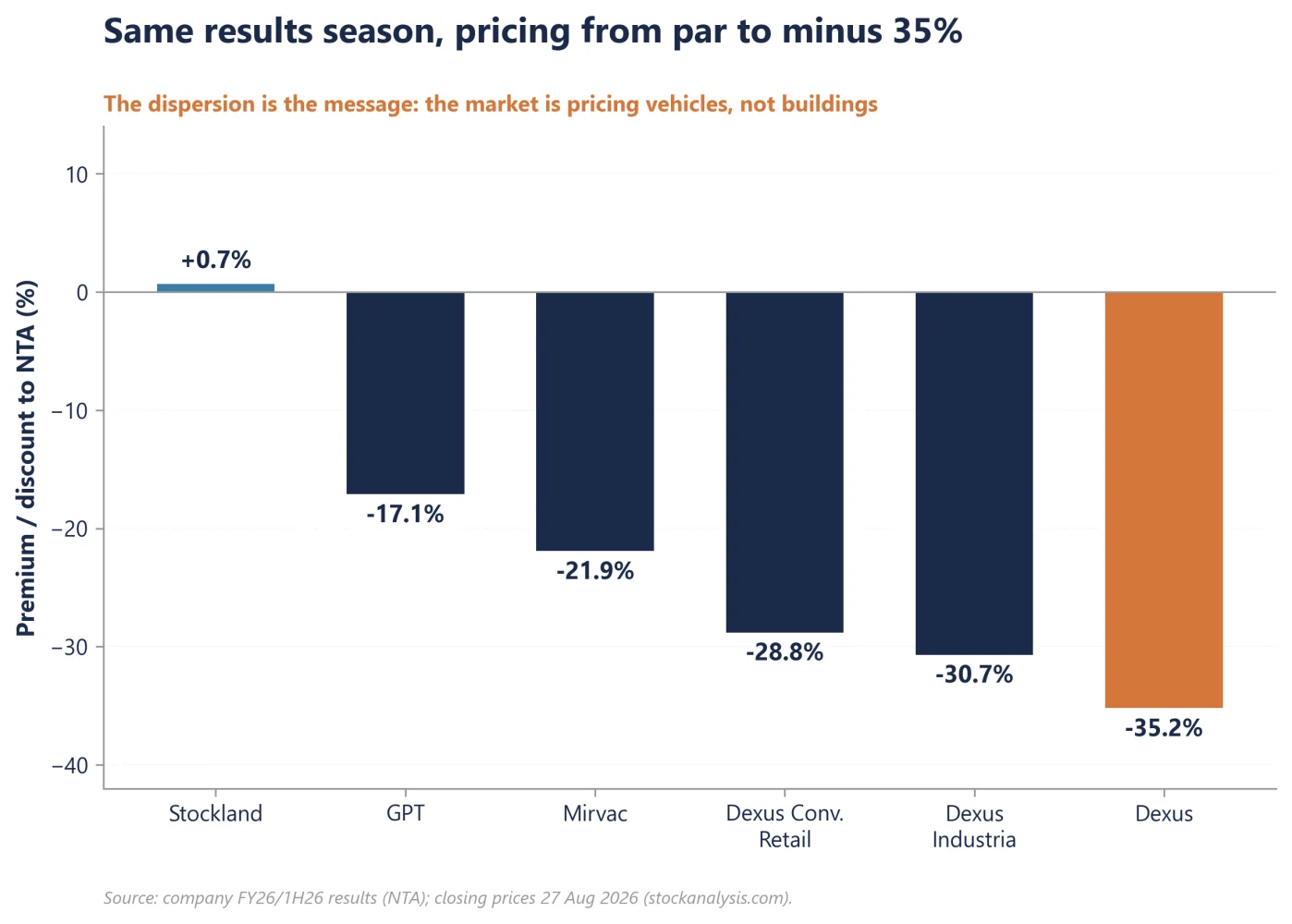
Rising rents, rising NTAs, record occupancy, falling gearing, and share prices a quarter below book. Either the equity market knows something the deal market does not, or the discount is measuring something other than the real estate.
View 1: The Discount Prices the Vehicle, Not the Assets
If the listed discount were really a verdict on Australian property values, it would be roughly uniform across vehicles holding similar assets. It is nothing of the sort.
Goodman trades at a large premium to book on the strength of its data centre development platform. Stockland, with its residential development engine, trades at par with book after closing results week at a premium (Capital Brief; stockanalysis.com, 27 Aug 2026). The discounts deepen as the vehicles get more passive: GPT at roughly 17%, Mirvac around 22%, office-weighted Dexus at 35%, and the externally managed small caps at 29-31% (company results; closing prices 27 Aug 2026). Same country, same asset classes, wildly different discounts. What varies is not the quality of the buildings but the character of the vehicle: earnings growth, platform economics, index flows and rate sensitivity.
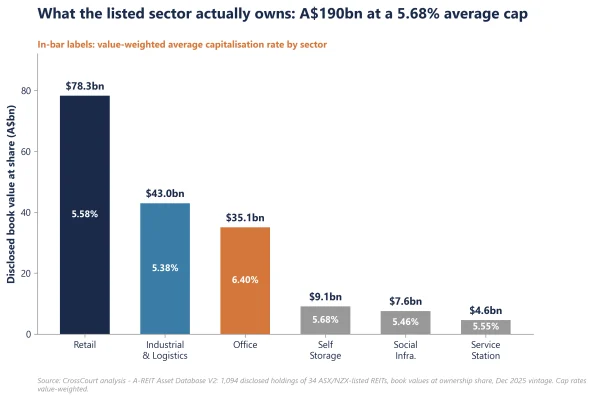
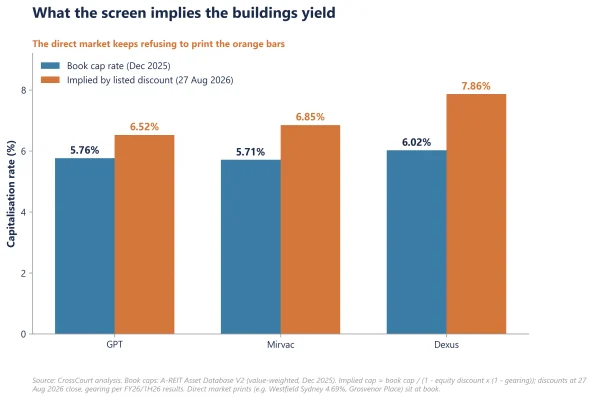
Our own asset-level database of 34 listed A-REITs, covering 1,094 disclosed holdings with A$190.2 billion of book value at share, puts the sector's value-weighted capitalisation rate at 5.68% as at December 2025 (CrossCourt analysis of REIT disclosures). Strip the leverage out of the listed discounts and the equity market is implying asset-level markdowns of roughly 10-25% on those books, which would push implied cap rates toward 8% for an office-heavy portfolio. Yet the direct market keeps refusing to print those numbers. Fortress retail cap rates compressed roughly 10 basis points over the last half, with Chadstone held at 4.25% and Westfield Sydney at 4.69% (Vicinity and Scentre disclosures, Dec 2025), and H1 2026 direct volumes rose 16% (CBRE). The marginal buyer with full information keeps transacting at or above book. The discount lives in the wrapper: liquidity, mandate flows, index weight and rate beta. I think this is a statement about vehicles, not about valuations.
View 2: The Take-Private Window Is Open, and Private Capital Is Walking Through It
When the same portfolio has two prices, the capital that can move between them collects the difference. National Storage was the proof of concept: bought at a 26.5% premium to the undisturbed price and still at only a modest premium to book, delisted 12 May 2026 (GIC; ASX). Ashurst's public M&A review expects sponsors to have a strong year of take-privates in 2026, with real estate one of the main sectors to watch (Ashurst, Australian Public M&A Deal Report 2026).
The screening logic is straightforward. The widest discounts sit on hard-asset registers with internalisation or management-rights angles, conservative gearing that leaves room for an acquirer's capital structure, and portfolios too small for index sponsorship to defend them. A vehicle trading 30% below a rising NTA with conservative gearing is, functionally, an institutional-grade portfolio pre-assembled at a price no direct process would achieve.
The flow also runs the other way, and this matters just as much for private buyers. Listed vehicles recycling capital have become one of the best-quality acquisition pipelines in the country, and the prints keep landing at book. Scentre sold a 19.9% interest in Westfield Sydney to Australian Retirement Trust for $864 million, at Scentre's June 2025 book value and an implied 4.69% capitalisation rate, settling 3 February 2026 (Scentre Group, Dec 2025). GPT bought a 50% interest in Grosvenor Place from Commonwealth Superannuation Corporation for $860 million (GPT, Dec 2025). A super fund paying book value for a fortress mall interest, while the vehicle that sold it traded below book on the screen, is the dislocation in a single transaction. Assets of that grade rarely reach the open market in normal conditions.
A discounted listed sector, under pressure to fund buy-backs and developments without issuing cheap equity, sells real assets instead. For private capital, the dislocation is not a threat to book values. It is a sourcing channel.
View 3: The Window Is Closing From Both Ends
Arbitrages this visible do not stay open indefinitely, and this one is being worked from both sides.
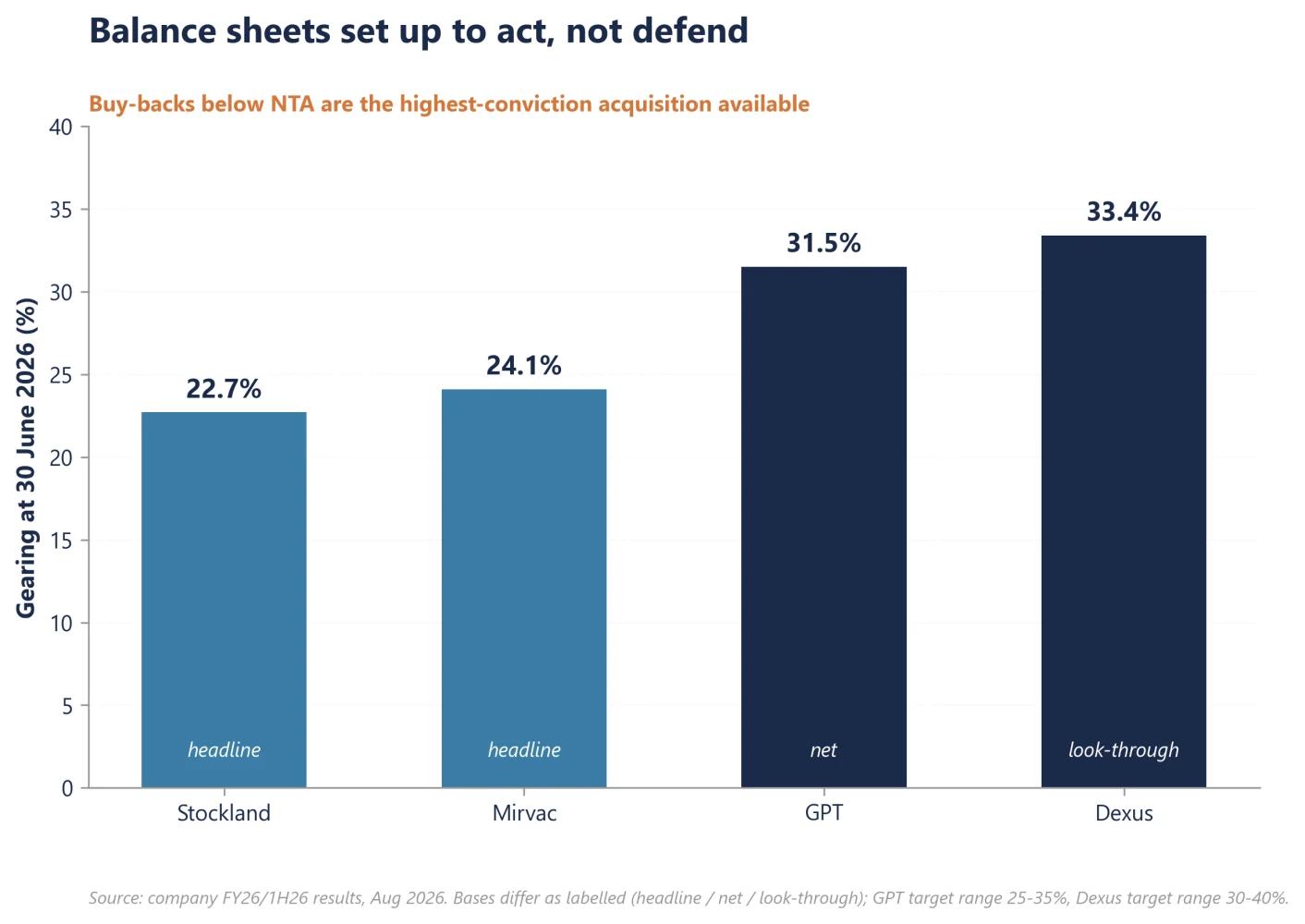
From the inside, boards have discovered the obvious: when your own portfolio trades at a deep discount, the highest-conviction acquisition available is your own register. Mirvac launched a $200 million buy-back alongside its results, and Dexus Convenience Retail doubled its program to 5% of securities on issue (Mirvac; Investing.com, Aug 2026). Gearing at Stockland (22.7%) and Mirvac (24.1%) sits near cycle lows, so the capacity is real. Every security bought back below NTA transfers value to remaining holders and mechanically narrows the gap.
From the outside, the private bid keeps arriving, and each completed scheme removes discounted stock from the exchange. National Storage took A$5.5 billion of investment property off the ASX in one transaction (NSR disclosures). At the same time the underlying books are growing again: NTA up 8.4% at Charter Hall Retail, up 6% at Dexus Convenience Retail, and returning to growth at Mirvac (Investing.com; Mirvac, Aug 2026). The index has already recovered from its February low of 1,472.9 to around 1,702 in August (Market Index), which is a 15% move off the bottom with the discount still intact. A discount that closes from both ends is a window measured in quarters, not years. So far every major test of this cycle's discount, from the National Storage scheme to the buy-backs now running across the sector, has closed the gap by moving the equity price toward the assets, not the assets toward the equity price.
Where This Goes From Here
My view: Cautiously bullish that this dislocation resolves upward, through listed re-rating, buy-backs and take-privates, rather than downward through a markdown of direct portfolios. The National Storage scheme is the single most important data point of this cycle on that question, because it was the one occasion a fully informed private buyer had to put a number on a discounted listed book, and the number came in above NTA.
For institutional and private investors, three practical implications follow. First, treat listed pricing as free price discovery rather than as a verdict: the dispersion between vehicles tells you what the equity market will and will not pay for, which is information you can use when structuring your own capital. Second, expect competition: the take-private bid is now a standing feature of the market, and it hunts in exactly the mid-market segments where listed sponsorship is thinnest. Third, watch the recycling pipeline: a discounted listed sector funding buy-backs will keep selling institutional-grade assets that would otherwise never trade, and being the counterparty of choice to that flow is the cleanest way to buy quality this cycle.
The screen says Australian real estate is worth a quarter less than book. The people who can actually buy the buildings keep paying book or better. In 2026, the cheapest way to buy Australian property is on a screen. The way to get paid for it is off one.
P.S. This piece sits on an asset-by-asset database of all 34 listed A-REITs: 1,094 disclosed holdings, $190bn of book value at share, every disclosed cap rate. If a sector cut would be useful for your next paper, send me a message and I'll share it.
Sources
- CBRE, Australian Capital Flows Report H1 2026, July 2026. https://www.cbre.com.au/insights/reports/australian-capital-flows-report-h1-2026
- Market Index, S&P/ASX 200 A-REIT Index (XPJ), August 2026. https://www.marketindex.com.au/asx/xpj
- National Storage REIT, Scheme Implementation Deed announcement, 8 December 2025.
- GIC Newsroom, "Brookfield and GIC Complete Record A$6.7 Billion Acquisition of National Storage REIT", May 2026. https://www.gic.com.sg/newsroom/all/brookfield-and-gic-complete-record-a6-7-billion-acquisition-of-national-storage-reit/
- Dexus, 2026 Annual Results, 20 August 2026. https://www.dexus.com/investing/results-events/dxs-full-year-results.html
- Mirvac, FY26 Full-Year Result, 19 August 2026. https://www.mirvac.com/investor-centre
- Stockland, FY26 Results, 19 August 2026; Capital Brief, "Stockland profit lifts 20% to $994m", 19 August 2026.
- GPT Group, 2026 Interim Result, ASX announcement, 17 August 2026. https://announcements.asx.com.au/asxpdf/20260817/pdf/072t142kf20mzq.pdf
- Scentre Group, "New joint venture partner at Westfield Sydney", December 2025. https://www.scentregroup.com/news-and-media/latest-news/new-joint-venture-partner-westfield-sydney
- GPT Group, "GPT acquires 50% interest in Grosvenor Place, Sydney", announced October 2025, completed 22 December 2025.
- Investing.com, Dexus Industria FY26 results coverage, 12 August 2026.
- Investing.com, Dexus Convenience Retail FY26 results coverage, 10 August 2026.
- Investing.com, Charter Hall Retail REIT FY26 results coverage, August 2026.
- Ashurst, Australian Public M&A Deal Report 2026.
- CrossCourt analysis: A-REIT Asset Database V2 (34 entities, 1,094 disclosed holdings, A$190.2bn at-share, December 2025 vintage), compiled from REIT compendiums, property synopses and annual reports.
- Vicinity Centres and Scentre Group, 1H FY26 / FY25 results disclosures, February 2026.
- Market prices as at 20-26 August 2026: Market Index (DXS $5.83, 20 Aug), Kalkine (MGR $1.90, 20 Aug), Capital Brief / stock coverage (SGP $4.66, 20 Aug), Investing.com (GPT $4.70, 26 Aug).