for institutional deal workflows


Australian commercial property transacted $19.0 billion in the first half of 2026, up 16% on the same period a year earlier (CBRE, Australian Capital Flows Report H1 2026). Inside that headline sits the number everyone has picked up: offshore buyers accounted for just 21% of transaction volume, down from 28% in the first half of 2025 (CBRE, Australian Capital Flows Report H1 2026 and H1 2025).
The interpretation has been fast and close to unanimous. Foreign capital is retreating from Australia. Global volatility, currency, geopolitics, take your pick of cause. CBRE's own Tom Broderick offered the tidiest version of it, noting that "volatility at the global level often causes investors to pause and concentrate on their home markets" (CBRE, quoted in Real Estate Business, August 2026).
I have had a version of that conversation a dozen times in the past month, with developers, fund managers and investors who all arrived at the same place from the same headline. It is worth pausing on the arithmetic before accepting it, because a share is a ratio, and there are two ways for one to fall.
Here is what actually happened. Offshore buyers deployed $4.0 billion in H1 2026, down 8% year-on-year (CBRE, Australian Capital Flows Report H1 2026). Total volumes rose 16%. A seven point fall in share, and roughly four fifths of it comes from the denominator. That math matters well beyond pedantry, because "offshore capital is leaving" and "domestic capital is surging" imply completely different things about where pricing goes next, who is on the other side of your exit, and what happens to liquidity when sentiment turns.
The Market Snapshot: What the Brokers Are Saying
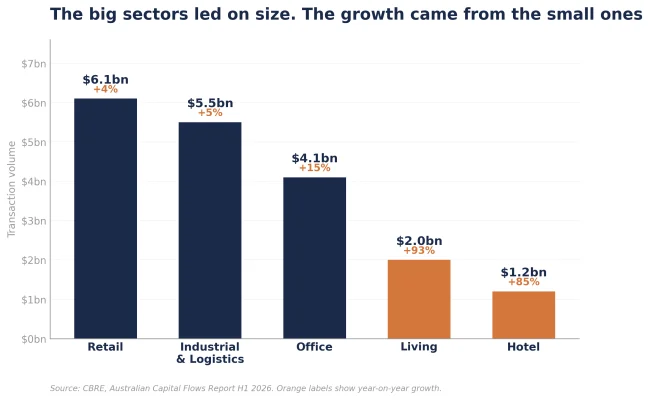
CBRE puts H1 2026 volumes at $19.0 billion, a 16% year-on-year increase, with every major sector recording higher volumes than the same period last year (CBRE, Australian Capital Flows Report H1 2026). Retail led at $6.1 billion, up 4%, followed by industrial and logistics at $5.5 billion, up 5%, and office at $4.1 billion, up 15% (CBRE, Australian Capital Flows Report H1 2026). The growth, though, came from the smaller sectors: living transacted $2.0 billion, up 93%, and hotels $1.2 billion, up 85% (CBRE, Australian Capital Flows Report H1 2026). CBRE's Flint Davidson read the 16% lift as evidence the market "was becoming more resilient to increasingly common shocks" (CBRE, quoted in Real Estate Business, August 2026).
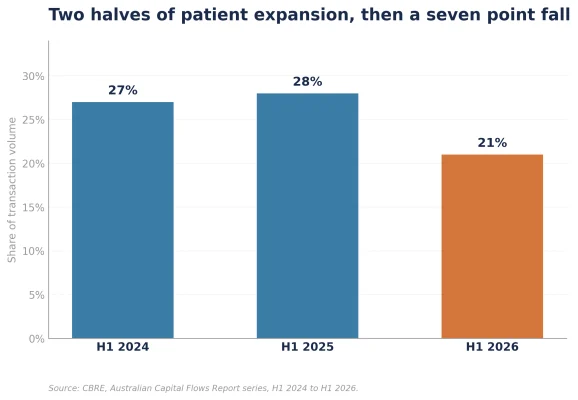
Offshore share ran 27% in H1 2024 and 28% in H1 2025 before dropping to 21% in H1 2026 (CBRE, Australian Capital Flows Report series). Two periods of patient expansion, then a seven point fall in a single half. Falls of that shape are usually caused by something breaking.
Colliers had called the turn in advance. Its 2026 outlook, published in December 2025, forecast that "domestic buyers are likely to increase their share of transactions after being net sellers for the past 24 to 36 months" (Colliers, Capital Markets Investment Review and Outlook 2026). That is an important detail. The domestic surge was not a reaction to offshore weakness. It was a forecast rotation by buyers who had spent two to three years selling and were always going to come back.
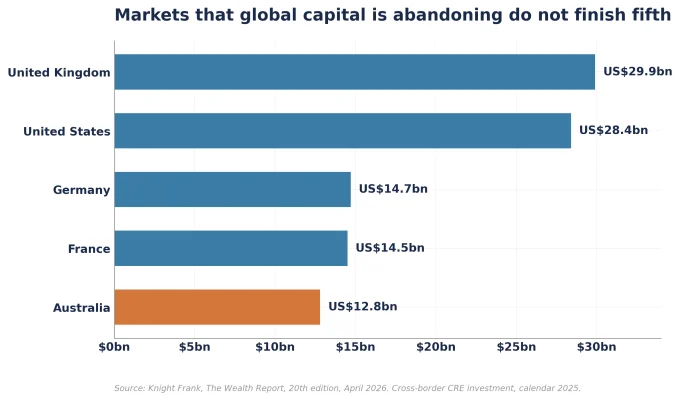
Knight Frank provides the check on the retreat narrative. Australia attracted US$12.8 billion of cross-border commercial real estate investment in 2025, ranking fifth globally behind the UK at US$29.9 billion, the US at US$28.4 billion, Germany at US$14.7 billion and France at US$14.5 billion, with Sydney the fourth most popular city worldwide at US$6.3 billion (Knight Frank, The Wealth Report, 20th edition, April 2026). Markets that global capital is abandoning do not finish fifth.
JLL frames the regional picture. Asia Pacific investment volumes reached US$47.0 billion in Q1 2026, up 31% year-on-year and the strongest first quarter on record, with Australia contributing US$5.7 billion at 49% year-on-year growth (JLL, Asia Pacific Capital Tracker, Spring 2026). The momentum held through the June quarter. JLL's August global update has Q2 2026 direct investment up 28% year-on-year worldwide, with Asia Pacific posting its most active second quarter in five years, up 38%, and Japan and Australia leading the region's liquidity gains (JLL, Global Real Estate Perspectives, August 2026). Cushman & Wakefield expects volumes to strengthen further in the second half (Cushman & Wakefield, Australia Capital Markets Marketbeat).
None of that describes a market in retreat. It describes a market that got busier, and a buyer mix that changed because one side of it accelerated.
View 1: Offshore Did Not Retreat. The Denominator Grew.
The reported figures do most of the work here.
Offshore buyers deployed $4.0 billion in H1 2026, an 8% decline year-on-year (CBRE, Australian Capital Flows Report H1 2026). That is a soft half, not an exit. Back out the domestic side and the contrast is stark: domestic buyers deployed roughly $15.0 billion in H1 2026 against roughly $12.0 billion in H1 2025, an increase of about $3.0 billion, or 25% (author's calculation, derived from CBRE, Australian Capital Flows Report H1 2026).
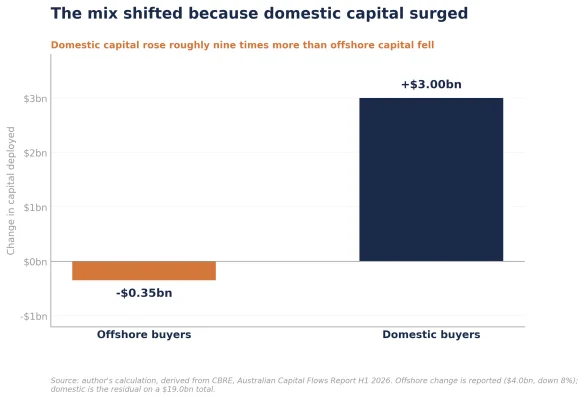
Figure 3 shows where the seven percentage points came from. Offshore capital fell by roughly $0.35 billion. Domestic capital rose by roughly $3.0 billion, close to nine times the size of the offshore decline. Describing that as a foreign retreat gets the causation almost exactly backwards.
The longer series says the same thing. Offshore groups deployed $8.3 billion into Australian commercial property in 2024, a 37% increase on 2023, and $9.3 billion in 2025, a further 12% increase (CBRE, Australian Capital Flows Report series). Offshore capital expanded its absolute commitment to Australia in each of the last two years, and it did so in 2025 even as overall transaction volumes declined. Over the twelve months to H1 2026, US investors accounted for $2.7 billion, Japan $1.5 billion and Singapore $1.5 billion (CBRE, Australian Capital Flows Report H1 2026).
There is a measurement wrinkle underneath this that deserves attention in my opinion. In June 2026, BGO, the real estate arm of Canadian insurer Sun Life, acquired 100 Mount Street in North Sydney from Dexus for $558 million alongside domestic managers Investa and Cliffbrook Capital, with Investa appointed to run the asset (Investa, June 2026). That is offshore capital entering Australia through a domestic platform rather than as a direct offshore buyer. However that trade is classified, it illustrates the problem: as foreign investors increasingly access Australia through local managers, joint ventures and mandates, a statistic built on the nationality of the direct acquirer will systematically understate foreign participation.
So the practical conclusion. For roughly three years the standard Australian pitch has carried a line about global capital circling assets priced below replacement cost, with an implied exit into a deep offshore bid. If you believed offshore capital was about to arrive in force, H1 2026 looks like that thesis failing. Look at the numbers and it never was the driver. Offshore participation has been steady and incremental throughout, running at roughly $4 to $5 billion a half. The volatility in the mix has come from the domestic side, which sold for two to three years and then turned.
View 2: A Different Buyer Prices Differently
If domestic institutions are setting the clearing price, the mechanics of price formation change, and not in a small way.
An offshore fund buying an Australian asset carries costs and constraints a domestic buyer does not. It hedges currency, and the hedge has a cost that moves with the rate differential. It usually operates inside a closed-end fund with a defined life, which imposes an exit date whether or not the market cooperates. It answers to an investment committee comparing Sydney industrial against Dallas industrial and Osaka industrial on the same page. Its required return embeds a country risk premium that a Sydney-based buyer does not apply to its home market.
A domestic institution has none of that. Australian superannuation capital in particular is liability-matched, has no fund clock, and compounds at a rate that requires deployment regardless of the cycle. A-REITs raising domestic equity face a similar imperative. Syndicators, which Colliers notes have gained traction in metro and fringe markets while institutional capital targets prime CBD stock (Colliers, Capital Markets Investment Review and Outlook 2026), compete for a different slice again.
That combination clears the market at different levels. A buyer without a hedge cost and without a five-year clock can rationally pay a lower yield for the same cash flow, because the return it needs is lower and the horizon over which it can wait is longer.
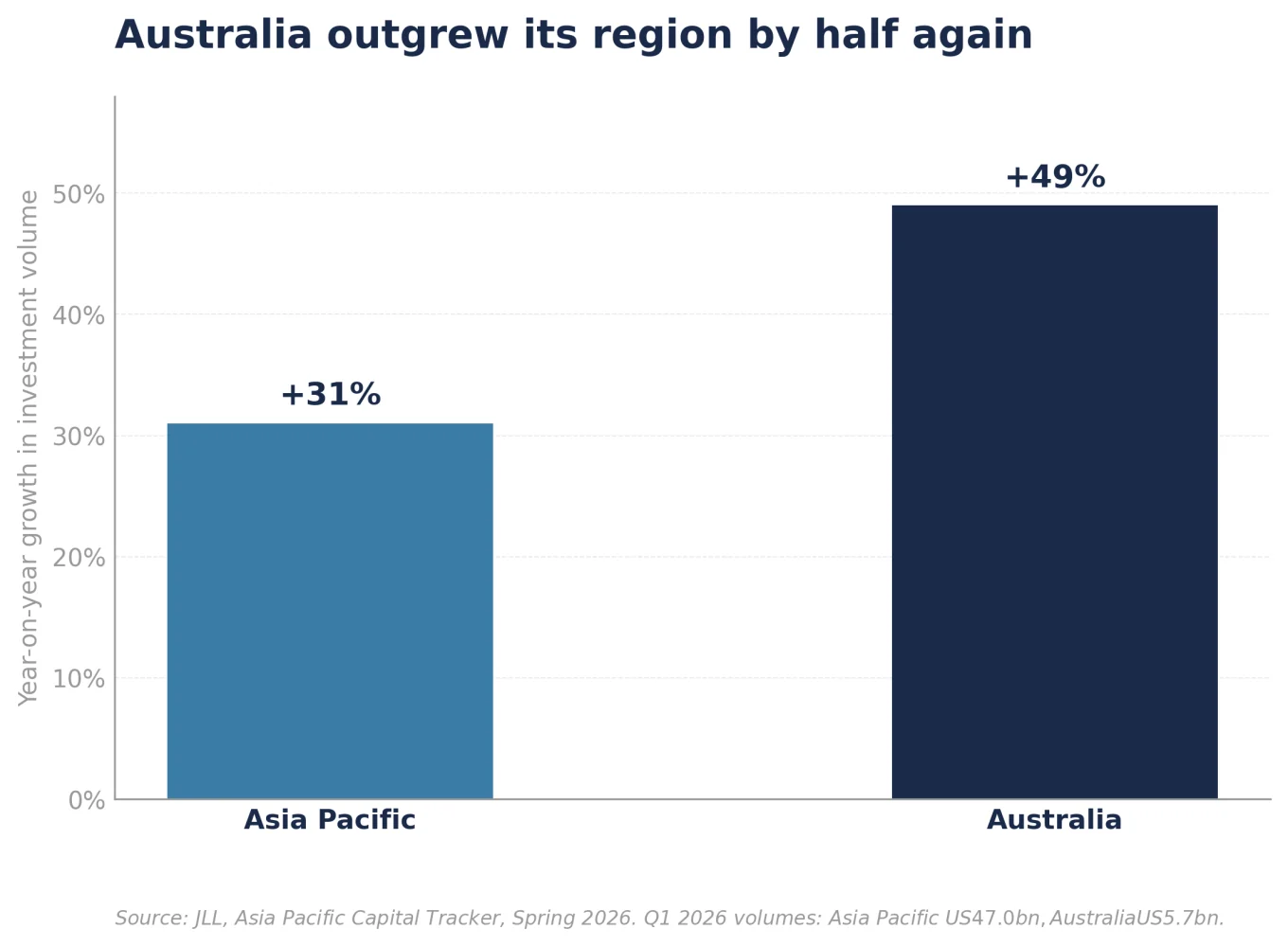
The evidence is in the growth differential. Australia grew investment volumes 49% year-on-year in Q1 2026 against a regional average of 31% (JLL, Asia Pacific Capital Tracker, Spring 2026). Australia is not outperforming because global capital chose it over Tokyo or Seoul. It is outperforming because it has a domestic buyer pool that most regional markets do not have at comparable scale.
Hold that against the rate backdrop. The RBA cash rate has sat at 4.35% since May 2026, a twelve-year high reached through three consecutive increases in February, March and May (Reserve Bank of Australia). The Board held it there again on 11 August, unanimously, and Governor Michele Bullock was explicit that the meeting considered only variations of holding, not cutting, and that the next move may still need to be an increase (RBA, Statement by the Monetary Policy Board, 11 August 2026; ABC News, 11 August 2026). Volumes rose 16% into a tightening cycle that the central bank has just confirmed is not over, which is not what the textbook predicts. A buyer pool that does not price off a global hurdle rate is a large part of the reason.
View 3: A Deeper Bid Is Also a Narrower One
Here is where I would resist the victory lap.
The two largest disclosed transactions of the half were both domestic. Goodman Group took full control of 1.3 million square metres of Sydney and Brisbane industrial property in a $2.65 billion buyout of its partnership with Washington H. Soul Pattinson, covering 25 stabilised assets and the Oakdale development pipeline in western Sydney (Goodman Group, June 2026). The GPT Wholesale Shopping Centre Fund agreed to acquire 50% interests in Sunshine Plaza and Macarthur Square from the Lendlease-managed Australian Prime Property Fund Retail for $1.2 billion, split $622 million and $568 million (GPT, ASX announcement, 15 June 2026).
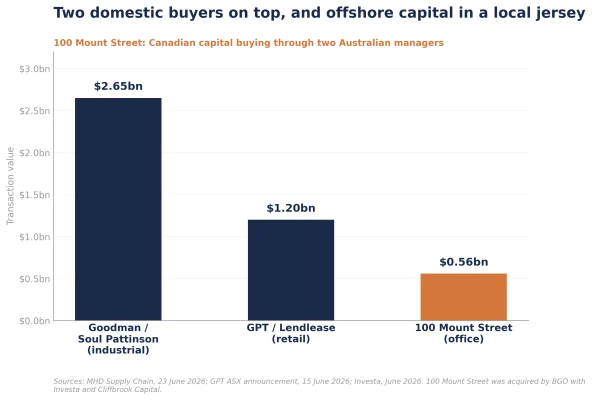
Read one way, that is a healthy market with deep domestic conviction at the top end. Read another way, it is concentration.
A diversified buyer pool is a shock absorber. When domestic institutions, North American funds, Singaporean capital and Japanese buyers are all live on the same asset, they respond to different signals: different cost of capital, different currency view, different portfolio need. Their bids are imperfectly correlated, which is exactly what keeps a market liquid when conditions move.
When one pool dominates, that diversification thins. Australian superannuation funds, A-REITs and domestic syndicators are not independent actors. They face the same cash rate, the same valuers, the same debt market, the same regulator and the same domestic macro headlines. If domestic sentiment turns, it turns across the pool at once, and the offshore bid underneath has been running at a steady four billion dollars a half largely regardless of what happens here.
The honest qualification is the one from View 1. The third largest disclosed deal of the half, 100 Mount Street at $558 million, was a Canadian institution buying through two Australian managers (Investa, June 2026). If that is the direction of travel, then the concentration is less severe than the headline share implies, because foreign capital is still in the market, just wearing a local jersey. That is better for pricing depth than a genuine exodus would be. It is not obviously better for liquidity in a downturn, because capital routed through domestic platforms tends to answer to domestic sentiment.
None of this predicts stress. It observes that the composition of liquidity has changed, and composition is invisible in a volume statistic. Nineteen billion dollars looks the same in a chart whether it came from four buyer pools or one.
Where This Goes From Here
Three things follow.
First, stop underwriting an offshore exit as an upside case. Offshore capital has been steady, rational and incremental, deploying roughly $4 to $5 billion a half without much regard for the local narrative. It is not going to arrive as a wave, and it has not been absent. Underwrite it as the constant it has actually been.
Second, if you are competing for prime assets, you are competing against a buyer with a structurally lower hurdle rate. Domestic institutional capital does not need what an offshore closed-end fund needs. On the best stock, the price that clears will increasingly be set by whoever has the longest horizon and the cheapest cost of capital, and right now that is domestic.
Third, watch composition rather than volume in the second half. Cushman & Wakefield expects H2 volumes to strengthen (Cushman & Wakefield, Australia Capital Markets Marketbeat). If they do, the question is whether the offshore share stabilises near 21% or keeps sliding while total volumes climb, and how much foreign capital is arriving through domestic platforms where the statistics will not see it.
My view: cautiously bullish over the medium term. The domestic bid is real, it is structurally funded by a superannuation pool that compounds whether or not anyone likes the cycle, and it delivered a 16% volume increase into a twelve-year-high cash rate that the RBA reaffirmed this month with a hiking bias still on the table, which is a genuinely impressive result. I hold that view with one caveat, which is that the depth we gained in H1 2026 came with a reduction in diversity that nobody put in a headline.
Ask who is on the other side of your exit. For the first time in several years, the honest answer is probably someone who files their tax return here.
Sources
- CBRE, Australian Capital Flows Report H1 2026. https://www.cbre.com.sg/insights/reports/australian-capital-flows-report-h1-2026
- CBRE, Australian Capital Flows Report H1 2025. https://www.cbre.com.au/insights/reports/australian-capital-flows-report-h1-2025
- CBRE, Australian Capital Flows Report H2 2025. https://www.cbre.com.au/insights/reports/australian-capital-flows-report-h2-2025
- CBRE, Australian Capital Flows Report H1 2024. https://www.cbre.com.au/insights/reports/-australian-capital-flows-report-h1-2024
- Real Estate Business, "Commercial property deals hit $19bn as domestic buyers drive rebound", August 2026. https://www.realestatebusiness.com.au/commercial/32123-commercial-property-deals-hit-19bn-as-domestic-buyers-drive-rebound
- Business News Australia, "Australian commercial property deals surge 16pc to $19b as domestic buyers fill offshore gap", August 2026. https://www.businessnewsaustralia.com/articles/australian-commercial-property-deals-surge-16pc-to-19b-as-domestic-buyers-fill-offshore-gap.html
- Knight Frank, The Wealth Report, 20th edition, April 2026. https://www.knightfrank.com.au/blog/2026/04/24/australia-5th-for-crossborder-commercial-real-estate-investment-in-2025-knight-franks-the-wealth-
- JLL, Asia Pacific Capital Tracker, Spring 2026. https://www.jll.com/en-au/insights/asia-pacific-capital-tracker
- Colliers, Capital Markets Investment Review and Outlook 2026, December 2025. https://www.commo.com.au/news/2025/12/11/colliers-outlook-what%E2%80%99s-ahead-australia%E2%80%99s-property-markets-2026/1765404000
- Cushman & Wakefield, Australia Capital Markets Marketbeat Report. https://www.cushmanwakefield.com/en/australia/insights/australia-capital-markets-marketbeat-report
- GPT Group, ASX announcement, 15 June 2026, acquisition of 50% interests in Sunshine Plaza and Macarthur Square. https://announcements.asx.com.au/asxpdf/20260615/pdf/070mf95tp2zwhw.pdf
- MHD Supply Chain, "Goodman grows Western Sydney logistics holdings in $2.65bn deal", 23 June 2026. https://mhdsupplychain.com.au/2026/06/23/goodman-grows-western-sydney-logistics-holdings-in-2-65b-deal
- Investa, "Investa adds 100 Mount Street, North Sydney to platform", June 2026. https://www.investa.com.au/news/investa-adds-100-mount-street-north-sydney-to-platform
- Reserve Bank of Australia, Cash Rate Target. https://www.rba.gov.au/statistics/cash-rate/
- Property Markets News, "Australian Commercial Property Sales Hit $19.0B", 2026. https://propertymarkets.news/australian-commercial-property-sales-hit-19-0b/
- Reserve Bank of Australia, Statement by the Monetary Policy Board: Monetary Policy Decision, 11 August 2026. https://www.rba.gov.au/media-releases/2026/mr-26-19.html
- ABC News, "Interest rates on hold but RBA governor keeps door open to hikes", 11 August 2026. https://www.abc.net.au/news/2026-08-11/rba-interest-rates-august-2026/107023850
- JLL, Global Real Estate Perspectives, August 2026. https://www.jll.com/en-uk/insights/market-perspectives/global