for institutional deal workflows

On 29 July 2026, the Energy and Climate Change Ministerial Council agreed to pursue regulations that would require data centres to offset their electricity demand by investing in additional renewable generation. Every jurisdiction signed except two: Queensland and the Northern Territory (SBS News, 29 July 2026).
Two weeks earlier, the Prime Minister had set the standard the council was implementing. "We will create a legal obligation for the next generation of large-scale data centres to underwrite new power supply," Anthony Albanese said on 15 July. "To build new renewable energy generation and firming to strengthen our national energy resilience. To be net-generators, not net-users" (PV Tech, 15 July 2026).
Read that last phrase again, because the market has not yet. The obligation being drafted is not that a data centre buys green certificates equal to its load. It is that a data centre puts at least as much energy into the grid as it takes out, that the generation is new, that the operator pays the full grid connection cost with no pass-through to households or other businesses, and that the facility reduces consumption when the system is under strain (PV Tech, 15 July 2026). I would call this the largest single change to Australian data centre underwriting since the asset class went institutional.
The consensus reaction has been to treat this as a brake on the sector. I think that's not a full view. This rule does not block development rather it reprices it. And the moment a constraint moves from the queue into the capital stack, its less of a question of whether a project happens and becomes a question of who can afford to make it happen. That is a very different market, and it favours a very specific group of owners.
The Market Snapshot: What the Brokers Are Saying
The broker consensus going into this announcement was uniformly bullish, and on the demand side it remains correct.
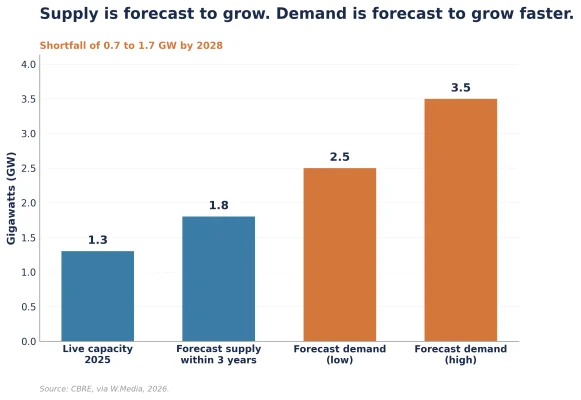
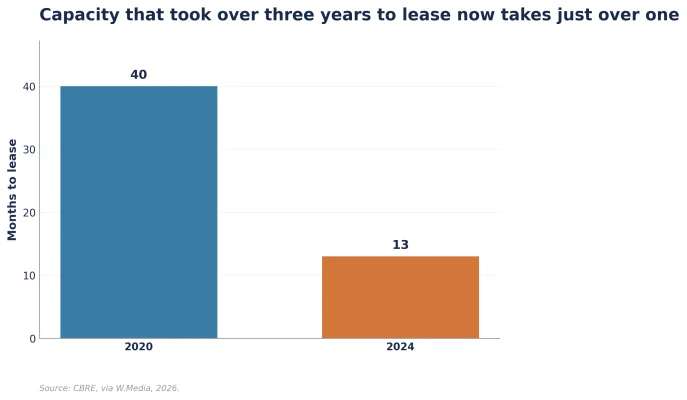
CBRE puts Australia's live data centre capacity at approximately 1.3 GW, rising to around 1.8 GW within three years, against forecast demand of 2.5 to 3.5 GW. That implies a supply shortfall of roughly 0.7 to 1.7 GW by 2028, with national vacancy compressed to 12% (CBRE, via W.Media, 2026). The scarcity is already visible in leasing behaviour: average time to lease has fallen from 40 months in 2020 to 13 months in 2024 (CBRE, via W.Media, 2026).
JLL frames 2026 as a year of consolidation, scale and strategic partnerships, with hybrid facilities evolving into dedicated AI campuses, some planned to exceed 500 MW (JLL, Australia's Data Centre Market, 2026). Knight Frank continues to rank Australia second globally, behind only the United States, as a data centre investment destination (Knight Frank, Global Data Centres Report, 2025).
The energy market operator now treats the sector as a system-planning problem rather than a demand footnote. AEMO's 2026 Integrated System Plan, released in June 2026, identifies data centres as one of the defining drivers of a near doubling of electricity consumption across the National Electricity Market over the next 25 years. At the end of the March 2026 quarter, 11 large-scale projects of more than 5 MW each, representing 5.4 GW of maximum demand, were progressing through the transmission connection process, with around 60% of that capacity in New South Wales and 40% in Victoria (AEMO, Digital Demand Surge, 2026).
And the regulator has been moving in parallel. In March 2026 the Australian Energy Market Commission published its Package 2 draft determination under the Improving the NEM Access Standards framework, setting a 30 MW threshold for large inverter-based loads and proposing that facilities of that scale stay connected and respond to instability during grid disturbances rather than dropping off. Submissions closed on 7 May 2026, with a final rule expected mid to late 2026 (AEMC, March 2026). The precedent behind it is instructive: in July 2024, 60 data centres in Virginia pulled 1,500 MW off the grid simultaneously during a single fault, triggering cascading instability (AEMC; WattClarity, April 2026).
The demand story remains what changed on 29 July is the cost of serving it.
View 1: This Prices Power, It Does Not Prohibit It
The most common error I am hearing in conversations this week is that additionality makes projects unviable. It does not. It makes them more expensive, and the increment is knowable.
Compliant power has a price, and it is already being quoted. InterContinental Energy, developer of two mega-scale Western Australian renewable projects, says it can supply a tier-four data centre below US$48 per megawatt hour, roughly A$66/MWh, which it puts at around half the price of on-grid firmed renewable projects (RenewEconomy, 12 May 2026). That quote comes from a Western Australian hub rather than the eastern grid, so treat it as a floor rather than a market rate; the direction is clear enough.
More to the point, the largest operators did not wait for the rule. Amazon was the largest corporate purchaser of carbon-free energy in Australia in 2025, signing nine new power purchase agreements across New South Wales and Victoria for 430 MW of new capacity, part of an estimated A$2.8 billion invested in Australian renewable projects between 2020 and 2025 (Amazon Australia, 2025). Microsoft has contracted a 315 MW green PPA in Australia (Austrade). Equinix signed a 151 MW agreement with TagEnergy drawn from Victoria's Golden Plains Wind Farm, its first long-term renewable PPA in Asia-Pacific (Data Center Dynamics; Equinix, February 2024).
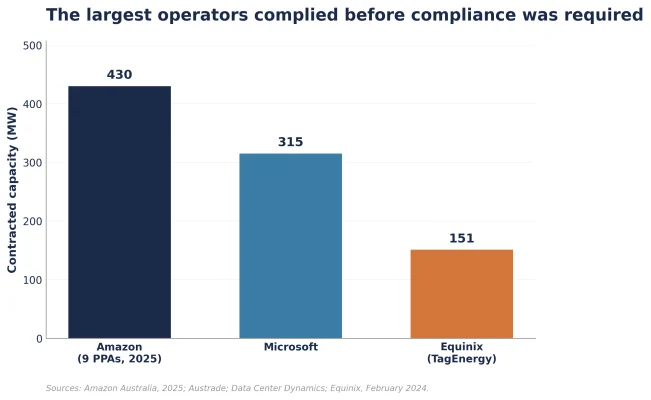
That is the point. The operators who will find compliance easiest are the ones who already did it voluntarily, before it was a rule. They have signed offtake, they have counterparty relationships with generators, and they have the balance sheet to underwrite a twenty-year contract. For them, the 29 July agreement converts a discretionary sustainability spend into a regulatory moat.
For everyone else, the underwriting question changes shape entirely. It used to be binary and it used to be about the queue: can I get a connection, and when. It is now continuous and it is about cost: what does compliant power cost per megawatt on this specific site, who funds the generation, and does the offtake sit on my balance sheet or the tenant's.
That last question is the one I would be pressing hardest on. A net-generator obligation attaches to the facility. The economics of who carries it, landlord or hyperscaler tenant, are not settled market practice in Australia, and on a twenty-year lease the difference is not a rounding error.
View 2: The Winners Own Power. The Losers Own Dirt.
The near-siting provision is where this rule does its real work, and it has received almost no attention.
The agreement contemplates that the renewable energy be generated near the data centre, unless local authorities opt out of that requirement (SBS News, 29 July 2026). Strip out the cheapest compliance route, which is buying generation wherever in the country it is cheapest to build, and you are left with a locational test. Land near developable generation capacity is now worth materially more than land that is not, independent of fibre, water, zoning or substation proximity.
This lands hardest on the announced pipeline, which was already thinner than the headlines suggested. Australia's national development pipeline stood at 8,181 MW as at November 2025, but only around 25% of that capacity was fully development-ready, with the balance constrained by power, water or planning approvals (M3 Property, Data Centre Growth in Australia, November 2025).
New South Wales has already run a version of this filter in public. On 27 March 2026 the state endorsed 15 data centre projects worth A$51.9 billion for fast-tracked support through the Investment Delivery Authority, while setting aside a further A$40.7 billion of proposals as premature or overly speculative (NSW Government, 27 March 2026; Johnson Winter Slattery, 2026).
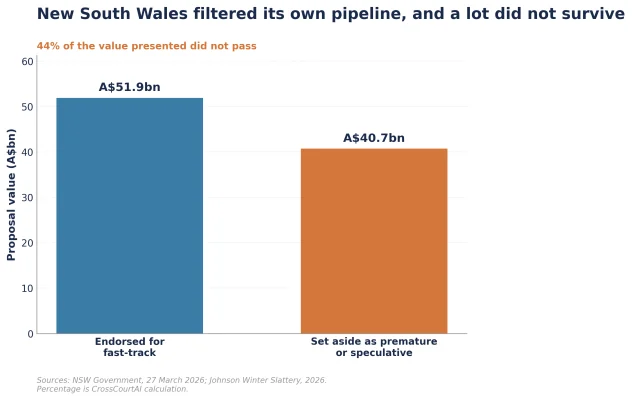
That A$40.7 billion is the number I would put in front of anyone underwriting a data centre land position off an announcement. Roughly 44% of the value brought to the state's own fast-track process did not survive contact with it, and that assessment was made before an additionality obligation existed. Add a requirement to underwrite new local generation and the filter tightens again.
The trade this creates is not subtle. Sites with secured firm power, existing connection agreements and a credible adjacent generation pathway have just been repriced upward relative to everything else. Land banked on the thesis that power would eventually arrive has been repriced downward. Both movements happened on the same day, in opposite directions, and neither has cleared through valuations yet.
View 3: The Two-Speed Market Is Real, But It Is Narrower Than It Looks
Queensland and the Northern Territory declining to sign creates an obvious arbitrage, and the temptation will be to trade it. I would be careful, for three reasons.
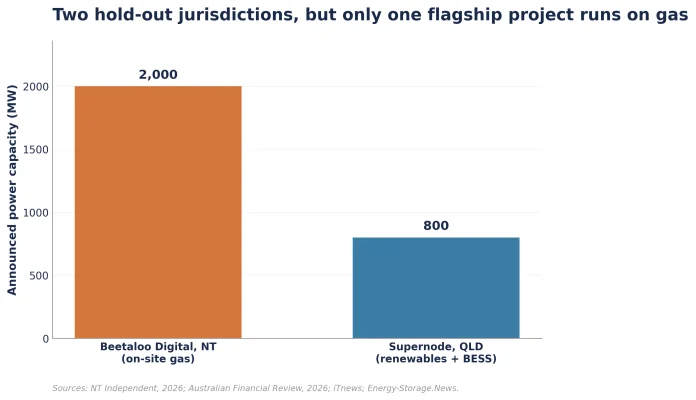
The first is that the two abstentions are not the same decision. The Northern Territory's position is legible from its pipeline. The NT Government has earmarked 185 hectares at Weddell, around 30 kilometres from Darwin, for Beetaloo Digital, a hyperscale campus powered by up to 2 GW of on-site generation fuelled by Beetaloo Basin gas, with the proponent claiming potential to attract up to A$40 billion in private investment at full development (NT Independent, 2026; Australian Financial Review, 2026). A jurisdiction whose flagship digital infrastructure project is a gigawatt-scale gas build has a straightforward reason not to sign a renewable additionality mandate.
Queensland is a different case. Its largest planned facility is Quinbrook's Supernode at Brendale, up to 800 MW across a multi-tenant hyperscale campus, capitalised at up to A$2.5 billion and designed around renewables and a co-located 2,000 MWh battery (Quinbrook; iTnews). That is not an energy-source objection. It reads as a jurisdictional one.
The second reason for caution is that the arbitrage has a stated shelf life. National Cabinet is scheduled to seek agreement from state and territory leaders, and legislation is targeted for introduction to Parliament in early 2027 (PV Tech, 15 July 2026). Changes to the national rules, including reforms to how data centres report energy use, go to the September ministerial meeting (SBS News, 29 July 2026). A data centre is a 40-year asset. Underwriting one off a two-jurisdiction holdout that has an eighteen-month political runway is a duration mismatch, not a strategy.
The third is that the rules are national with a floor, not a ceiling. States and territories may add further requirements on top (SBS News, 29 July 2026). The realistic long-run spread between jurisdictions is therefore not compliant versus non-compliant. It is compliant versus more than compliant.
Industry is pushing back on exactly this point, and not without cause. "A one-size-fits-all approach will not work and may well be counterproductive," Data Centres Australia chief executive Belinda Dennett said of the agreement (SBS News, 29 July 2026). The Climate Council took the opposite view of the abstentions: "Unless these hold-out governments get on board, Queenslanders and Territorians will be left paying higher power bills," chief executive Amanda McKenzie said (SBS News, 29 July 2026).
Both can be true. A uniform national standard applied to facilities ranging from 30 MW to 800 MW will produce some poor outcomes at the edges. And a two-jurisdiction carve-out in a single national electricity market will produce cost shifting. Neither observation changes the direction of travel.
Where This Goes From Here
The sequence from here is knowable, which is unusual in policy and worth exploiting. The September ministerial meeting takes the reporting reforms and the national rule changes. The AEMC finalises its access standards mid to late 2026. National Cabinet seeks leader-level agreement. Legislation reaches Parliament in early 2027. Anyone acquiring or financing a data centre site between now and then is underwriting into a known drafting process, and the drafting detail, particularly the definition of "large-scale" and the treatment of existing PPAs, is where the value sits.
My view: cautiously bullish, and more bullish on the sector's incumbents than I was a month ago. The demand case has not weakened. Australia still ranks second globally for data centre investment (Knight Frank, 2025), still faces a 0.7 to 1.7 GW shortfall by 2028 (CBRE), and still has 5.4 GW queued for transmission connection (AEMO, Digital Demand Surge, 2026). What has changed is that the sector's central constraint has been converted from an administrative queue into a priced obligation, and priced obligations reward balance sheet, existing offtake and secured land. Every one of those favours the operators who are already at scale.
The uncomfortable implication for the rest of the market is that a large amount of announced Australian data centre pipeline was never a development. It was an option on power arriving. On 29 July, the strike price on that option went up.
Power was the thing we waited for. It is now the thing we buy.
---
---
Sources
1. SBS News, "The new plan to prevent data centres from driving power prices up," 29 July 2026. https://www.sbs.com.au/news/article/new-plan-prevent-data-centres-driving-power-prices-up/j0li5asyx
2. PV Tech, "Australia to legally require large data centres to become net-generators of renewable energy," 15 July 2026. https://www.pv-tech.org/australia-to-legally-require-large-data-centres-to-become-net-generators-of-renewable-energy/
3. Australian Government, Minister for Industry and Innovation, "An Australian approach to AI: Expectations for data centres that deliver for Australians," March 2026. https://www.minister.industry.gov.au/ministers/timayres/media-releases/australian-approach-ai-expectations-data-centres-deliver-australians
4. CBRE, "Global Data Center Trends 2026," CBRE Research, 2026. https://www.cbre.com/insights/reports/global-data-center-trends-2026
5. CBRE, "Australia among world's leading data centre hubs," via W.Media, 2026. https://w.media/australia-among-worlds-leading-data-centre-hubs-cbre/
6. JLL, "Australia's Data Centre Market," 2026. https://www.jll.com/en-au/insights/australias-data-centre-market
7. Knight Frank, "Global Data Centres Report 2025," via W.Media, 2025. https://w.media/knight-frank-report-identifies-australia-as-second-only-to-the-usa-as-data-centre-investment-destination/
8. AEMO, "Digital demand surge: Preparing Australia's power systems for the rise of data centres," 2026. https://www.aemo.com.au/newsroom/news-updates/digital-demand-surge
9. AEMO, "2026 Integrated System Plan," June 2026. https://www.aemo.com.au/energy-systems/major-publications/integrated-system-plan-isp/2026-integrated-system-plan-isp
10. AEMC, "AEMC proposes new grid standards for data centre connections," March 2026. https://www.aemc.gov.au/news-centre/media-releases/aemc-proposes-new-grid-standards-data-centre-connections
11. WattClarity, "AEMC proposed new grid standards for Data Centre connections," April 2026. https://wattclarity.com.au/articles/2026/04/05april-aemc-draft-datacentre/
12. M3 Property, "Specialist Independent Valuation: Data Centre Growth in Australia," November 2025. https://m3property.com.au/static/88f0d39061ca9072f2bf0a5b61dc5c3f/M3-Property-Report-Data-Centre-Growth-in-Australia-November-25.pdf
13. NSW Government, "NSW Government backs data centre investment, sets course for sustainable development," 27 March 2026. https://www.nsw.gov.au/ministerial-releases/data-centre-investment-sustainable-development
14. Johnson Winter Slattery, "Data centre development focus: 'dirt to tokens', planning approval speed and maintaining social licence," 2026. https://jws.com.au/what-we-think/data-centre-development-focus-dirt-to-tokens-planning-approval-speed-and-maintaining-social-licence/
15. W.Media, "NSW moves 15 data centres worth AUD 51.9bn into IDA pipeline," 2026. https://w.media/nsw-moves-15-data-centres-worth-aud-51-9bn-into-ida-pipeline/
16. RenewEconomy, "Developer of Australia's biggest renewable projects to offer cheap power below $66/MWh for data centres," 12 May 2026. https://reneweconomy.com.au/developer-of-australias-biggest-renewable-projects-says-it-can-offer-super-cheap-deals-for-data-centres/
17. Amazon Australia, "Amazon Australia signs nine new renewable energy deals, taking Australian capacity to nearly 1GW," 2025. https://amazonau.gcs-web.com/news-releases/news-release-details/amazon-australia-signs-nine-new-renewable-energy-deals-taking
18. Austrade, "Australia: APAC's rising regional hub for green data centres." https://international.austrade.gov.au/en/news-and-analysis/news/australia-apacs-rising-regional-hub-for-green-data-centres
19. Data Center Dynamics, "Equinix signs 151MW PPA in Australia." https://www.datacenterdynamics.com/en/news/equinix-signs-151mw-ppa-in-australia/
20. Equinix, "Equinix Signs its First Renewable Energy PPA in Australia with TagEnergy," 6 February 2024. https://newsroom.equinix.com/2024-02-06-Equinix-Signs-its-First-Renewable-Energy-PPA-in-Australia-with-TagEnergy
21. NT Independent, "NT Government backs proposed 2GW data centre at Weddell," 2026. https://ntindependent.com.au/nt-government-backs-proposed-2gw-data-centre-at-weddell/
22. Australian Financial Review, "Beetaloo gas-powered data centre project could pull in $40b, says NT," 2026. https://beetalooenergy.com/wp-content/uploads/Beetaloo-gas-powered-data-centre-project-could-pull-in-40b-says-NT-AFR.pdf
23. iTnews, "Supernode plans $2.5bn data centre development north of Brisbane." https://www.itnews.com.au/news/supernode-plans-25bn-data-centre-development-north-of-brisbane-582396
24. Energy-Storage.News, "Quinbrook closes financing on BESS for new 'Supernode' data centre in Queensland, Australia." https://www.energy-storage.news/quinbrook-closes-financing-on-bess-for-new-supernode-data-centre-in-queensland-australia/