for institutional deal workflows

For twenty years the sustainability report was the safest document a fund manager published. It was prose, reviewed by marketing, read by almost nobody, and legally adjacent to nothing. That era ended quietly in September 2024, when the Australian Accounting Standards Board issued AASB S2 and climate reporting moved into the Corporations Act: a statutory sustainability report lodged alongside the financial statements, carrying a directors' declaration, assured by the auditor, and policed by ASIC (AASB, Overview of Australian Sustainability Reporting Standards, April 2025). The first wave of mandatory reports is being lodged right now, and the regulator has already marked the early homework.
The common framing is compliance burden: another report, another adviser, another fee. The better framing is repricing event. Real estate is the asset class where the disclosed numbers, energy, emissions, ratings, attach to individual buildings that trade. Once those numbers are standardised and audited, the market gets to price them, asset by asset, and the evidence below says it will.
This piece is the playbook: what actually changes and on what schedule, why the report is really a data pipeline problem, and what audited numbers do to the green premium that brokers have been measuring for a decade.
The Market Snapshot: What the Brokers Are Saying
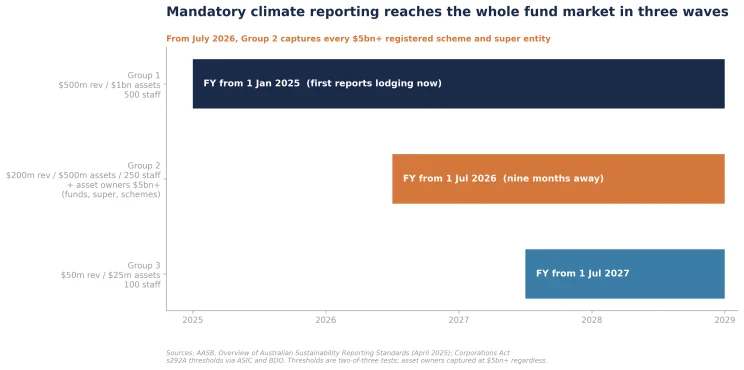
Lets start with the machinery. AASB S2 is Australia's adoption of the ISSB's global climate standard, made mandatory through the Corporations Act for entities meeting size tests under section 292A (AASB, April 2025). The rollout comes in three waves: Group 1 (two of: $500m revenue, $1bn assets, 500 staff) for financial years from 1 January 2025; Group 2 (two of: $200m revenue, $500m assets, 250 staff) from 1 July 2026; Group 3 (two of: $50m revenue, $25m assets, 100 staff) from 1 July 2027 (ASIC; BDO). The clause that matters most for readers of this newsletter sits inside Group 2: asset owners are captured at $5 billion of assets regardless of the other tests, explicitly including registered schemes and superannuation entities (BDO, Climate reporting for Group 2 asset owners). From next July, mandatory climate reporting stops being a listed-market story and becomes a funds-management story.
What goes in the report: governance, strategy, risk management, and metrics and targets on the TCFD architecture; Scope 1 and 2 emissions from year one with Scope 3 from year two; and climate scenario analysis (AASB, April 2025). It is lodged with ASIC next to the accounts, and the directors sign it.
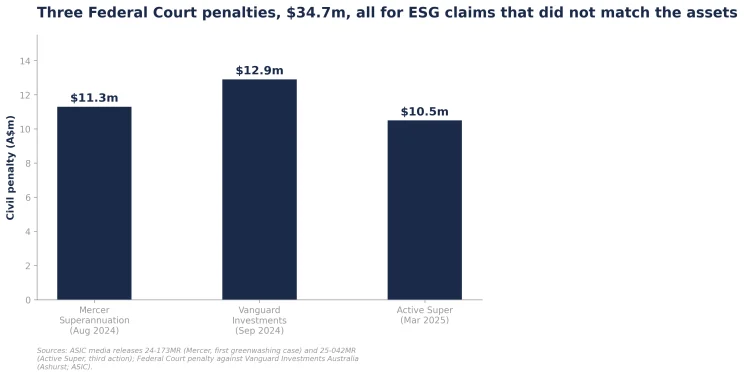
Two forces explain why the legislature bothered. The first is global: the ISSB baseline gives capital markets one comparable climate-reporting language, and Australian stakeholders overwhelmingly favoured adopting it with minimal change (AASB, April 2025). The second is local and punitive: the voluntary-claims era ended in the Federal Court. ASIC's three greenwashing actions produced $11.3m against Mercer Superannuation in its first-ever case, $12.9m against Vanguard Investments Australia, and $10.5m against Active Super, a combined $34.7m, in each case because ESG claims did not match what the money was actually invested in (ASIC media releases 24-173MR, 2024 and 25-042MR, 2025; Federal Court via Ashurst).
And the regulator is already reading the new reports. ASIC's first review covered a sample of 40 sustainability reports from December 2025 year-ends, out of 312 lodged in that cohort, and found the quality and consistency of climate disclosure markedly improved on the voluntary era, with the gaps concentrated in forward-looking disclosures, assumptions, strategy and targets (ASIC, Report 839 via ESG News, 2026). Hold that list of gaps; it is the thesis of View 2.
View 1: Prose Becomes Numbers, on a Published Schedule
The deepest change is not any single disclosure; it is the change of genre. A sustainability report used to be an essay. Under AASB S2 it is a set of numbers with the same institutional scaffolding as the accounts: directors declare it, auditors assure it, ASIC enforces it. For anyone who has watched what that scaffolding did to financial reporting discipline over decades, the trajectory is predictable. What gets audited gets systems; what gets declared gets governance attention; what gets enforced gets conservative.
The transition is deliberately cushioned, and the cushions expire on a published schedule. In the first year, an entity need not disclose Scope 3 emissions or comparatives (AASB, April 2025). Forward-looking statements carry modified liability protection in year one, and the most contested disclosures, Scope 3, scenario analysis and transition plans, are protected for three years, during which only ASIC can act and only for injunctions or declarations (Allens, September 2024; BDO). Assurance starts limited and rises to reasonable assurance, the same standard applied to the financial statements, for financial years beginning on or after 1 July 2030 (Anthesis; AUASB phasing).
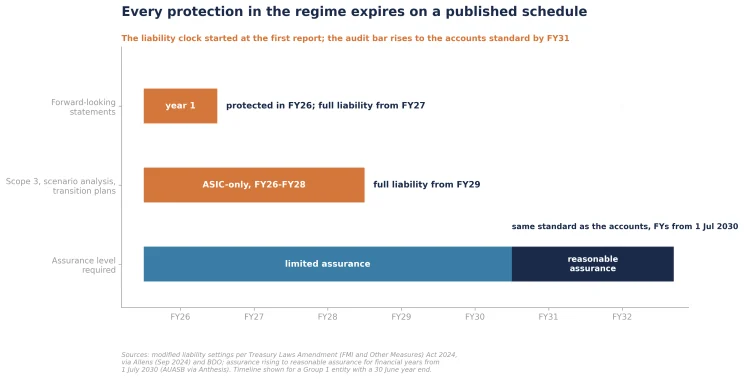
Read Figure 3 the way a director should: every protection in the regime has a countdown attached, and the countdowns started at the first report. A Group 1 June balancer that lodged its first report this spring loses forward-looking protection next year and Scope 3 protection in FY29, and faces an accounts-grade audit of the whole document from FY31. A Group 2 fund starting in FY28 runs the same clocks three years later. The practical implication is that the standard you should build to is not this year's requirement but the end-state requirement, because retrofitting audit-grade data processes under a live liability regime is precisely as pleasant as it sounds. The private-markets instinct, that disclosure regimes arrive diluted and get delayed, has a poor record here: the thresholds, dates and assurance ramp were all legislated in 2024 and have held.
View 2: The Report Is Downstream of the Asset Register
Here is what the compliance framing misses about real estate specifically: almost nothing in a property fund's climate report originates at the fund. It originates at the asset. Scope 1 is the gas burned in your buildings' boilers and the refrigerants in their chillers. Scope 2 is the electricity behind base-building meters. Scope 3, mandatory from each entity's second report, is where it gets hard: for a landlord it reaches tenant-consumed energy in your buildings and the embodied carbon in your developments, with additional financed-emissions disclosure for entities with asset management activities (AASB, April 2025). None of that can be written by a sustainability consultant at the fund level. It has to be assembled, meter by meter, lease by lease, asset by asset, and then survive assurance.
This is why ASIC's early findings matter so much. The regulator found the first cohort strongest on governance and risk process, the parts you can draft, and weakest on forward-looking disclosures, assumptions and targets, the parts you must compute (ASIC, Report 839 via ESG News, 2026). The gap in the first 312 reports sits exactly where prose ends and data begins.
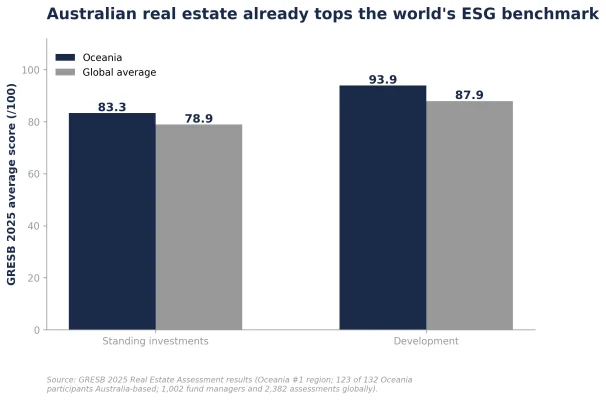
The playbook, for managers watching the Group 2 clock: the leaders treat this as an asset-data problem with a reporting output, not a reporting problem with a data annex. The raw materials mostly exist already, because Australian real estate has spent two decades building them: NABERS ratings on every sizeable office asset, utility data behind them, GRESB submissions on top. That infrastructure is why Oceania scored 83.3 for standing investments and 93.9 for developments in the 2025 GRESB benchmark against global averages of 78.9 and 87.9, the best region in the world, with 123 of Oceania's 132 participants based in Australia (GRESB, 2025 Real Estate Assessment Results). The work is not inventing data; it is piping what exists at the asset into something a fund-level auditor can trace, and starting the Scope 3 tenant-data conversations now, because lease covenants that compel tenant energy disclosure take a leasing cycle to propagate through a rent roll.
View 3: The Green Premium Finally Gets a Market Test
For a decade the brokers have measured a green premium that most underwriters quietly declined to model. Knight Frank's research on Sydney and Melbourne office sales found buildings rated up to 4.5 stars NABERS Energy sold at an 8% premium to unrated stock, rising to 18% for 5 to 6 star buildings (Knight Frank, green building value research). CBRE's NABERhood Watch found 2% to 4% higher rents for each additional NABERS rating notch within the same CBD, and a 7% occupancy advantage for green-rated buildings (CBRE, NABERhood Watch 2023). Those are large numbers to leave out of a cash flow, and the standard justification for leaving them out was epistemic: ratings were patchy, self-reported, inconsistently maintained, and nobody audited the inputs.
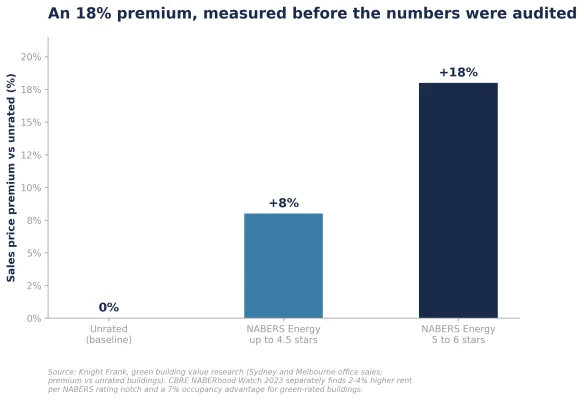
Mandatory reporting deletes that justification. Within this decade, every institutional owner's emissions and energy performance will be disclosed on one standard and assured to the same standard as its accounts. Buyers will diligence a building's emissions trajectory off statutory documents rather than vendor marketing. Lenders, themselves Group 1 reporters with financed-emissions disclosures to make, will price the loan book's carbon because they must report it. Valuers, as the last three editions argued, convert whatever buyers and lenders consistently price into yields. That is the mechanism by which a survey finding becomes a valuation input, and it only runs one way: the 18% premium and its mirror image, the brown discount on assets that cannot demonstrate a pathway, stop being an ESG talking point and start being a line in the capitalisation.
The repricing will not be symmetric, and I think this is the investable idea. The premium end is already priced by the institutions that dominate prime ownership. The discount end is not: secondary assets held by managers who treated ratings as optional are about to have their performance made legible to every counterparty at exactly the moment the audit arrives. Legibility is the enemy of the benefit of the doubt. If you own well-rated assets with clean data, the regime is free marketing; if you own poorly rated assets with no data, the regime is a slow-motion mark-down with a statutory timetable.
Where This Goes From Here
The sequence from here is visible. The first full Group 1 cycle completes over the coming year under ASIC's expanding review (ASIC, 2026). Group 2 switches on for financial years from July 2026, bringing the $5bn asset owners and the mid-market managers with them (BDO). Scope 3 arrives in each cohort's second year, assurance tightens on its legislated ramp to FY2031, and the modified liability protections roll off in order (Allens; Anthesis). Somewhere in that sequence, the first transaction will trade visibly through or over a valuation because of what a statutory climate report revealed, and the market will do what it always does with a new legible variable: price it everywhere at once.
My view: Constructive, and generally okay with the burden framing. Australian real estate enters this regime with the best ESG data infrastructure in the world, a top global GRESB region with NABERS as the national spine (GRESB, 2025), and a measured green premium waiting to be underwritten (Knight Frank; CBRE). The cost of compliance is real but it is mostly the cost of finally organising asset data, and the managers who do it first get a double return: a cheaper audit and a cleaner story for the increasingly climate-literate capital on the other side of the table. The sustainability report spent twenty years as the document nobody read. From here it is the document the auditor signs, the lender prices and the buyer diligences. Prose just became numbers, and numbers move prices.
Sources
- Australian Accounting Standards Board, An Overview of Australian Sustainability Reporting Standards (AASB S1 and AASB S2), April 2025, https://aasb.gov.au/media/xpilzp2e/overviewofasrs_04-25.pdf
- BDO Australia, Are you considered an asset owner for Group 2 climate reporting purposes? ($5bn asset-owner capture; group thresholds), https://www.bdo.com.au/en-au/insights/esg-sustainability/are-you-considered-an-asset-owner-for-group-2-climate-reporting-purposes
- Allens, Mandatory climate-related financial reporting is here, September 2024 (modified liability settings), https://www.allens.com.au/insights-news/insights/2024/09/mandatory-climate-related-financial-reporting-legislation/
- BDO Australia, ASIC provides guidance on the modified liability settings for mandatory sustainability reporting, https://www.bdo.com.au/en-au/insights/esg-sustainability/asic-provides-guidance-on-the-modified-liability-settings-for-mandatory-sustainability-reporting
- Anthesis, ASRS and AASB S2: a guide to mandatory climate reporting in Australia (assurance phasing to reasonable assurance for FYs from 1 July 2030), https://www.anthesisgroup.com/au/insights/asrs-and-aasb-s2-a-guide-to-mandatory-climate-reporting-in-australia/
- ASIC, media release 24-173MR, ASIC's first greenwashing case results in landmark $11.3 million penalty for Mercer, August 2024, https://www.asic.gov.au/about-asic/news-centre/find-a-media-release/2024-releases/24-173mr-asic-s-first-greenwashing-case-results-in-landmark-11-3-million-penalty-for-mercer/
- Ashurst, Federal Court approves ASIC's second civil penalty of $12.9 million for greenwashing conduct (Vanguard), https://www.ashurst.com/en/insights/federal-court-approves-asic-second-civil-penalty-for-greenwashing-conduct/
- ASIC, media release 25-042MR, Active Super ordered to pay $10.5 million penalty in ASIC's third greenwashing court action, 2025, https://www.asic.gov.au/about-asic/news-centre/find-a-media-release/2025-releases/25-042mr-active-super-ordered-to-pay-10-5-million-penalty-in-asic-s-third-greenwashing-court-action/
- ASIC, ASIC issues early observations on sustainability reporting ahead of 30 June 2026, and Report 839 coverage via ESG News, ASIC finds climate reporting improving under new rules (40 reports reviewed; 312 lodged; gaps in forward-looking disclosures, assumptions, strategy and targets), 2026, https://esgnews.com/asic-finds-climate-reporting-improving-under-new-rules/
- GRESB, 2025 Real Estate Assessment Results (Oceania 83.3 standing / 93.9 development vs global 78.9 / 87.9; 1,002 managers, 2,382 assessments; 132 Oceania participants, 123 Australian), https://www.gresb.com/2025-real-estate-assessment-results/
- Knight Frank, Green building value: do green-rated buildings add a premium to sales price? (8% premium up to 4.5 stars; 18% for 5-6 stars, Sydney and Melbourne offices), https://www.knightfrank.com/research/article/2021/9/green-building-value-do-greenrated-buildings-add-a-premium-to-sales-price
- CBRE, Australia NABERhood Watch 2023 (2-4% rent premium per NABERS notch; 7% occupancy advantage), https://www.cbre.com.au/insights/reports/australia-naberhood-watch-2023